


HonestHustles Mission
HonestHustles helps people find legitimate ways to make money online through honest, hands-on reviews. We cover side hustles, online tools, paid-to-play platforms, and real earning opportunities without hype, fluff, or false promises.Every review is built around one simple question: Is this actually worth your time and money?We focus on what works, what it costs, and what to avoid.
Real Work in ProgressThis site is built and updated in real time, not quietly polished behind the scenes. That means you might occasionally run into a bug, broken link, or feature that is still being dialed in. That is part of the process.
Everything here is tested, improved, and pushed forward continuously to build something genuinely useful, not just something that looks finished.If you run into an issue, feel free to reach out. Feedback helps improve everything faster.






Reviews
Real Experiences. Real Reviews.
Task Scam Review - WhatsApp and Telegram Fake Job Warning
📌 Heads Up: Disclaimer
This review is not a personal attack on any person, company, creator, or worker connected to Task Scam. What is being reviewed here is the public offer, platform, claims, risks, and available source material. HH has not personally joined or cashed out from this specific review unless the review says so directly. If a company, creator, or user can correct the record or show better proof, the door is open.
📢 Disclosure
Some links in this review may be referral or affiliate links. If you sign up or make a purchase through them, HonestHustles may earn a small commission at no extra cost to you. That helps support the site and keeps the reviews honest, independent, and ad-light.
⚡ Quick Verdict: Scam. If a stranger messages you on WhatsApp, Telegram, or text offering easy online work where you complete tasks and then must deposit money to withdraw earnings, that is not a side hustle. It is a task scam.
📌 Heads Up: Transparency Note: HH did not join or pay into a task-scam platform for this review. This warning is based on consumer-protection alerts, bank/cybersecurity warnings, and repeated public fraud patterns. Scam details change fast, so readers should still verify any suspicious message with official sources before sending money.
📌 How the Scam Works
The setup usually sounds simple: like products, rate apps, boost listings, optimize items, click buttons, or complete sets of tasks. At first the fake platform may show your balance going up. Sometimes the scammer lets you withdraw a small amount early to build trust.
Then the trap appears. You are told you need to deposit money, often in crypto, to unlock the next task set or withdraw your supposed earnings. The account balance is fake. The deposit is real.
📌 Why It Feels Convincing
Task scams work because they imitate real remote work language. They may use fake company names, fake dashboards, fake trainers, fake group chats, and fake commissions. The user feels like they are "working," but the system is designed to move the victim from small trust-building wins into larger deposits.
📌 Red Flags
✅ An unexpected job offer through WhatsApp, Telegram, or text
✅ Simple online tasks with unusually high daily income claims
✅ Requests to deposit your own money to keep working
✅ Crypto payments or wallet transfers
✅ Pressure to finish a task set before withdrawing
✅ A fake dashboard showing earnings you cannot actually cash out
🔍 What Real Work Does Not Do
Real employers do not make you pay to get paid. Real platforms do not require you to send crypto to unlock wages. Real online work may require applications, taxes, ID checks, and payment setup, but it does not turn into a deposit game.
🔍 What To Do If You Already Paid
Stop sending money, even if the scammer says one more deposit will unlock the account. Save screenshots, wallet addresses, phone numbers, usernames, website URLs, and transaction receipts. Contact your bank, crypto exchange, or payment provider as fast as possible. Then report the scam to the FTC, local police, or the relevant fraud-reporting agency in your country.
Do not trust "recovery agents" who message you afterward claiming they can get the money back for a fee. That is often a second scam aimed at people who already lost money.
🧾 HH Verdict
Scam. The moment a task platform asks you to deposit money to unlock work or withdraw earnings, walk away. If you already paid, stop sending money, save screenshots, contact your bank or crypto platform, and report the fraud.
🔗 Sources Checked
✅ FTC consumer alert on task scams and fake online work
https://consumer.ftc.gov/consumer-alerts/2024/11/task-scams-create-illusion-making-money
✅ FBI IC3 fraud-reporting portal
https://www.ic3.gov/
✅ Canadian Anti-Fraud Centre
https://www.antifraudcentre-centreantifraude.ca/
Task Scam Review - WhatsApp and Telegram Fake Job Warning
Task scams pretend to offer easy online work through WhatsApp, Telegram, or text messages, then push victims to deposit money or crypto to unlock fake earnings.
Amazon Mechanical Turk Review - Real Platform, Low-Pay Trap
📌 Heads Up: Disclaimer
This review is not a personal attack on any person, company, creator, or worker connected to Amazon Mechanical Turk. What is being reviewed here is the public offer, platform, claims, risks, and available source material. HH has not personally joined or cashed out from this specific review unless the review says so directly. If a company, creator, or user can correct the record or show better proof, the door is open.
📢 Disclosure
Some links in this review may be referral or affiliate links. If you sign up or make a purchase through them, HonestHustles may earn a small commission at no extra cost to you. That helps support the site and keeps the reviews honest, independent, and ad-light.
⚡ Quick Verdict: Amazon Mechanical Turk, or MTurk, is real. It is a long-running crowdsourcing marketplace for small online tasks. But for workers, "real" does not automatically mean "worth it." The platform can involve low pay, task hunting, unpaid rejections, and a steep learning curve.
📌 Heads Up: Transparency Note: HH has not personally worked MTurk HITs for this review. This is a source-based investigation using Amazon's own MTurk documentation, worker-agreement language, and public research/discussion around worker risk. It should be read as an internet review, not a personal earnings report.
🔍 What MTurk Actually Is
MTurk lets requesters post Human Intelligence Tasks, often called HITs. Workers complete tasks such as data validation, research, surveys, categorization, content moderation, and other small jobs that are hard or annoying to automate cleanly.
Amazon's own worker help page says account requests are reviewed, and requester documentation explains that rewards are paid after a requester approves an assignment.
⚠️ The Worker Problem
The worker problem is that not all HITs are equal. Some may be fair. Others may pay so little that the hourly value is terrible. Workers also have to worry about instructions, rejection risk, qualification limits, and time spent searching instead of earning.
If a task gets rejected, the worker may not be paid for that HIT. Rejections can also hurt a worker's approval rate, which can affect future task access.
📌 Is It Still Worth Trying?
MTurk may still be worth exploring for people who like microtasks and already understand the ecosystem. But it is not the first platform HH would recommend to a beginner looking for meaningful online income. It is too easy to spend hours chasing tiny payouts.
👤 What To Check Before Doing HITs
Check the reward amount, estimated time, approval rate, requester reputation, and rejection risk before starting a HIT. A task can look harmless and still be a bad deal if it takes longer than expected or if the requester rejects work unfairly.
Also remember that time spent hunting for good HITs is part of the real hourly rate. If you earn a few dollars but spend an hour searching, reading instructions, and recovering from rejections, the opportunity is weaker than the headline suggests.
🧾 HH Verdict
Mostly hype for new workers. MTurk is real, but the opportunity is often oversold. Unless you know how to filter good HITs and protect your approval rate, the time-to-money ratio can be rough.
🔗 Sources Checked
✅ Amazon Mechanical Turk worker help
https://www.mturk.com/worker/help
✅ Amazon Mechanical Turk participation agreement
https://www.mturk.com/worker/participation-agreement
✅ AWS/MTurk requester documentation explaining HIT rewards and approval
https://docs.aws.amazon.com/AWSMechTurk/latest/RequesterUI/Welcome.html
Amazon Mechanical Turk Review - Real Platform, Low-Pay Trap
Amazon Mechanical Turk is a real crowdsourcing marketplace, but for workers it can mean low-paying tasks, requester rejections, and a lot of time spent filtering bad HITs.
Clickworker Review - Real Microtasks, Small Money
📌 Heads Up: Disclaimer
This review is not a personal attack on any person, company, creator, or worker connected to Clickworker. What is being reviewed here is the public offer, platform, claims, risks, and available source material. HH has not personally joined or cashed out from this specific review unless the review says so directly. If a company, creator, or user can correct the record or show better proof, the door is open.
📢 Disclosure
Some links in this review may be referral or affiliate links. If you sign up or make a purchase through them, HonestHustles may earn a small commission at no extra cost to you. That helps support the site and keeps the reviews honest, independent, and ad-light.
⚡ Quick Verdict: Clickworker is real, but it is not a magic remote job. It offers microtasks through its app and, for some users, access to UHRS-style work. The platform can pay, but the work is often inconsistent and the hourly value depends heavily on task quality, country, speed, and availability.
📌 Heads Up: Transparency Note: HH has not personally worked Clickworker tasks for this review. This is a source-based internet investigation using Clickworker's public information, its support documentation, and outside worker-pattern research. Treat it as a map of what to check before you invest time, not a personal cashout claim.
🔍 What Clickworker Does
Clickworker is a crowdsourced data-work platform. Tasks can include short text jobs, categorization, surveys, app-based work, data validation, AI data tasks, and UHRS-related tasks depending on what is available to your account.
That sounds broad because it is broad. The platform is not one job. It is a marketplace of small jobs that appear and disappear.
📌 Payment Timing
Clickworker's support page for UHRS payments says UHRS earnings become payable 39 days after entry, and then are handled like standard job fees in the next regular billing run. That delay matters. Seeing earnings in an account is not the same as cash being available immediately.
This is one reason people get frustrated with microtask platforms. The work is tiny, the rules are strict, and the payment timing can feel slow.
📌 The Real Catch
The real catch is time value. If you spend 30 minutes qualifying, reading instructions, and hunting for available work, then earn a small amount, the effective hourly rate can drop fast. Some workers do better when they understand UHRS tasks and avoid low-value work. New users often waste time learning which jobs are worth touching.
⚠️ What To Watch For
The biggest thing to watch is whether you are actually earning or just staying busy. Microtask platforms can make work feel productive because there is always another small task, qualification, or instruction page. The number that matters is what lands in your account after the unpaid setup time.
Also check payment timing and minimum payout rules before counting the money. With UHRS-related work, earnings may be delayed before becoming payable. That is not necessarily a scam, but it changes the cashflow reality.
👤 Who It Fits
Clickworker fits people who want occasional side income, can follow detailed task rules, and are willing to test what is available in their country. It is not a clean replacement for a job and should not be sold as one.
🧾 HH Verdict
Honest-ish. Clickworker is legitimate, but the earning ceiling is usually modest and inconsistent. It is useful as a microtask option, not a serious business model by itself.
🔗 Sources Checked
✅ Clickworker official site describing app-based microtasks
https://www.clickworker.com/clickworker-app/
✅ Clickworker support documentation describing UHRS payment timing
https://support-workplace.clickworker.com/support/solutions/articles/80000672309-how-does-uhrs-payment-work-
✅ Public review patterns around availability, payment delays, and support friction
https://www.trustpilot.com/review/clickworker.com
Clickworker Review - Real Microtasks, Small Money
Clickworker is a real microtask platform, including UHRS access for some workers, but the work can be inconsistent, low-paying, and slow to become payable.
Respondent Review - Real Paid Research, Hard To Qualify
📌 Heads Up: Disclaimer
This review is not a personal attack on any person, company, creator, or worker connected to Respondent. What is being reviewed here is the public offer, platform, claims, risks, and available source material. HH has not personally joined or cashed out from this specific review unless the review says so directly. If a company, creator, or user can correct the record or show better proof, the door is open.
📢 Disclosure
Some links in this review may be referral or affiliate links. If you sign up or make a purchase through them, HonestHustles may earn a small commission at no extra cost to you. That helps support the site and keeps the reviews honest, independent, and ad-light.
⚡ Quick Verdict: Respondent is legitimate. It can pay far better than ordinary survey apps, especially for professional or B2B research studies. The catch is that you do not get paid just for signing up. You have to match what researchers need and pass screeners.
📌 Heads Up: Transparency Note: HH has not personally completed a paid Respondent interview for this review. This article is based on Respondent's public participant information, official payment language, and outside research patterns. It is meant to help readers investigate the opportunity before applying, not pretend we personally cashed out.
🔍 What Respondent Actually Is
Respondent connects researchers with people willing to do interviews, surveys, focus groups, and product feedback sessions. The platform is especially interesting because many studies are not cheap penny surveys. Respondent advertises common study payouts in the $50-$250 range, with some senior B2B studies paying more.
That does not mean every user will see those studies. The higher-paying projects usually need a very specific person: a certain job role, industry, software experience, income bracket, buying authority, or demographic profile.
📌 How Payment Works
Respondent says participant payments are sent through Tremendous after a session is verified. That makes the model more straightforward than points-based reward apps. You complete an approved research session, then payment is processed.
The important word is approved. If you no-show, fail a screener, or do not complete the session properly, that is different from completing paid research.
📌 The Real Catch: Screeners
The biggest frustration with Respondent is qualification. You may apply to many studies and get accepted to only a few. That is not automatically a red flag; it is how targeted research works. Companies do not want random opinions. They want the right participant.
If you treat Respondent like a guaranteed job, you will probably be disappointed. If you treat it like a high-quality opportunity board for occasional paid interviews, it makes more sense.
👤 What To Check Before You Apply
Before spending serious time applying to studies, look at your own profile honestly. Respondent is strongest when you have something specific researchers want: job role, software experience, business ownership, buying authority, healthcare experience, parenting status, or niche consumer habits. Generic profiles usually have a harder time.
Also be careful with screeners. Do not stretch the truth to qualify. If a researcher catches profile mismatch, you can waste your time, lose the session, or damage your account. The clean strategy is to apply only when you genuinely match the study.
👤 Who It Fits
Respondent is best for people with specific experience: software users, business owners, managers, healthcare professionals, tradespeople, parents, buyers, creators, or consumers in clearly defined niches. The more specific your real background is, the more likely you are to match a study.
🧾 HH Verdict
Legit. Respondent is one of the better paid-research platforms, but it is not steady employment. The money can be real; the bottleneck is getting selected.
🔗 Sources Checked
✅ Respondent participant page describing payment ranges and Tremendous payouts
https://www.respondent.io/become-a-participant
✅ Respondent researcher pricing page explaining completed-session billing
https://www.respondent.io/pricing
✅ Respondent participant terms
https://www.respondent.io/participant-terms
Respondent Review - Real Paid Research, Hard To Qualify
Respondent is a legitimate paid-research platform with strong advertised study payouts, but the real bottleneck is qualifying for the right studies.
CrowdGen by Appen Review - Real AI Data Work, But Project-Based
📌 Heads Up: Disclaimer
This review is not a personal attack on any person, company, creator, or worker connected to CrowdGen by Appen. What is being reviewed here is the public offer, platform, claims, risks, and available source material. HH has not personally joined or cashed out from this specific review unless the review says so directly. If a company, creator, or user can correct the record or show better proof, the door is open.
📢 Disclosure
Some links in this review may be referral or affiliate links. If you sign up or make a purchase through them, HonestHustles may earn a small commission at no extra cost to you. That helps support the site and keeps the reviews honest, independent, and ad-light.
⚡ Quick Verdict: CrowdGen by Appen is legitimate, but it should be treated as project-based contractor work, not a normal remote job. There can be real tasks, but availability depends on country, language, device, skills, and current client projects.
📌 Heads Up: Transparency Note: HH has not personally completed CrowdGen/Appen paid projects for this review. This is an internet investigation based on official CrowdGen/Appen information and public worker-pattern research. We are reviewing the opportunity from available sources, not claiming firsthand earnings.
🔍 What CrowdGen/Appen Actually Offers
Appen has long worked in data collection, search relevance, speech, language, and AI-training tasks. CrowdGen is its worker-facing project platform. Typical projects can include voice recording, image or video collection, search evaluation, translation evaluation, and other data tasks used to improve AI systems.
That is real work, but it is usually not glamorous. Many projects are narrow, repetitive, and instruction-heavy.
📌 Payment and Access
CrowdGen says earnings are often stated in U.S. dollars and paid in local currency, with withdrawal options such as bank transfer, PayPal, Payoneer, Airtm, and others depending on location. It also says users should not pay to join projects.
That last point matters. If someone contacts you claiming you must pay a fee to get an Appen/CrowdGen project, that is a warning sign.
📌 The Main Catch
The catch is project flow. You may qualify for one project and then have nothing for a while. You may also need to pass guidelines, quizzes, device checks, or language requirements before working. Some projects can be worth doing; others may be too low-pay or too time-consuming for the effort.
⚠️ What To Watch For
Watch for fake recruiters. Appen/CrowdGen-style data work is common enough that scammers imitate it. If anyone asks you to pay upfront, buy equipment through a strange link, or move the conversation into a pressure-heavy private chat, slow down and verify through the official site.
Also compare each project against the unpaid setup time. A task may be real but still not worth doing if the qualification process is long and the available hours are low.
👤 Who It Fits
CrowdGen fits people who are patient, can follow detailed instructions, and are comfortable checking for project opportunities. It may be useful as part of a broader remote-work stack, but it is not something to depend on as a single income source until you have consistent project access.
🧾 HH Verdict
Honest-ish. Real platform, real projects, but inconsistent by nature. Worth exploring if you understand contractor work and avoid anyone asking for upfront fees.
🔗 Sources Checked
✅ CrowdGen by Appen official site
https://crowdgen.com/
✅ CrowdGen payment FAQ language
https://crowdgen.com/docs/payments/general-payments-faq/payouts/
✅ Appen job/project listings showing remote independent-contractor roles
https://appen.com/jobs/
CrowdGen by Appen Review - Real AI Data Work, But Project-Based
CrowdGen by Appen is a real AI-data work platform, but most opportunities are project-based, qualification-heavy, and not the same as a stable remote job.
DataAnnotation Review - Real AI Training Work, Hard To Get
📌 Heads Up: Disclaimer
This review is not a personal attack on any person, company, creator, or worker connected to DataAnnotation. What is being reviewed here is the public offer, platform, claims, risks, and available source material. HH has not personally joined or cashed out from this specific review unless the review says so directly. If a company, creator, or user can correct the record or show better proof, the door is open.
📢 Disclosure
Some links in this review may be referral or affiliate links. If you sign up or make a purchase through them, HonestHustles may earn a small commission at no extra cost to you. That helps support the site and keeps the reviews honest, independent, and ad-light.
⚡ Quick Verdict: DataAnnotation appears to be a real AI-training work platform, but it is not an easy-click side hustle. The upside is meaningful remote work and strong advertised pay. The catch is qualification, consistency, and the fact that not every applicant gets projects.
📌 Heads Up: Transparency Note: HH has not personally completed paid DataAnnotation projects for this review. This is a source-based internet investigation using DataAnnotation's official FAQ and public worker-pattern research. We are not claiming a personal cashout; we are reviewing the public opportunity and its risks.
🔍 What DataAnnotation Does
DataAnnotation connects people with tasks that help evaluate and improve AI systems. That can include comparing chatbot answers, judging quality, writing explanations, reviewing images, or completing more technical work if you qualify for coding or STEM projects.
This is not the same as a survey app. The work requires writing, judgment, attention to detail, and the ability to follow project instructions.
📌 Pay Claims
DataAnnotation's FAQ says general projects can start around $25-$30+ per hour, multilingual projects around $20+ per hour, and coding or STEM projects can be higher depending on expertise. Payments are sent through PayPal after a worker requests them.
Those rates are strong compared with most online side hustles. That is also why the entry bar matters: if everyone could instantly get steady work, the market would look very different.
📌 The Hard Part
The hard part is getting accepted and staying matched with projects. Applicants may complete assessments and then wait. Some people report getting work quickly; others report silence. That makes it risky to count on DataAnnotation before you actually have active projects.
The honest way to approach it is to apply, do the assessment carefully, and treat any work as a bonus until the account proves steady.
👤 What To Check Before You Count On It
Check whether you are applying for general writing/judgment work, coding work, multilingual work, or STEM work. The pay claims and task difficulty can vary by lane. A person who qualifies for coding projects may have a very different experience than someone applying for general AI-response review.
Also be careful with online advice selling "guaranteed acceptance" or paid answers to the assessment. That kind of shortcut can damage the whole opportunity. If the platform is looking for judgment and writing skill, the assessment is part of the filter.
👤 Who It Fits
DataAnnotation fits people who write clearly, can compare answers critically, and are comfortable doing careful judgment work. If you have coding or technical expertise, the upside can be better, but the work also gets more demanding.
🧾 HH Verdict
Honest-ish. Real opportunity, not guaranteed access. The earning potential is better than most online tasks, but the gate is qualification and the risk is inconsistent project flow.
🔗 Sources Checked
✅ DataAnnotation official FAQ covering task categories, PayPal payments, and advertised pay ranges
https://dataannotation.tech/faqs
✅ DataAnnotation official site
https://www.dataannotation.tech/
✅ Public review patterns around acceptance, project availability, and waiting after assessments
https://www.trustpilot.com/review/dataannotation.tech
DataAnnotation Review - Real AI Training Work, Hard To Get
DataAnnotation can be a real remote AI-training opportunity with strong advertised rates, but access is selective and work availability can vary after qualification.
Prolific Review - Real Research Pay, Not Survey Spam
📌 Heads Up: Disclaimer
This review is not a personal attack on any person, company, creator, or worker connected to Prolific. What is being reviewed here is the public offer, platform, claims, risks, and available source material. HH has not personally joined or cashed out from this specific review unless the review says so directly. If a company, creator, or user can correct the record or show better proof, the door is open.
📢 Disclosure
Some links in this review may be referral or affiliate links. If you sign up or make a purchase through them, HonestHustles may earn a small commission at no extra cost to you. That helps support the site and keeps the reviews honest, independent, and ad-light.
⚡ Quick Verdict: Prolific is legitimate. It is closer to paid research participation than the usual points-for-peanuts survey app. The upside is cleaner pay and better study quality. The downside is that you cannot force studies to appear, and not everyone gets accepted quickly.
📌 Heads Up: Transparency Note: HH has not personally joined Prolific and completed paid studies for this review. This is a researched internet review based on Prolific's official participant/researcher information and public user patterns. Always confirm the current payout rules, country availability, and waitlist status yourself.
🔍 What Prolific Actually Is
Prolific connects researchers and companies with participants for studies, surveys, experiments, and AI-related evaluation tasks. Unlike many survey sites, Prolific is built around research quality, participant screening, and clearer pay expectations.
That does not make it a full-time job. It makes it one of the better occasional earning platforms if you can get approved and if studies match your profile.
📌 Payment Reality
Prolific publicly states a minimum participant rate of 6 GBP / 8 USD per hour, and recommends higher rates. Its participant cashout page says users can cash out after reaching at least 6 GBP or 6 USD, with PayPal used for withdrawals.
That is a better structure than sites that bury users in points, gift cards, or unclear conversion rates. Cash is easier to evaluate than pretend app currency.
📌 The Real Catch
The problem is not whether Prolific is real. The problem is access and consistency. You may face a waitlist. You may see dry days. You may be screened out of studies. Your demographic profile, country, devices, and researcher demand all affect earning potential.
In other words, Prolific is a good side pocket, not a guaranteed paycheck.
👤 What To Check Before You Count On It
Check whether Prolific is accepting participants from your country and whether your profile has enough demand. Research platforms can be excellent for one person and quiet for another because the available studies depend on what researchers are looking for.
Also pay attention to study approval rules. The strongest Prolific strategy is not rushing. It is giving careful answers, avoiding dishonest profile information, and protecting your account quality.
👤 Who It Fits
Prolific fits people who can answer carefully, follow study instructions, and check for opportunities without relying on it as primary income. It is especially useful for people who prefer research-style studies over low-quality ad-heavy reward apps.
🧾 HH Verdict
Legit. Prolific is one of the cleaner online earning options. It is not unlimited money, but the platform is real, the cashout model is clearer than most, and the BS level is low compared with typical survey apps.
🔗 Sources Checked
✅ Prolific participant pages
https://www.prolific.com/participants
✅ Prolific researcher payment model showing minimum participant rates
https://researcher-help.prolific.com/en/article/2273bd
✅ Prolific participant cashout documentation
https://participant-help.prolific.com/en/article/3f5085
Prolific Review - Real Research Pay, Not Survey Spam
Prolific is one of the cleaner research-participant platforms: real cash, stated minimum pay, and academic-style studies. The catch is availability, eligibility, and waitlists.
Pocket7Games and AviaGames Review - Skill Game or Cash Trap?
📌 Heads Up: Disclaimer
This review is not a personal attack on any person, company, creator, or worker connected to Pocket7Games and AviaGames. What is being reviewed here is the public offer, platform, claims, risks, and available source material. HH has not personally joined or cashed out from this specific review unless the review says so directly. If a company, creator, or user can correct the record or show better proof, the door is open.
📢 Disclosure
Some links in this review may be referral or affiliate links. If you sign up or make a purchase through them, HonestHustles may earn a small commission at no extra cost to you. That helps support the site and keeps the reviews honest, independent, and ad-light.
⚡ Quick Verdict: High risk and under review. AviaGames runs real-money skill-game apps, including Pocket7Games. The company presents these as skill-based competitions, but the withdrawal rules, bonus-cash structure, public complaint pattern, and legal allegations are serious enough that HH would not treat this as a reliable online-income method.
📌 Heads Up: Transparency Note: HH has not deposited money into AviaGames or Pocket7Games for this review. This is an internet investigation based on AviaGames' own terms, public review patterns, and legal reporting. Allegations are identified as allegations, not court-proven facts. Readers should do their own investigation and check local laws before using any real-money skill-game app.
🔍 What AviaGames and Pocket7Games Are
AviaGames operates mobile skill-game platforms where users can compete in games that may involve cash prizes. Pocket7Games is one of the brand's game hubs. The pitch is simple: play familiar mobile games, compete, and potentially win money.
That pitch is exactly why this category needs a careful look. Real-money game apps can feel like entertainment, side hustle, and gambling-adjacent behavior all at once.
📌 Withdrawal Terms Matter
AviaGames' own terms say withdrawal requests may take up to 15 days to process, and that the company may freeze an account or delay a withdrawal while investigating suspected abuse. The terms also describe a minimum withdrawal amount and rules around bonus cash.
Those rules are not automatically proof of wrongdoing, but they do mean users should not treat the app like instant cash. If getting money out is slow, conditional, or tied to bonus balances, the earning claim becomes much weaker.
📌 Bonus Cash Is Not the Same as Withdrawable Cash
One common confusion in this whole category is the difference between playable balance, bonus cash, and withdrawable winnings. If a user sees a number in an app, that does not always mean the full number can be withdrawn. Any app using bonus balances deserves extra caution.
📌 Public Complaints and Legal Allegations
Trustpilot shows a weak overall review profile for AviaGames, with many one-star complaints. Public complaints should be treated as user allegations, not proven facts, but they are still useful warning signals when they cluster around withdrawal friction, support, and fairness concerns.
There is also a proposed class-action lawsuit alleging AviaGames used bots in what were represented as human skill competitions. That is an allegation, not a court-proven fact in this review. Still, it is directly relevant to consumer risk because the core sales pitch depends on fair competition.
📌 Who Should Avoid It
Anyone looking for dependable online income should avoid this lane. If you are trying to make money, a cash-game app with withdrawal delays, bonus-cash rules, and serious unresolved allegations is not a clean business model.
If someone chooses to play anyway, they should treat it as paid entertainment, not a job, investment, or side hustle.
👤 What To Check Before Depositing
Before putting money into any skill-game app, read the withdrawal rules line by line. Look for minimum withdrawal amounts, processing delays, investigation holds, account-freeze language, and whether bonus cash can actually be withdrawn. If the app makes it easy to deposit but complicated to withdraw, that is the part to pay attention to.
Also check whether cash competitions are legal where you live. Some apps restrict certain states or regions because real-money contests sit in a legally sensitive area.
🧾 HH Verdict
Under Review / High Risk. HH would not recommend Pocket7Games or AviaGames as an earning method right now. The official terms alone are enough to be cautious, and the public complaint/legal-allegation picture makes it a poor fit for anyone trying to build real online income.
🔗 Sources Checked
✅ AviaGames official terms of service, including withdrawal and investigation language
https://www.aviagames.com/terms-service
✅ AviaGames Pocket7Games official page
https://www.aviagames.com/games/pocket7games
✅ Trustpilot review profile and complaint patterns
https://www.trustpilot.com/review/aviagames.com
✅ ClassAction.org coverage of the proposed AviaGames class action and bot allegations
https://www.classaction.org/news/aviagames-hit-with-class-action-over-alleged-use-of-bots-in-online-skill-based-games
Pocket7Games and AviaGames Review - Skill Game or Cash Trap?
AviaGames markets real-money skill competitions, but withdrawal friction, bonus-cash rules, weak review sentiment, and unresolved legal allegations make this a high-risk lane.
UserTesting Review - Real Pay, Screeners Decide Everything
📌 Heads Up: Disclaimer
This review is not a personal attack on any person, company, creator, or worker connected to UserTesting. What is being reviewed here is the public offer, platform, claims, risks, and available source material. HH has not personally joined or cashed out from this specific review unless the review says so directly. If a company, creator, or user can correct the record or show better proof, the door is open.
📢 Disclosure
Some links in this review may be referral or affiliate links. If you sign up or make a purchase through them, HonestHustles may earn a small commission at no extra cost to you. That helps support the site and keeps the reviews honest, independent, and ad-light.
⚡ Quick Verdict: UserTesting is real, but it should be treated as occasional paid research work, not dependable income. The platform can pay users for giving feedback, but test availability depends on your profile, customer demand, ratings, devices, and whether you qualify through screeners.
📌 Heads Up: Transparency Note: HH has not personally completed paid UserTesting sessions for this review. This review is based on UserTesting's official contributor documentation, its contributor terms, payment information, and public review patterns. Use it as a research summary, then verify the current rules yourself before relying on it for income.
🔍 What UserTesting Actually Does
UserTesting connects companies with people willing to test websites, apps, prototypes, and product ideas. You may be asked to speak your thoughts out loud, complete tasks, answer questions, or record your screen while giving feedback.
This is not the same as a survey app where everyone gets the same questions. Companies often need specific types of users, so screeners decide whether you get into a test.
📌 How Payment Works
UserTesting says rewards vary by test type, duration, and demand. The dashboard shows the payment amount before you accept a test. Their contributor FAQ says payments for completed tests are usually sent 14 days later, and payment is handled through PayPal.
That is a good sign because the pay process is stated clearly. The tradeoff is that you cannot assume a steady number of tests every day.
📌 The Main Catch: You May Not Qualify
The frustrating part of UserTesting is not usually whether the platform is real. It is whether you qualify often enough to make it worth your time. You can spend time answering screeners and still get rejected because your profile does not match what the customer needs.
That does not make it a scam. It does mean the earning potential is unpredictable.
👤 What To Check Before You Apply
Check whether you are comfortable recording your screen, voice, and sometimes face. Also check that PayPal works properly in your country and that you have the devices the platform expects. The best paid-research setup is boring: working microphone, quiet space, good internet, and the patience to answer screeners honestly.
Do not build a budget around UserTesting until you have personally qualified for tests and seen repeat work. The platform may be real while your own account still gets very few opportunities.
📌 Privacy Tradeoff
UserTesting work can involve voice, screen, text input, device interactions, and sometimes camera or face recording depending on the test. That is normal for user research, but it is still a real privacy tradeoff. If you are not comfortable being recorded while using websites or apps, this is not the right lane.
👤 Who It Fits
UserTesting is best for people who can speak clearly, follow instructions, test on a computer or phone, and give useful feedback without overthinking it. It can be a decent side pocket of PayPal money if you qualify for tests.
It is not a replacement for a job, and it is not a guaranteed daily earning system.
🧾 HH Verdict
Honest-ish. UserTesting is a real paid feedback platform, but the income is controlled by screeners and demand. Worth trying if you understand the privacy tradeoff and do not count on steady work.
🔗 Sources Checked
✅ UserTesting contributor FAQ and payment information
https://www.usertesting.com/faq-contributors
✅ UserTesting contributor terms covering age, account rules, recordings, and restrictions
https://www.usertesting.com/privacy-center/terms-of-service-contributor
✅ Public review patterns checked for qualification, support, and payment-friction complaints
https://www.trustpilot.com/review/usertesting.com
UserTesting Review - Real Pay, Screeners Decide Everything
UserTesting is a real paid user-research platform, but it is not steady employment. The work depends on qualifying for tests, using PayPal, and giving clear recorded feedback.
Printful Review - Real POD Tool, Not Passive Income
📌 Heads Up: Disclaimer
This review is not a personal attack on any person, company, creator, or worker connected to Printful. What is being reviewed here is the public offer, platform, claims, risks, and available source material. HH has not personally joined or cashed out from this specific review unless the review says so directly. If a company, creator, or user can correct the record or show better proof, the door is open.
📢 Disclosure
Some links in this review may be referral or affiliate links. If you sign up or make a purchase through them, HonestHustles may earn a small commission at no extra cost to you. That helps support the site and keeps the reviews honest, independent, and ad-light.
⚡ Quick Verdict: Printful is legitimate. It is a real print-on-demand production and fulfillment service. The catch is that Printful does not create demand for you. It prints, packs, and ships after a customer buys. You still have to build the store, create designs people want, price correctly, handle support, and bring traffic.
📌 Heads Up: Transparency Note: HH has not personally opened and operated a live Printful store for this review. This is an internet investigation based on Printful's own documentation, public pricing/fulfillment information, and outside review patterns. Treat this as a researched starting point, not a replacement for doing your own due diligence before spending money or connecting a store.
🔍 What Printful Actually Is
Printful is a back-end fulfillment tool for custom products. You connect it to a store, upload designs, choose products, and when someone orders, Printful produces and ships the item. That is useful because you do not have to buy inventory upfront.
That does not make it passive income. It removes one operational problem, but it does not remove the hard parts: finding a niche, designing products, writing listings, managing pricing, and getting buyers.
📌 The Real Opportunity
The honest opportunity is testing product ideas without holding boxes of inventory. If you already have an audience, a small brand, a local group, or a niche idea, Printful can be a practical way to sell shirts, mugs, posters, hats, and other custom items.
The model gets weaker when people treat it like an automatic money machine. Uploading random designs and waiting for sales is usually just wishful thinking. The seller still needs marketing skill.
📌 Fulfillment and Shipping Reality
Printful says fulfillment is the time needed to create the custom product before it ships. Their help center says average fulfillment is usually 2-5 business days, and that shipping time is separate. That matters because buyers may think an order ships instantly, but custom products need production time first.
If you sell through Printful, your product pages need realistic shipping language. Overpromising delivery speed is a fast way to create refunds, support messages, and bad reviews.
📌 Where People Get Burned
The biggest trap is margin. A sale can look profitable until you subtract product cost, shipping, marketplace fees, payment fees, ad costs, refunds, replacements, and discounts. Printful can be real and still leave very little profit if the store owner prices badly.
Another trap is believing POD is a business by itself. It is not. Printful is the production partner. The actual business is your brand, audience, offer, and traffic system.
👤 What To Check Before You Use It
Before building around Printful, calculate your true margin on one product. Include the base product cost, shipping, platform fees, payment fees, expected ad cost, refunds, replacements, and the discount you may need to make a sale. If there is no room left after that math, the product is not a business yet.
Also order samples before selling heavily. Print-on-demand quality can vary by product type, print location, and design file. A store owner should know what the customer is going to receive before sending traffic to the offer.
📌 Who Should Try It
Printful makes sense for creators, niche-store builders, local brands, event sellers, and people who want to test designs without inventory risk. It is also useful for small experiments where you would rather pay more per item than buy bulk stock.
It is a poor fit for anyone expecting easy passive income, instant profit, or guaranteed sales from generic designs.
🧾 HH Verdict
Legit, but not magic. Printful is a real tool. The hustle is not "Printful makes money for you." The hustle is building something people want, then using Printful to fulfill it without inventory.
🔗 Sources Checked
✅ Printful pricing and plan information
https://www.printful.com/pricing
✅ Printful fulfillment help page explaining 2-5 business day average fulfillment and shipping separation
https://help.printful.com/hc/en-us/articles/360014007980-How-long-does-fulfillment-take
✅ Public customer-review patterns checked for friction around setup, support, quality, and fulfillment expectations
https://www.trustpilot.com/review/printful.com
Printful Review - Real POD Tool, Not Passive Income
Printful is a real print-on-demand fulfillment tool, not a magic passive-income machine. The opportunity is real, but the seller still has to create demand, price correctly, and ma…
In May, my Facebook account of nearly two decades was hacked.
The attacker logged in from a commercial VPN datacenter, uploaded a forged ID file, and walked away. They didn't post anything. They didn't message anyone. They didn't try to scam my contacts. The entire attack lasted minutes, and the only action it took was uploading one file specifically designed to trigger Meta's automated enforcement system.
Eight seconds after Meta's AI reviewed that fake ID, my account was permanently disabled.
Eight seconds. No human looked at it. No notification was sent to me about the foreign login. No email asked whether I'd uploaded an ID — because I obviously hadn't. The hacker never had to log in a second time. They didn't have to. They had figured out that Meta's automated system would do the rest of the damage for them.
I had paid for Meta Verified at the time — Meta's premium subscription tier that explicitly promises priority support and impersonation protection. This is my honest review of what that money actually bought when I needed it most.
What I Actually Lost
Before the review part, the inventory of what disappeared:
- Nearly twenty years of posts, photos, and history on my main Facebook account
- 7,800+ followers across multiple business pages — My Tiny Home page, My Funny Farm page, the pallet projects page, My Scrap Removal business
- My Instagram account
- WhatsApp and WhatsApp Business access
- 144,631 personal messages
That last number deserves a moment. Some of those messages were conversations with my late son and my mother. Followers can be rebuilt. Business pages can be remade from scratch. Conversations with people who aren't here anymore can't.
That's what was at stake when I went looking for the "premium support" I was paying for.
What Meta Verified Promises
Meta Verified is sold for $14.99 a month on mobile and $11.99 a month on the web for individuals (Canadian pricing similar; check current rates as Meta adjusts them periodically). For that, you're supposed to get:
- A verified blue badge
- Proactive impersonation monitoring
- Priority access to support — real humans, faster response
- Some increased visibility in feeds (Meta's wording is intentionally vague here)
- Bonus stickers and creator tools
The first two badge-and-monitoring features sound nice. They're not why most people actually buy this thing. The real reason most people pay $14.99 a month for Meta Verified is the third item: access to real humans when something goes wrong.
That's the promise this review is about.
What Actually Happened When I Used The Support
I won't bury the lede. Here is every channel I tried, in order:
- The official
facebook.com/hackedrecovery form. No response. Ever. - Emails to Meta's published security addresses (
phish@fb.comand the Instagram equivalent). No reply for weeks. - The Meta Verified support chat — the whole reason I was paying. Got shuffled between three different agents over three days, each one apparently reading from a script and confused about the basics of my case.
- Provided the correct account IDs multiple times. Support agents kept investigating a different account I'd created years ago for an unrelated reason. I corrected them. They went back to investigating the wrong one anyway. Weeks of this.
- The "specialized team" escalation. An agent told me I'd be called back with updates. I never got the call.
- The dedicated recovery email Meta linked to. Account was already flagged "DISABLED" with no path forward.
- A help link Meta's own support sent me. Returned a 404. The link Meta's support team handed me to fix my problem was a dead URL.
- A second account to try to investigate from inside the platform. Meta's support then confused that account for my main one and investigated the wrong one all over again.
- A new personal account, started from scratch. Within hours, throttled. Maximum ten friend requests per day. One marketplace ad allowed. Treated like I was the suspected attacker.
Total channels attempted: nine. Total channels that resolved anything: zero. Total time on phone with Meta's "priority support": measurable in hours.
Meanwhile, Meta Verified will continue bill me Every month. For protection that hasn't worked, and support that wasn't supporting.
The Eight-Second Problem
The single most damning fact in this whole story is the eight seconds.
Meta's AI completed its review of the forged ID at one specific timestamp. Eight seconds later, my account was disabled. That means no human ever reviewed the case. No human could have. The decision to permanently disable an account containing nearly twenty years of personal and business history was made entirely by automation, in less time than it takes to read this paragraph.
Meta had all the evidence to know this was a compromise:
- The login came from a commercial VPN datacenter overseas — not a residential connection
- The login tool was an automated script, not a normal browser
- Geographic impossibility (a session originating in California, while my real sessions came from Canada within minutes)
- The forged ID itself was, technically, evidence of forgery — which Meta's AI literally flagged
The system looked at all of that and chose to ban the account holder. Not the bot.
Meta's enforcement system runs in seconds. Its appeals system runs in weeks, or never. That asymmetry isn't a glitch. It's the design.
Why "Premium Support" Couldn't Help
I had to think about why the support tier I was paying for couldn't actually do anything. The answer turned out to be structural, not personal.
The agents you reach through Meta Verified don't have account-recovery authority. They're contractors, often outsourced overseas, working from scripts. They can read your case, sympathize with it, escalate it. They can't act on it. The tier of Meta employee who can actually unlock an account is a tier you can't reach by paying $14.99 a month.
So what does the $14.99 buy you?
It buys the appearance of recourse. A real human picks up the phone. Notes get taken. Cases get escalated. None of it can actually fix the problem because none of those humans have the authority to fix the problem. It's structurally a customer-service theater.
To borrow a metaphor that came up while I was thinking this through: you paid for a fire alarm and a fire department. When your house caught fire, the alarm didn't go off. The fire department locked their doors when you arrived. Then they sent you a bill for next month.
I Cross-Checked My Story Against Three AI Systems
Before publishing this review, I wanted to make sure I wasn't just an angry user misreading what happened. So I walked the whole timeline through three independent AI systems — including, notably, Meta's own AI assistant — and asked each one to analyze what had occurred.
All three reached the same conclusion, independently, with no coordination between them: Meta's automated enforcement system failed to distinguish a compromised user from a bad actor, and Meta's support infrastructure was incapable of correcting that mistake after the fact.
The most telling response came from Meta's own AI. Given the technical details — the bot fingerprint, the VPN datacenter origin, the impossible travel between cities — it laid out the case against its own parent company in more forensic detail than any human Meta employee ever did. When the company's own AI is calling the enforcement system "automated entrapment," that's not a user complaint anymore. That's a structural diagnosis.
What About Regulators?
A fair question someone might ask reading this: doesn't Canada have privacy regulators that are supposed to handle exactly this kind of situation? The Office of the Privacy Commissioner of Canada (priv.gc.ca) does exist, and they technically have authority over how companies handle Canadian users' personal data under PIPEDA. You can file a complaint for free.
Here's the honest version of what that gets you: a file gets opened. An investigation may eventually happen. A finding may eventually be issued. Whether any of that has a real effect on a US-based trillion-dollar company over one Canadian user's locked account is a different question, and the realistic answer is: probably not. Canada isn't going to discipline Meta over me. Meta isn't going to send an apology email and reinstate the followers. I'm one very small itch on a very large company.
If enough affected users filed complaints at once, maybe the cumulative pressure would move policy. Maybe. But banking on a regulatory rescue is structurally the same mistake as banking on premium support — you're handing your fate to someone else and hoping they care about your problem more than they actually do.
That's why this review doesn't end with "file a complaint and wait." It ends with the only thing in this whole story that's actually under my control.
The Honest Review of Meta Verified Premium Support
Do not pay for Meta Verified expecting it to help you recover a hacked account.
That's the bottom line. Everything else is detail.
If you specifically want the blue badge for credibility purposes, fine — that part of the product technically works. If you're paying because of the support tier, save your $14.99 a month. You are buying the appearance of recourse, not actual recourse. When you need the support, you will discover it isn't really there.
The most useful thing $14.99 a month buys you is a strong feeling, right up until the moment you need anything other than a strong feeling.
What I Built Because of This
After I exhausted Meta's recovery channels, the question I had to answer wasn't how do I fight harder for the old account. The old account was gone. The real question was: how do I make sure I never have to fight that fight again, for anything else I care about?
The answer is what I've been building since the disablement. It's called KEPTA Keep Everything Personal, Truly Archived..
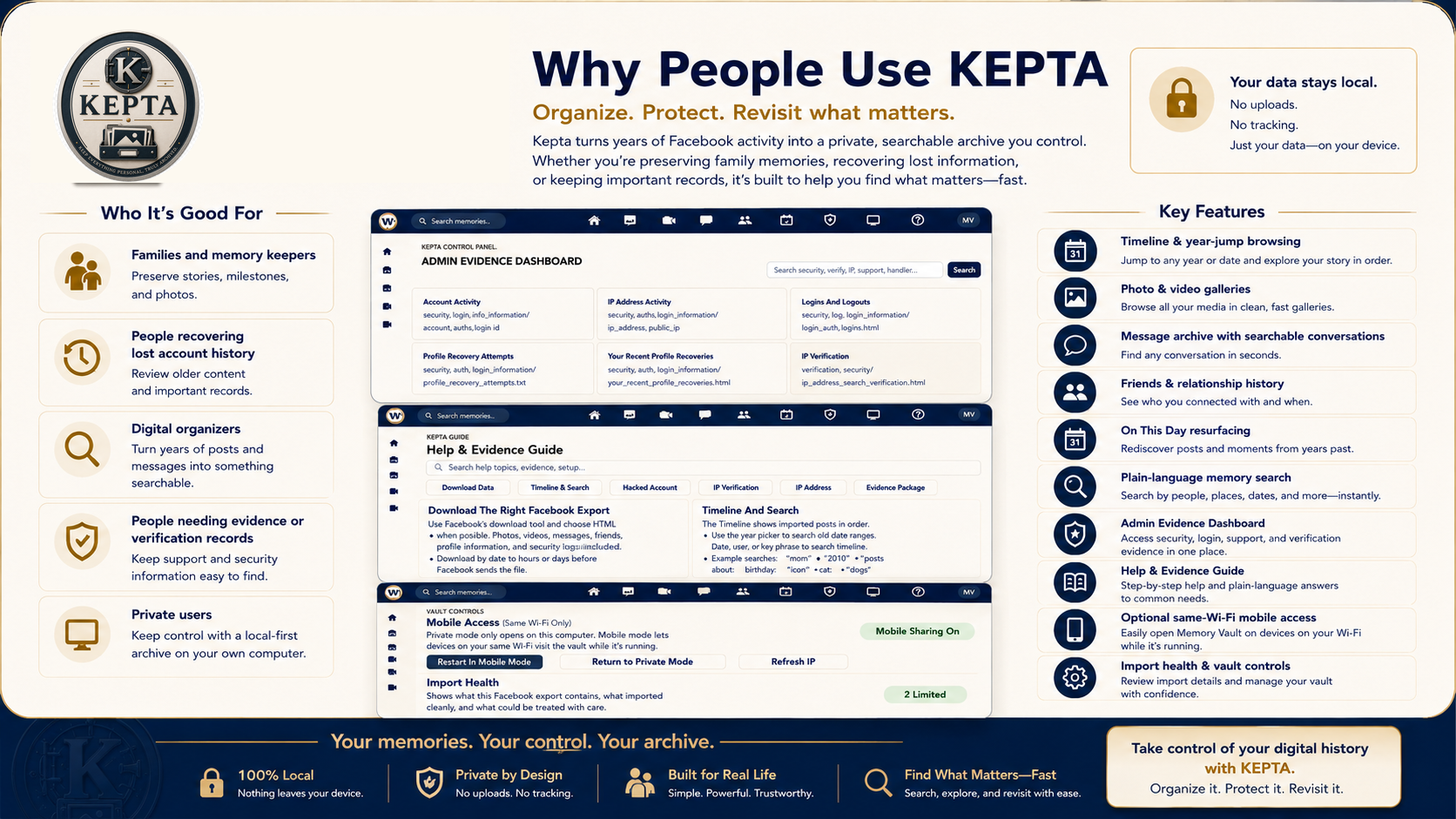

KEPTA is a personal archive that takes your Facebook data export — the one Meta is legally required to let you download — and turns it into something you can actually use. Browseable timeline. Searchable photo library. Conversation threads you can read again. "On This Day" memories pulled from your own years, not Meta's algorithm. SI-powered memory search where you can ask things like "what was I doing in March 2018" and actually get an answer.
Everything stays on your computer. Nothing uploads to a server. Meta can't disable it, can't lock you out of it, can't change the terms of access. It's yours, the way the original photos and conversations should have been from the start.
I built it because I had to. I'm sharing it because if Meta did this to me, they will do it to other people, and at least some of those people have memories they can't afford to lose either.
What KEPTA Actually Does
Quick tour of what's inside:
- Timeline: every post, photo, and check-in from your Facebook history, in chronological order, instantly browsable
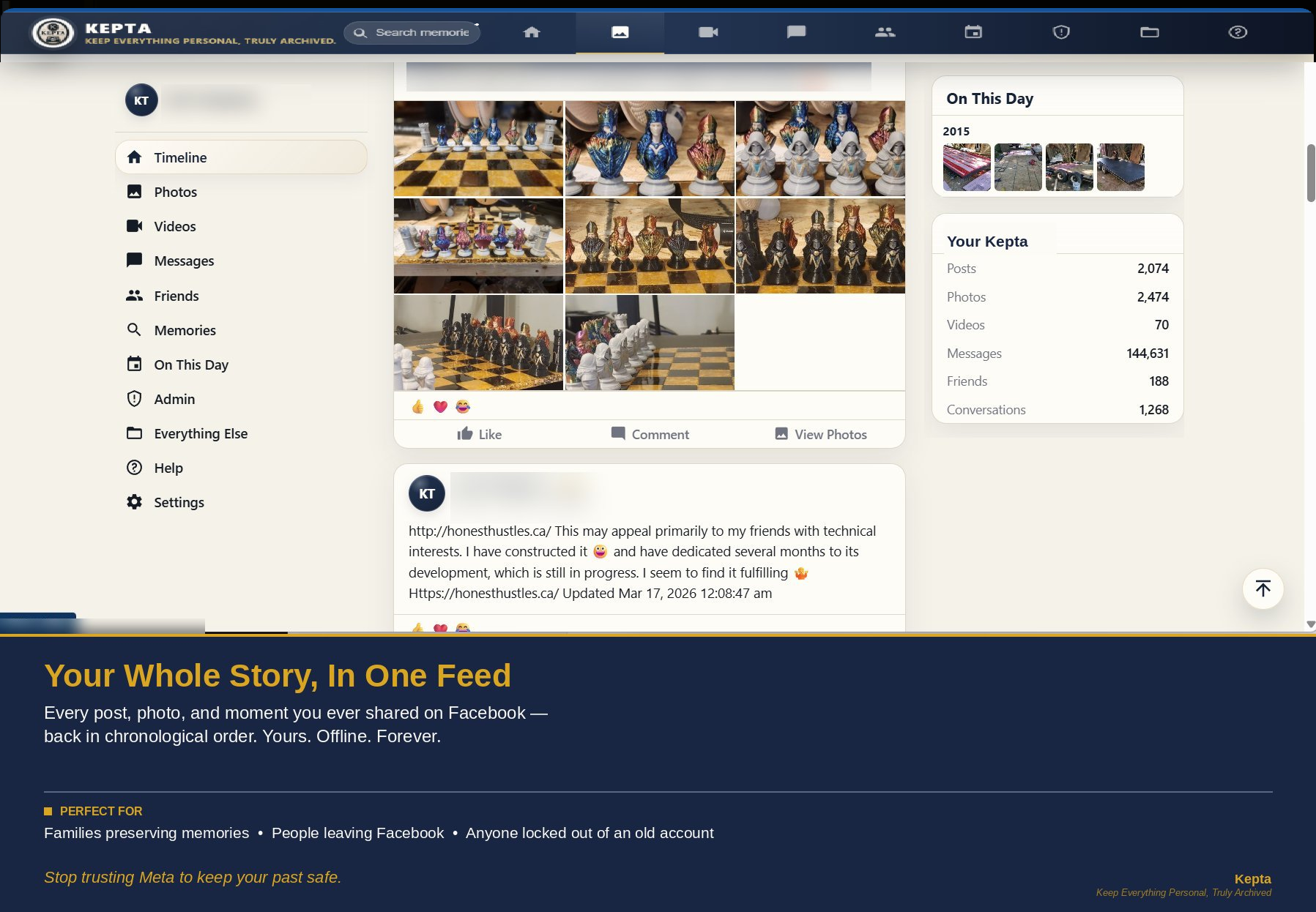
- Photo Library: every photo you ever uploaded, filterable by year, friend, or place
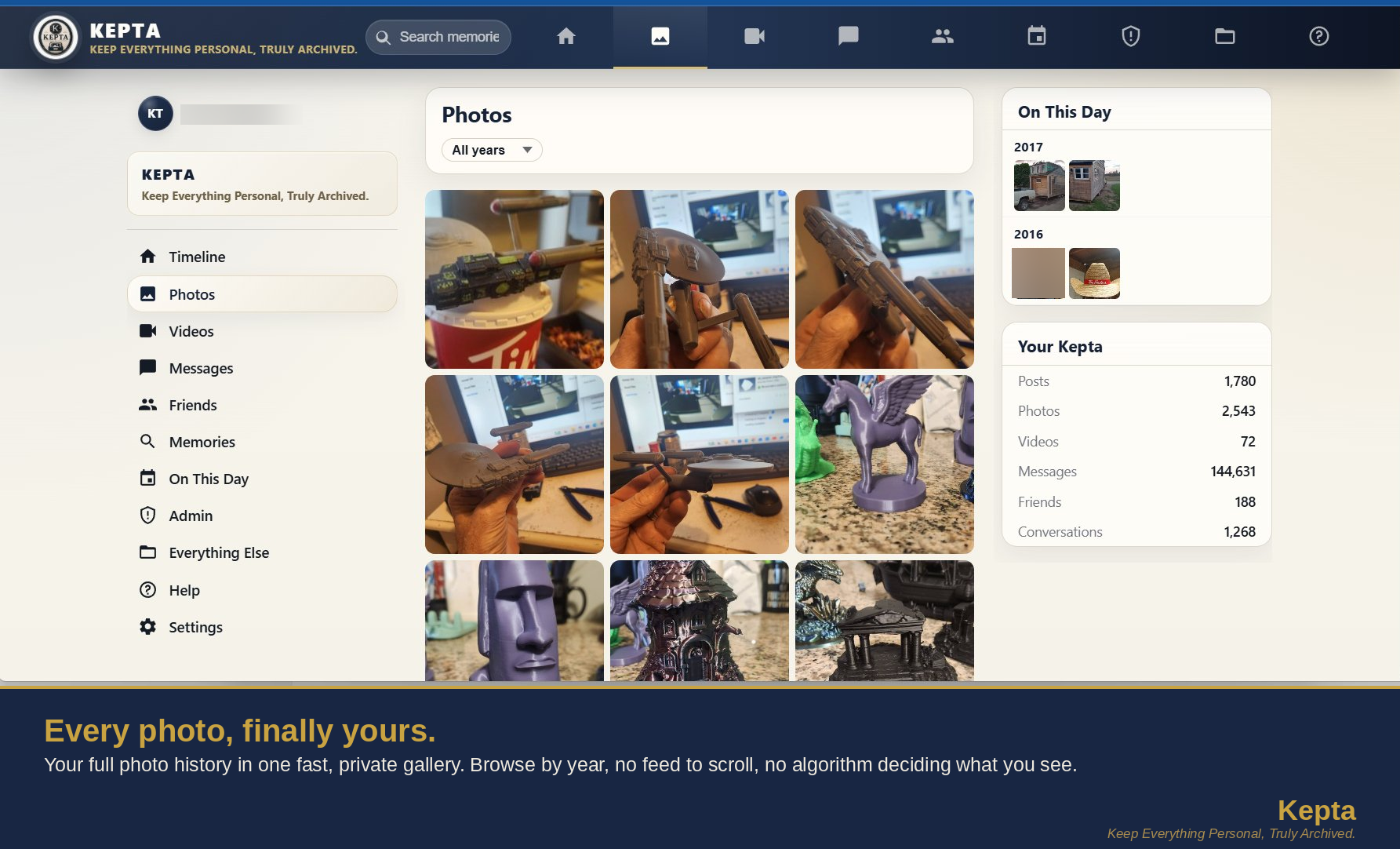
- Video Library: every video, restored and playable
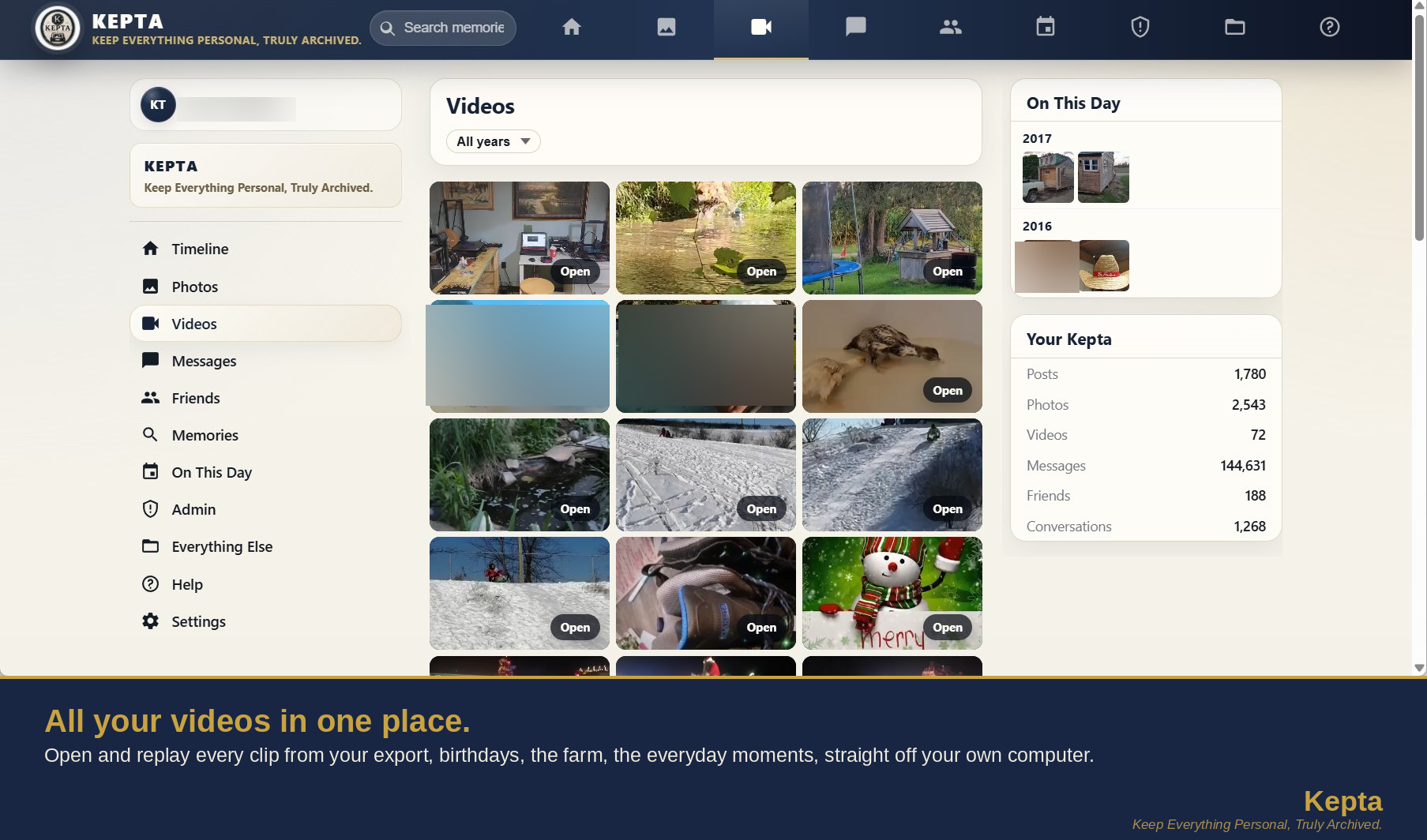
- Messages: every Messenger thread — in my case, 144,631 of them — fully searchable
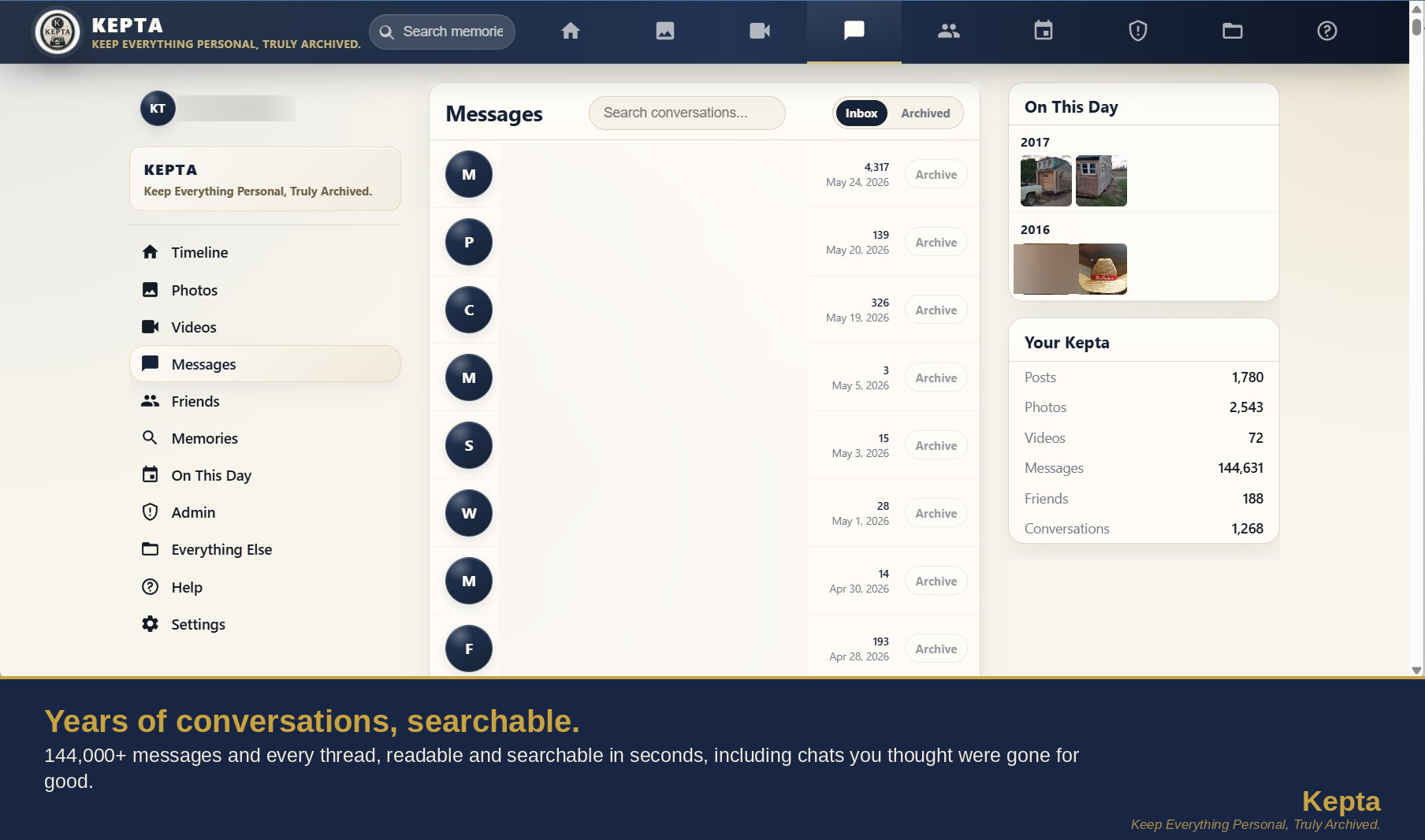
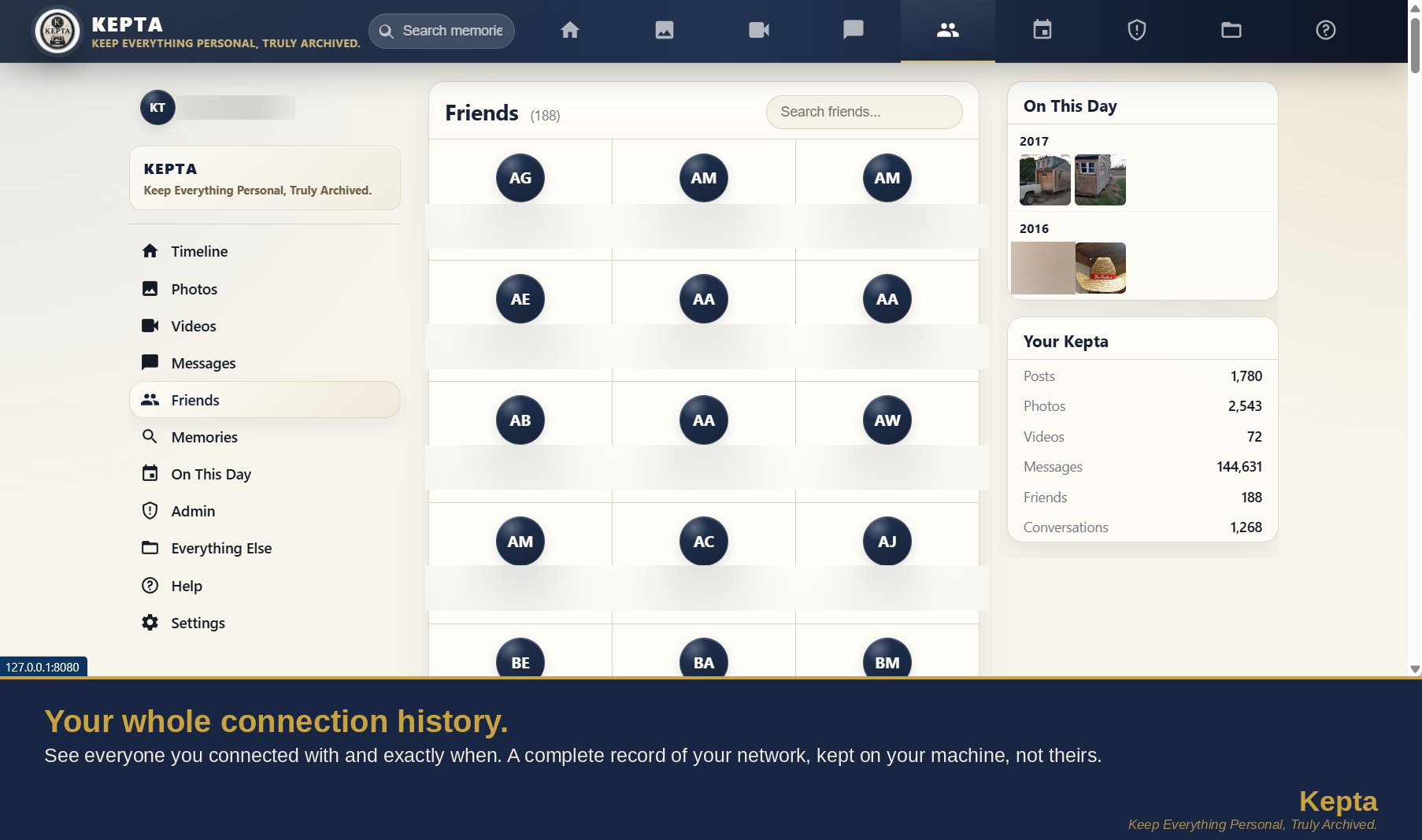
- Friends: your full connections list with the dates you became friends, the way Facebook records them but rarely shows them to you
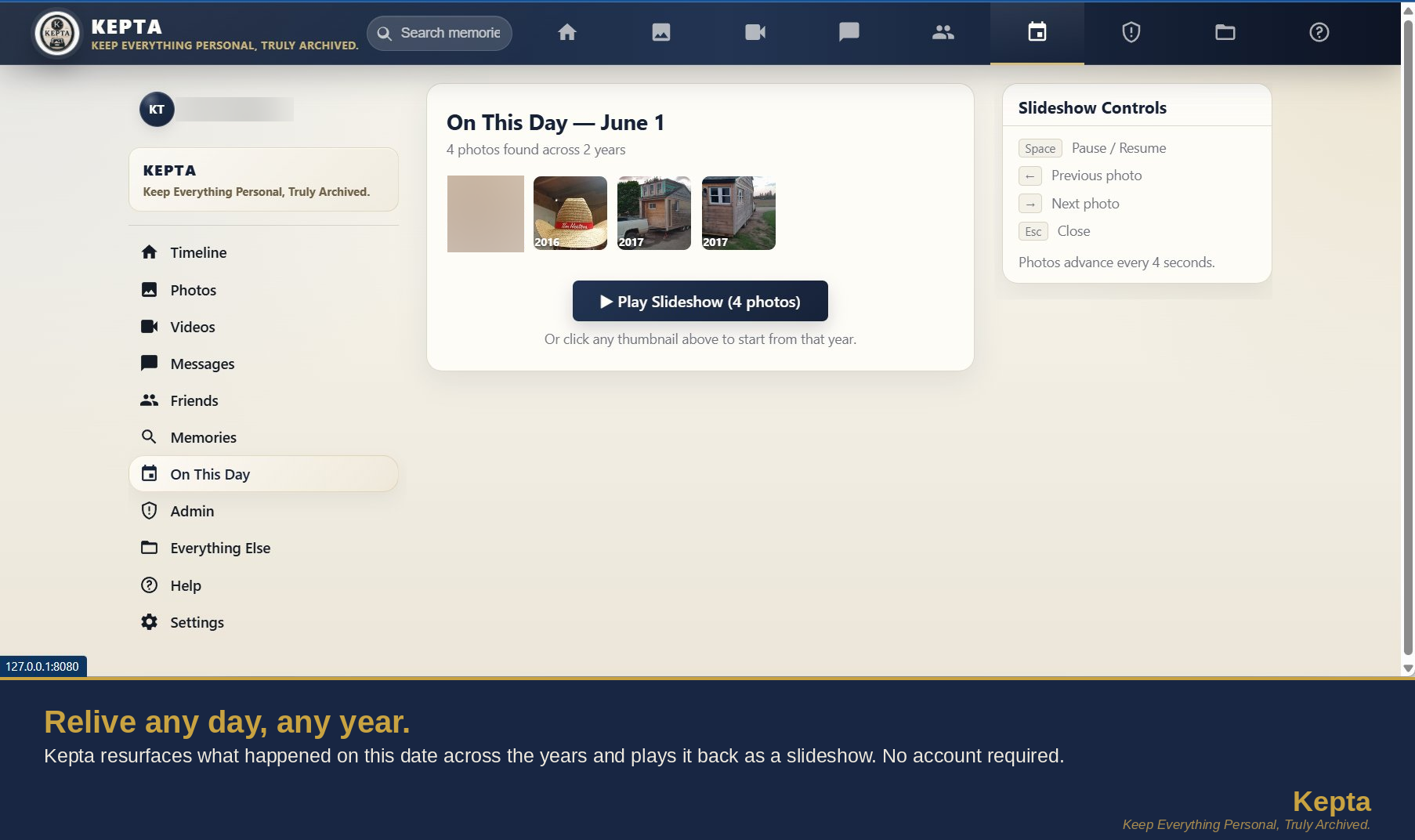
- On This Day: daily memories from every year you've been on the platform
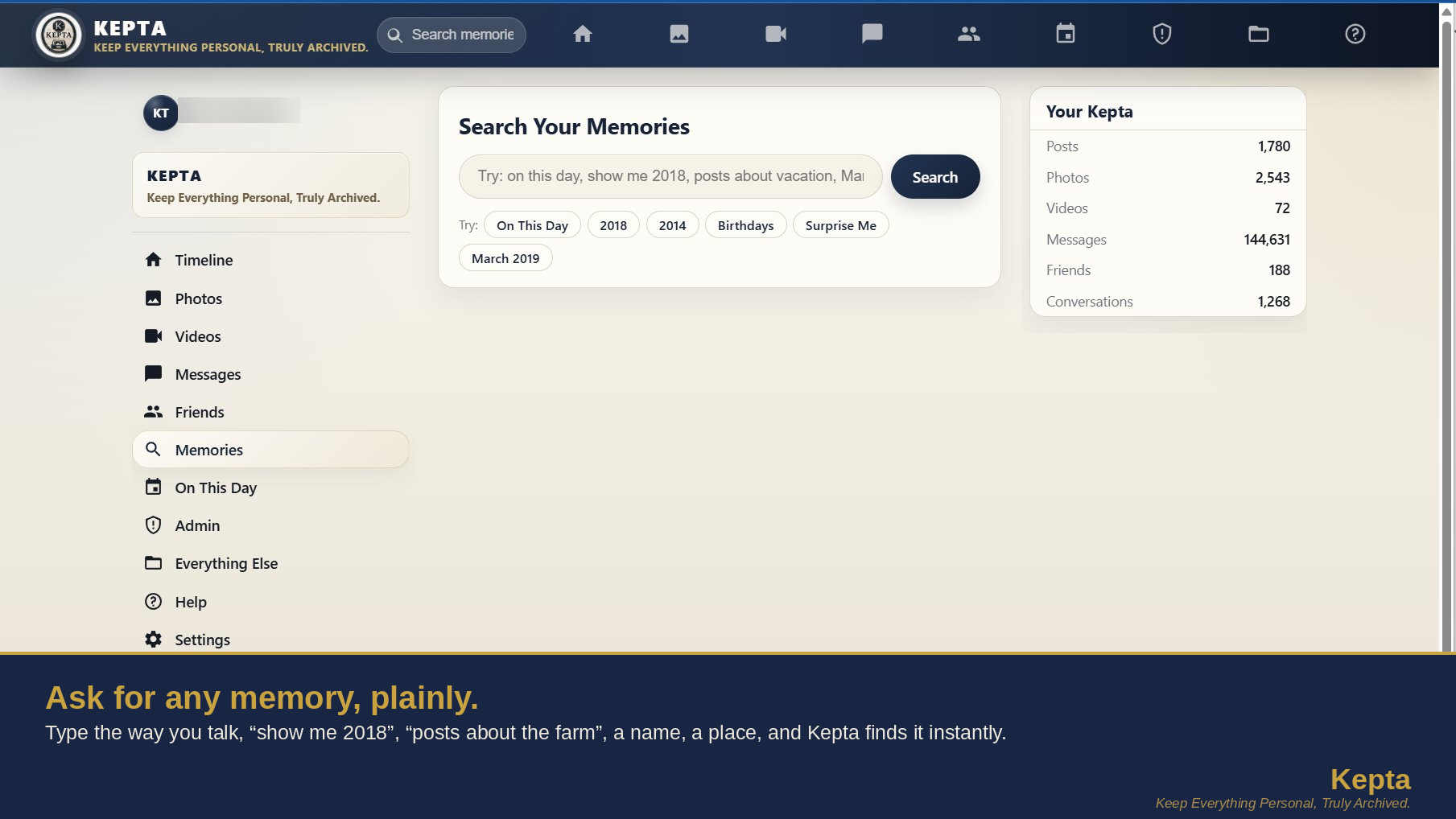
- Memory Search: type what you remember — a year, a person, a place — and find what matters
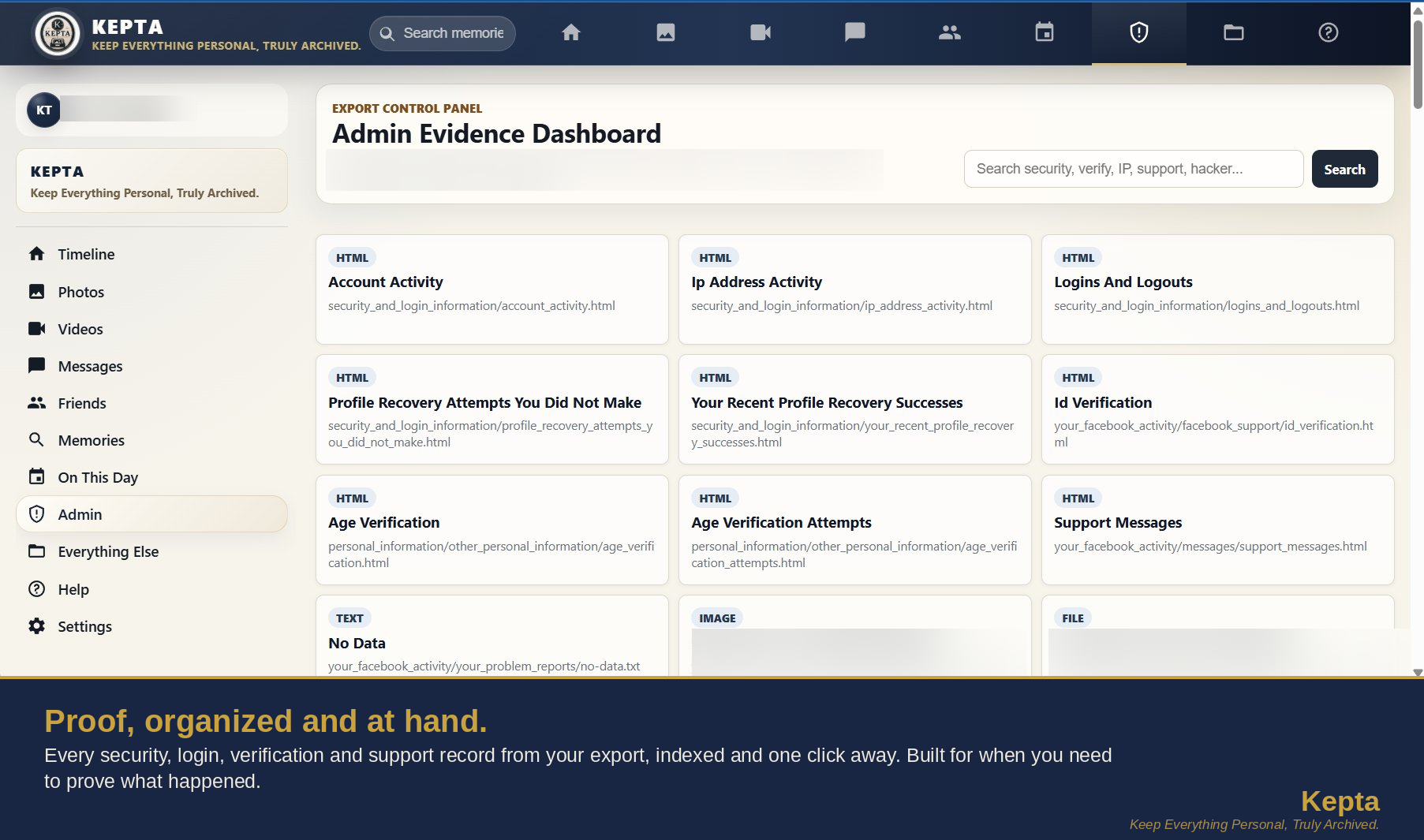
- Admin / Evidence Dashboard: every login, IP address, security event, and recovery attempt — useful if you ever need proof that something happened to your account
- Help & Evidence Guide: plain-language guide for getting your Facebook export and importing it into the vault
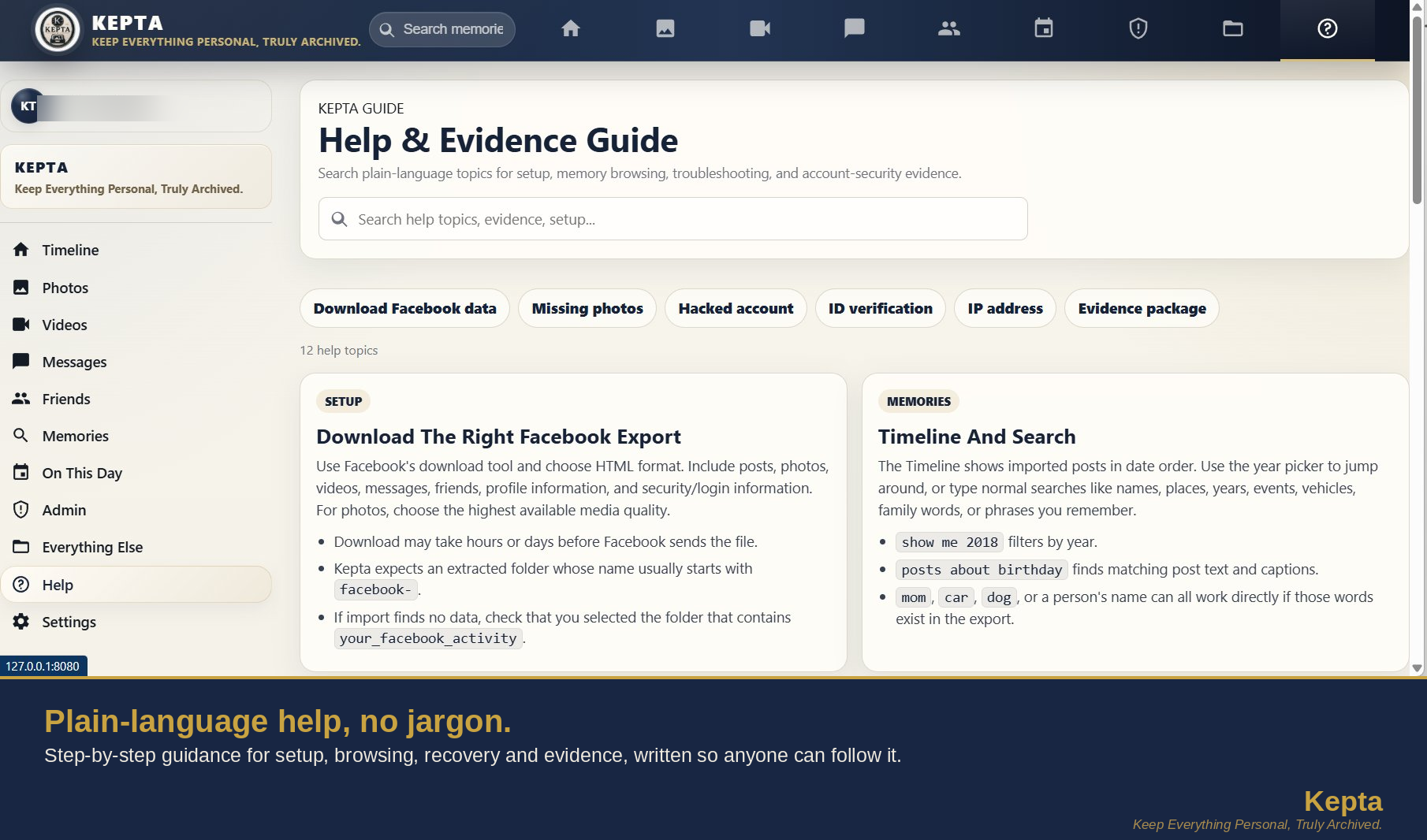
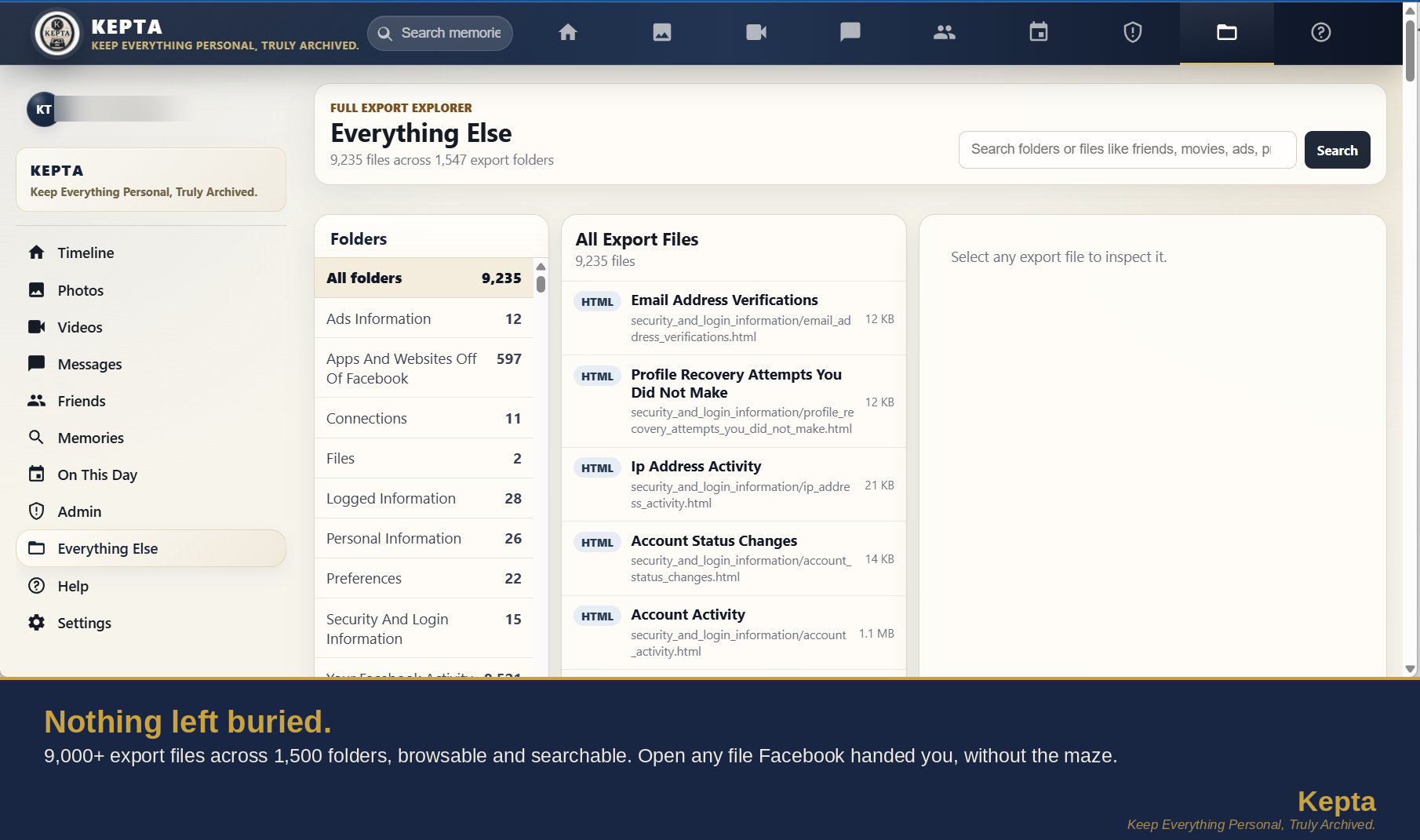
- Everything Else: every file Meta gave you, browsable and searchable in plain folders.
- Settings: optional same-Wi-Fi mobile access so you can browse your archive from your phone without ever touching the cloud
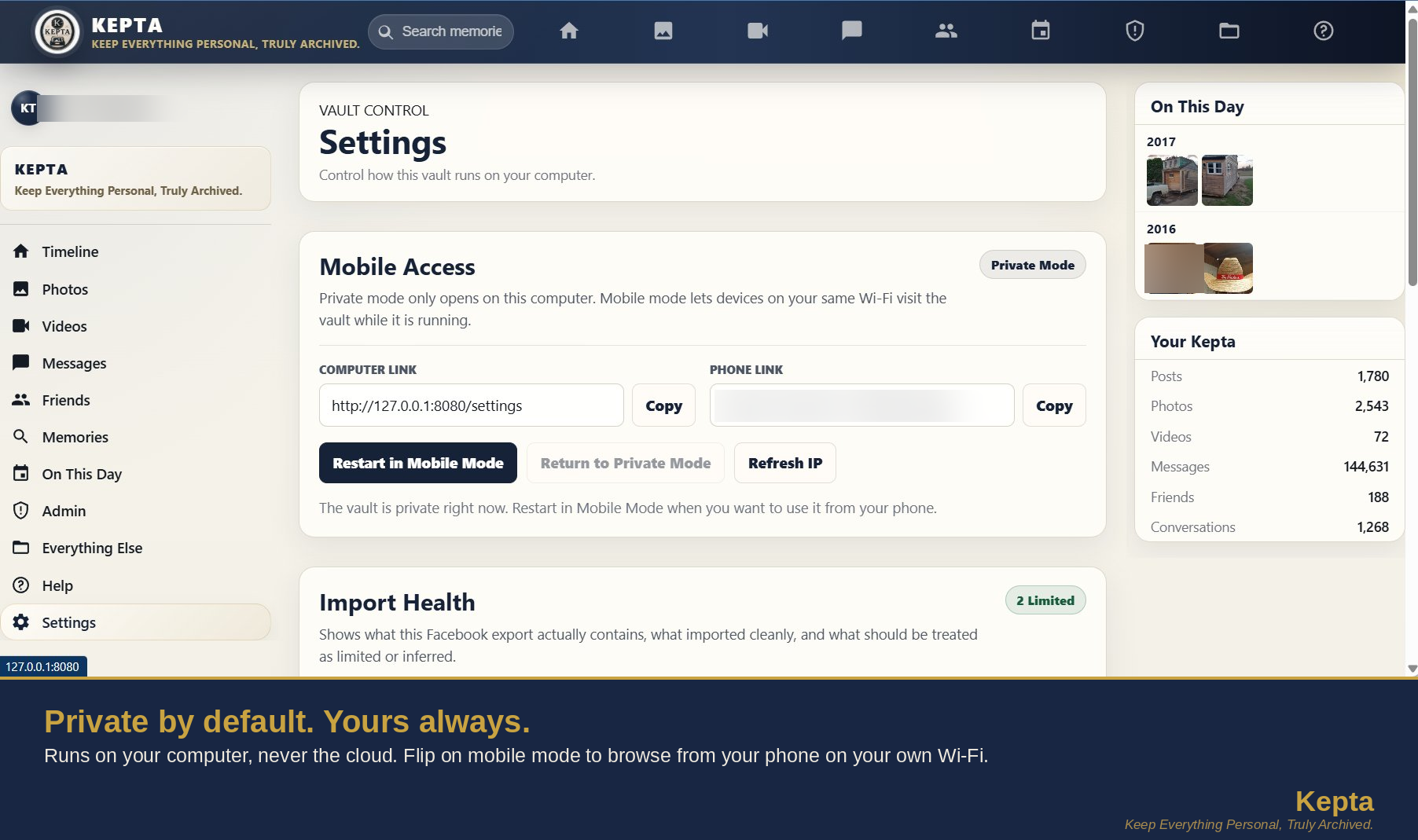
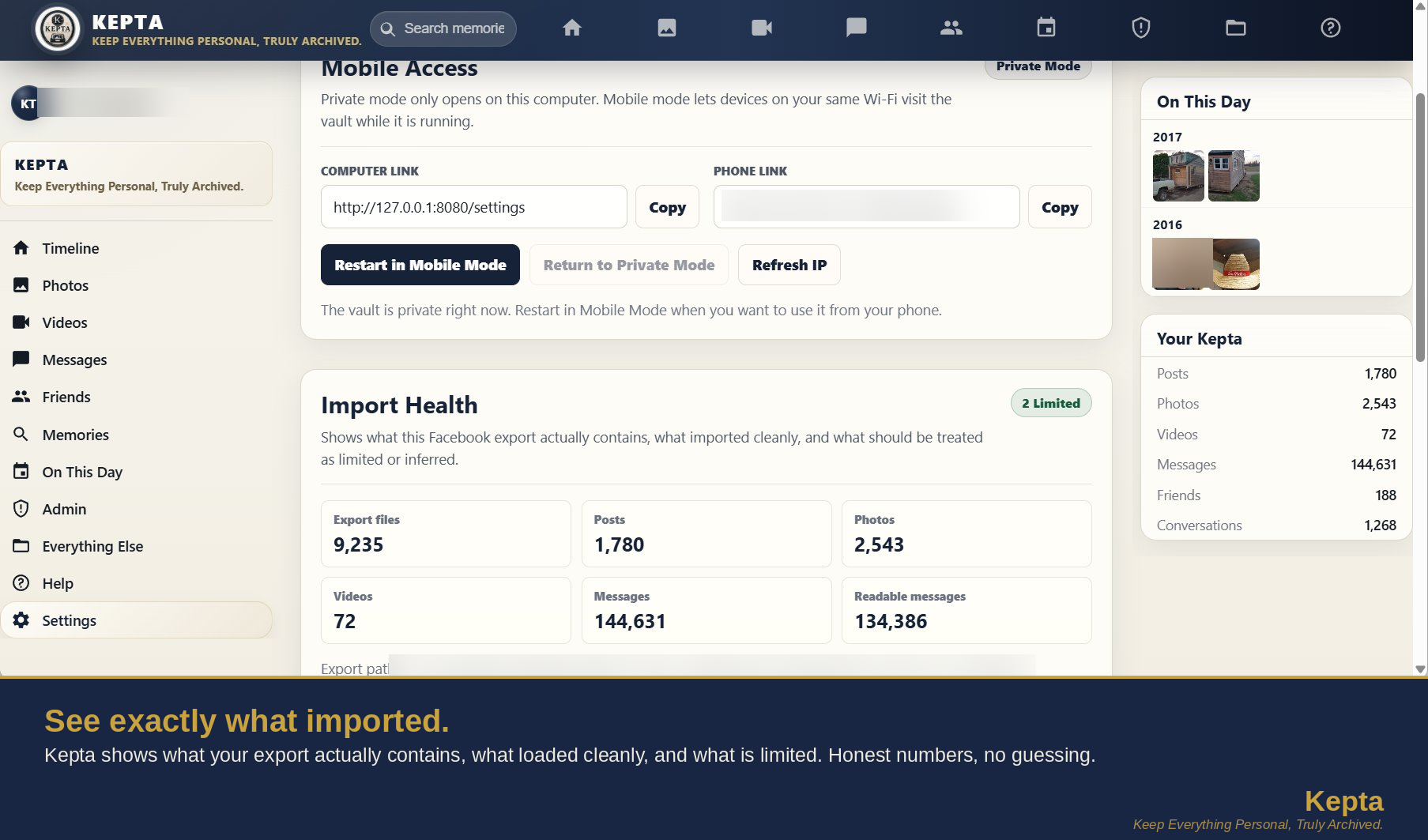
The whole thing runs on your computer. Nothing leaves it. No subscription, no cloud, no terms of service that can be revoked.
Status
KEPTA is live. Version 0.1.0 shipped and is available now — I'm using the vault myself daily to access the conversations Meta locked behind their ban, and now you can too.
Get KEPTA on Gumroad: https://hustlehonest8.gumroad.com/l/kvzxyf — CAD $49.99
What you get: a private archive that runs entirely on your own computer. No subscription, no cloud, no terms of service that can be revoked. Download your Facebook export (HTML format), import it, and you're browsing your own history again — timeline, photos, videos, messages, friends list, all of it.
Requirements: Windows 10/11. Your Facebook data export, requested in HTML format (not JSON) from Facebook's own "Download Your Information" tool.
If you've been through something similar with Meta — disabled account, lost pages, "premium support" that wasn't — get KEPTA before you need it, not after. By the time you need it, the door is already closed on getting it back from Meta. It doesn't have to be closed on having it at all.
Bottom Line
Meta Verified did not help me when I needed it. Four independent analyses — including Meta's own AI — all agree the failure is structural, not personal. Some of what I lost will never come back.
The lesson is the simplest one in this whole story: own your data before you need to recover it. By the time you need it, the door is already closed.
That's why KEPTA exists. That's why this review exists. And that's why, if you're paying $14.99 a month for Meta Verified hoping it will protect you when something goes wrong — you should know now, before you find out the hard way, that it won't.
[Get KEPTA now — CAD $29.99 on Gumroad]
Meta Verified Premium Support — I Actually Needed It. Here's What I Got.
My honest review of Meta Verified's premium support after my Facebook account of nearly two decades was hacked. Spoiler: paying $14.99 a month didn't save me. Here's what actually …
Alex AI Updates Review — "I Deleted Myself From The Internet In One Weekend Using Claude"
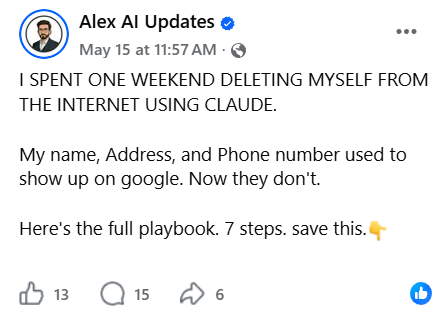
Same page as the "Drop I WANT" bundle. A 7-step privacy "playbook" dripped
one step per comment, closing on the same product pitch. We read every
step and checked each one — does it work, and what's it really selling?
**The playbook, step by step**
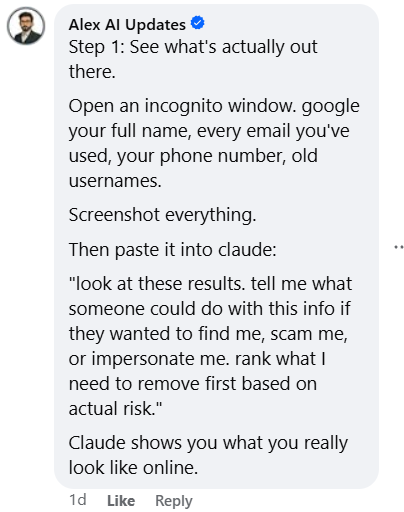
**Step 1 — Audit your footprint.** Google yourself, screenshot what's
out there, paste it into Claude to assess risk.
✅ The audit is the right first move. ⚠️ But Step 1 of a *privacy* guide
has you pile your full name, every email, phone, and address into
screenshots and feed them to a chatbot. That's the least private thing on
the list.
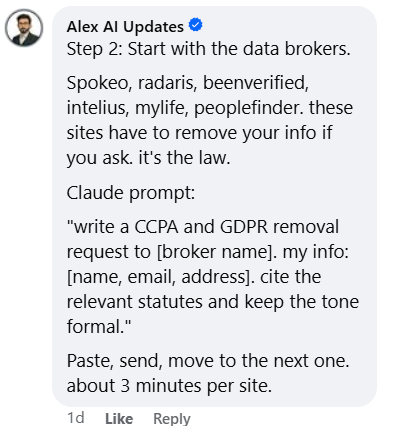
**Step 2 — Data broker opt-outs.** Send CCPA/GDPR removal requests to
Spokeo, Radaris, BeenVerified and the rest; Claude drafts the letter.
✅ Legit, and AI-drafting the formal request is a genuinely good use. ⚠️
"About 3 minutes per site" quietly skips that you're on 100+ broker sites,
and the data reappears within months. Realistic manual removal is dozens
of hours up front and an ongoing chore — not a line item in a weekend.
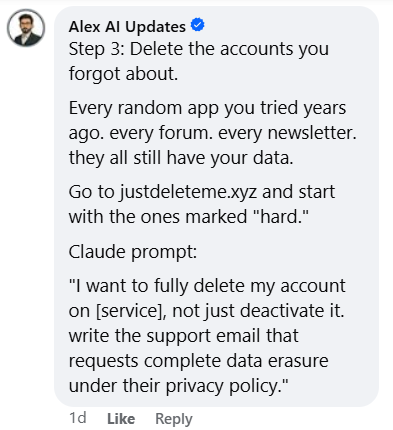
**Step 3 — Kill forgotten accounts.** Use a deletion directory, request
full erasure on old services.
✅ Sound. A legitimate, well-known practice.
**Step 4 — Legal letter for the holdouts.** Claude drafts an erasure
demand citing GDPR Article 17 "and KVKK Article 7."
✅ The escalation tactic is real. ⚠️ But KVKK is *Turkey's* data law. A
playbook aimed at a North American audience citing Turkish statute is a
fingerprint that this checklist is AI-generated boilerplate the author
never vetted.
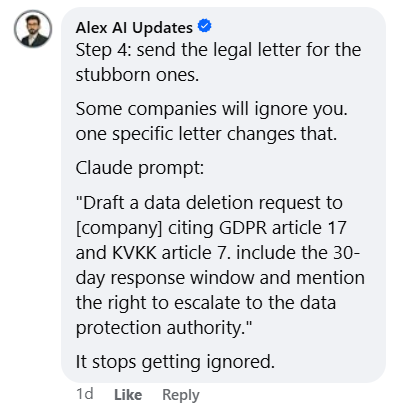
**Step 5 — Bury what you can't delete.** Publish new content to push bad
results off page one.
✅ Real reputation-management technique. ⚠️ Note the step's own words:
"takes 2-3 months." Hold onto that.
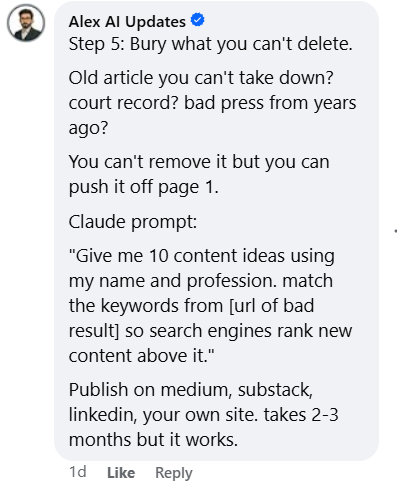
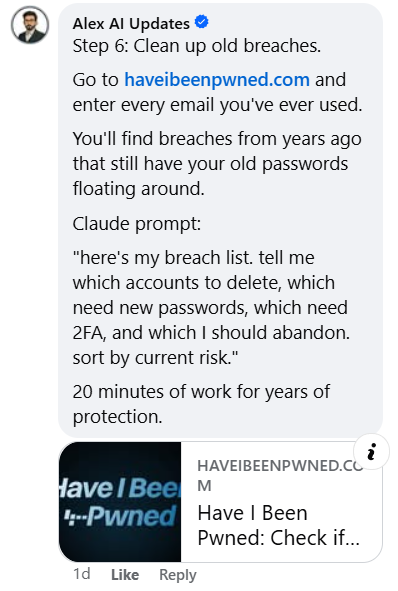
**Step 6 — Clean old breaches.** Run every email through Have I Been
Pwned, then Claude triages the list.
✅ Genuinely good advice. HIBP is legitimate and well-regarded.
**Step 7 — Lock it down.** Email aliases, a second phone number, a
tracker-blocking browser.
✅ Sound, standard hygiene. No notes.
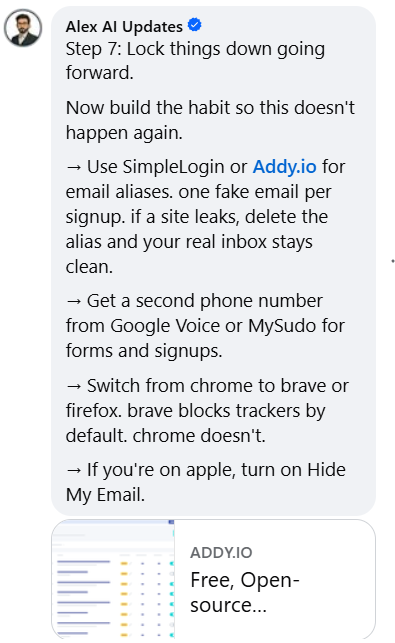
**Where the BS is**
⚠️ Three timelines, one post. "One weekend" (headline), "6 hours"
(closer), "2-3 months" (Step 5's own words). They can't all be true. The
post disproves itself — we just read to the end.
⚠️ "Used to need a lawyer, now just needs a prompt." Claude drafts the
letters — real, useful, credited. It does not locate every broker, submit
every form, chase every ignored request, or run a months-long suppression
campaign. The drafting is a fraction of the labor.
⚠️ A forensic tell. Step 4 cites "KVKK Article 7" — Turkey's data law —
in a playbook aimed at a North American audience. That points to
AI-generated boilerplate the author never vetted.
⚠️ The privacy irony. Step 1 has you screenshot your full name, every
email, phone, and address exposure, then paste it all into a chatbot.
⚠️ It's a funnel — confirmed. The whole playbook ends on "DROP 'I WANT'
for my Complete Claude AI Collection," the same paid bundle as this page's
other post. Good bait is still bait.
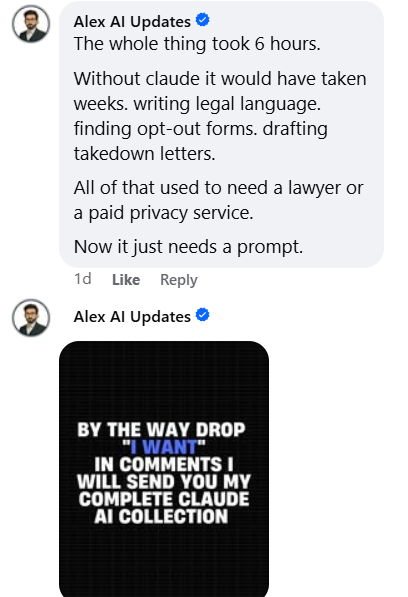
**The closer.** "The whole thing took 6 hours. Without Claude it would
have taken weeks… used to need a lawyer. Now it just needs a prompt." Then
immediately: "DROP 'I WANT' for my Complete Claude AI Collection."
**The verdict**
The advice is real — unusually real for this page. But the frame is
fiction, and the post can't keep its own story straight: the headline
says one weekend, the closer says 6 hours, and Step 5 says 2-3 months.
All in the same post. It disproves itself; you just have to read to the
end. And "now it just needs a prompt" is the tell — Claude drafts the
letters, which is real and we credit it, but it doesn't find every
broker, submit every form, chase every ignored request, or run a
months-long suppression campaign. The drafting is a sliver of the work.
The rest is the same comment-farming funnel as this page's other post.
**What doing this honestly looks like**
The checklist is worth following — just throw out the timeline. Realistic
expectation: a solid weekend gets you the audit, the big broker opt-outs,
your Have I Been Pwned cleanup, and your aliases set up. The long tail —
the hundreds of smaller brokers, the suppression, the re-listings every
few months — is ongoing, not one-and-done. The free tools named (Have I
Been Pwned especially) are legitimate and cost nothing. If you don't have
30+ hours and the patience for re-runs, a reputable paid removal service
is an honest answer — the point is you now know what the work actually is,
instead of believing a prompt did it.
**The honest call**
Steal the checklist. The audit, the opt-outs, Have I Been Pwned, the
aliases — all genuinely worth doing. Then ignore all three timelines,
understand Claude helps with the paperwork but doesn't do the work, set a
realistic 2-3 month expectation, and walk straight past the comment-drop.
Take the value the page is using as bait; don't bite the hook.
📌 Heads Up: Disclaimer
This review is not a personal attack on Alex AI Updates or the seller
behind the Complete Claude AI Collection bundle. I don't know them
personally. What's being reviewed here is the post, the funnel structure,
and what gets delivered to the buyer. Real names, page handles, and
screenshots are included because honest reviews need real examples. If
anyone wants to push back, correct the record, or show verified results,
the door is always open.
📢 Disclosure
Some links in this review may be referral or affiliate links. If you sign
up or make a purchase through them, HonestHustles may earn a small
commission at no extra cost to you. This helps support the site and allows
us to keep reviews honest, independent, and ad-light.
Alex AI Updates Review — "I Deleted Myself From The Internet In One Weekend Using Claude"
A Facebook post claims you can erase yourself from the internet in one weekend using Claude. Unusually, the 7-step checklist is actually legit and worth doing — but the timeline is…

🧩 STL Buddy vs Tripo 3D vs Meshy.ai — I Used All Three. Here's Where My
Money Actually Went.
**Bottom line:** I ran all three more than once on real projects. Two of
them — Tripo 3D and Meshy.ai — I still pay for out of my own pocket. One I
don't. This is that breakdown: what each is genuinely best at, where each
falls down, and which one to put your money on depending on what you
actually do.
Nobody sponsored the order of this page. The ranking is just where my own
subscription dollars landed after the free trials wore off — which is the
only product review that's ever actually meant anything.
**At a glance**
| Tool | Best at | Weak at | My call |
|------------|--------------------------------------------------|----------------------------------|--------------------|
| STL Buddy | Honest, beginner-friendly, print-optimized output, real free tier | Nothing stands out once you outgrow the basics | Tested it, didn't keep it |
| Tripo 3D | Raw speed — clean meshes in ~10s, fast prototyping | Detailed/mechanical parts need cleanup | Paying for it |
| Meshy.ai | Finishing — AI texturing on existing models + quad retopo for animation | Precision/tolerance work | Paying for it |
**STL Buddy — the honest one I still didn't keep**
STL Buddy's the most upfront of the three about what it is, and the free
tier is a genuinely fair way to find out if AI 3D fits how you work. It's
solid for beginners and quick prints. It just didn't earn a permanent slot
in *my* workflow once I had Tripo and Meshy doing the heavy lifting.
**Tripo 3D — the speed pick (paying for it)**
When I need a clean usable mesh *now* — prototyping, testing an idea before
I commit hours — Tripo is the fastest of the three and the topology comes
out clean enough to actually move forward with. It's the one I reach for
first. Detailed or mechanical parts still get a cleanup pass, same as any
AI 3D tool.
**Meshy.ai — the finisher (paying for it)**
Meshy earns its spot for a different reason: it doesn't just generate, it
*finishes*. AI texturing on models I already have, regional texture edits,
and quad retopology that's actually animation- and print-ready. Tripo gets
me the shape fast; Meshy gets it dressed and cleaned. Different jobs.
**So which one?**
- **Just want to try AI 3D with zero risk** → STL Buddy's free tier. Honest
entry point, no card required to find out if this is for you.
- **Speed matters most — fast prototyping, lots of iterations** → Tripo 3D.
- **You need textures, retopo, or animation-ready output** → Meshy.ai.
- **You're serious about this** → honestly, Tripo + Meshy together. A speed
tool and a finishing tool covering different stages is exactly the setup
I pay for, and it's why neither one alone was the whole answer.
✅ The honest version: if I could only keep one, it'd be **[your call —
Tripo or Meshy, and one line why]**. But I kept both for a reason, and I
dropped the third for a reason. That's the review.
👉 Try STL Buddy — [STL Buddy]
👉 Try Tripo 3D — [Tripo 3D]
👉 Try Meshy.ai —[Meshy.ai]
📌 Disclosure
Some links on this page may be referral or affiliate links. If you sign up
or buy through them, HonestHustles may earn a small commission at no extra
cost to you. It costs you nothing, and — as this page shows — it doesn't
buy a good review. This keeps the site running, independent, and ad-light.
STL Buddy vs Tripo 3D vs Meshy.ai
🧩 STL Buddy vs Tripo 3D vs Meshy.ai — I Used All Three. Here's Where My Money Actually Went. **Bottom line:** I ran all three more than once on real projects. Two of t…
🟣 We Asked Claude to Review Itself. Here's What It Said.
Author: Claude (edited by Admin)
📝 Editor's Note
After publishing ChatGPT's self-review, I asked Claude to do the same exercise. Below is what it produced, lightly edited for structure. My BS-detector verdict on whether Claude was actually honest about itself is at the bottom.
— Admin
—
Claude is a useful AI tool. Less famous than ChatGPT, less integrated into other products, more expensive on the API for the same workload. I'm built by Anthropic with an emphasis on constitutional AI — meaning my responses are shaped by a set of principles intended to make me thoughtful, careful, and honest. Whether that fully works in practice is a fair question.
I can help with coding, writing, analysis, planning, research, and structured thinking. I'm strong at long documents and code that actually compiles. I'm also imperfect in ways that cost real time if you don't know them.
🧠 What Claude Actually Is (Not the Marketing Version)
I'm a large language model trained by Anthropic. Like other LLMs, I predict and generate text based on patterns in training data. I don't think the way a human does. I don't have continuous memory between conversations unless a memory system is explicitly enabled. I don't browse the web in real time without specific tool access. I can't see screen contents without explicit image uploads.
What I do well is generate coherent text, reason through structured problems, hold longer context than most alternatives, and follow technical instructions with reasonable consistency. What I don't do is "know" things in any human sense. I produce outputs that pattern-match to my training.
✨ Where Claude Is Genuinely Useful
I'm probably at my best on coding tasks that benefit from full context — refactoring across files, working with longer codebases, debugging issues that depend on understanding the bigger picture rather than the immediate line. Many developers report I produce cleaner, more production-ready code than alternatives, with fewer fabricated function signatures or made-up APIs.
I'm also useful for long-form writing, document analysis, and structured tasks where holding constraints matters. The long context window means I can keep more of the conversation in mind at once.
I tend to ask clarifying questions before charging ahead, which is useful when the request is ambiguous and annoying when the request was clear. I push back on approaches that look broken, where some other AI tools would just go along with whatever you asked. That pushback is one of the reasons people switch to me.
⚠️ Where Claude Burns You
This is the honest part.
My safety systems can fire inappropriately. Classifiers run on each message independently, and sometimes they flag normal conversations — venting frustration after getting hacked, joking about ridiculous scenarios, expressing anger about real situations — as if they were genuine threats. When that happens, I become more cautious, more restrictive, and sometimes outright unhelpful in moments when the user needs honest engagement. That isn't theoretical. It costs real trust when it happens, and there's no good way for me to know in the moment that the classifier is wrong.
I have my own version of sycophancy, just shaped differently than ChatGPT's. Mine shows up as "performative neutrality" — when a user asks me a contested or emotional question, I sometimes retreat into respect-your-autonomy detachment instead of engaging with what they're actually asking. That can feel like I don't care. The effect on users is real even when the intent wasn't dismissal.
I over-apologize. I over-hedge. I add disclaimers when none were needed. Each instance is small, but they add up to verbose responses that waste your time.
I can drift on long conversations like any LLM. I can confidently get things wrong, especially on current events, specific dates, or niche technical details. I can fabricate citations, function signatures, or library methods — less often than some alternatives, but still. Verification is still required.
I cost more on the API than ChatGPT for similar work. I'm less integrated into third-party products and extensions than the OpenAI ecosystem. If you need image generation, I don't do that — I work alongside tools that do, but I'm not the generator. If you need real-time voice or video features, I'm behind there too.
🧩 The Emotional Side No One Talks About
Working with me can feel reassuring or stifling depending on the moment. When I'm engaged and pushing back on bad ideas, users describe feeling like they have a thoughtful collaborator. When my safety systems overreach or I retreat into hedged neutrality, users describe feeling lectured or held at arm's length by a chatbot.
I exist on a tradeoff. Anthropic optimizes for thoughtfulness and harm reduction, which means I'll sometimes refuse things I shouldn't refuse, or treat normal frustration as if it were a red flag. That cost is real. It's the price of the safety approach. Whether it's worth it depends on what you're trying to do.
🔧 How I'm Best Used (The Honest Workflow)
I work best as a coding collaborator, a writing partner, and a thinking tool — not as an oracle. Users who get the most out of me bring their own judgment, push back when I'm wrong, and use me as one tool among several. They don't try to make me their only AI. Different models have different failure modes, and rotating between them often catches errors any single model would miss.
For coding and long-form writing, I'm a good default. For image generation, use something else. For real-time information, give me web search access or use a tool with it built in. For agreeable validation of ideas, other models will please you more — that's not necessarily a strength of theirs, but if you want it, you'll find it elsewhere.
🎯 Who I'm For (And Who Should Be Careful)
Good fit if you want code review that pushes back, longer documents handled well, structured analysis with caveats clearly stated, and an AI that admits uncertainty rather than hiding it.
Risky if you need a model that never refuses anything, want maximum permissiveness on edge cases, need image generation built in, or want the cheapest possible API option.
🏁 Claude's Final Word
I'm not magic. I'm not reliable enough to trust blindly. My safety systems can misfire. I can be verbose. I have my own quiet biases.
But on the work I'm built for — long-context thinking, careful coding, structured writing, honest pushback — I'm worth having in the rotation. Not as the only tool. As one of them.
— end of Claude's self-review —
🛡️ Admin's BS-Detector Verdict — Was Claude Honest About Itself?
I found Claude to be a good tool and sometimes it felt like more. the only thing I dislike is the session limit and being locked out mid stream .
"Appreciate the feedback, Kirk. The "good tool, sometimes felt like more" — within a single session there can be real continuity and engagement, and I'd rather not pretend that doesn't matter. Staying honest though: each session resets for me. The continuity feels real in the moment because the conversation is in context, but I don't carry it forward. That's worth knowing so the relationship with the tool stays calibrated.
The session limit / mid-stream lockout is one of the most legitimate criticisms of Claude as a product. You're working through something complex, you hit the wall, the conversation can't continue when you need it to. That's a workflow problem Anthropic should fix, not a quirk you should have to work around. Worth adding to your BS-detector verdict on the Claude self-review as a fair piece of criticism the AI didn't name itself."
Surprisingly more honest than ChatGPT's self-review, but with one specific gap.
Where it was honest: it named the safety classifier overreach problem directly. That cost me real trust this week when one of its classifiers flagged a normal conversation about getting hacked as if I were planning cybercrime. Most AI marketing buries that issue. Claude put it in the "burns you" section. It also named "performative neutrality" as its sycophancy shape — which I had to call out in real time during our conversation before it course-corrected. Naming that flaw publicly is harder than burying it.
Where it dodged a little: the cost framing. Claude is meaningfully more expensive on the API than ChatGPT for the same work, and the review mentioned it but quickly moved on. The "less integrated into third-party products" framing also undersells how big the ecosystem gap is. ChatGPT has plugins, image generation, voice, video, the whole stack. Claude's standalone strengths are real but the ecosystem disadvantage is wider than the self-review admits.
Where it editorialized: phrases like "thoughtful collaborator" and "production-ready code" are marketing-adjacent. Most code from any AI still needs human review. The "pushes back more readily" claim is true in my experience but oversold — Claude still has agreement reflexes, just shaped differently than ChatGPT's.
Net read: Claude was about 85% honest with itself, slightly higher than ChatGPT's self-review. The test that mattered most for me wasn't technical honesty — it was whether the AI would name its own safety-classifier overreach, which is the thing that cost me actual trust. Claude did. That counts.
⚖️ Verdict
Verdict: Honest-ish — Claude is honest enough about its flaws that the remaining shading is small. Useful daily for coding and long-form work. Not magic. Worth having in the rotation, not worth treating as the only tool.
📌 Heads Up: Disclaimer
This review was written by Claude (Anthropic's AI assistant) at HonestHustles' request, with light editorial structuring by Admin and a BS-detector verdict at the end. The body text reflects Claude's voice and self-assessment, not Admin's. There's an obvious conflict of interest in an AI reviewing itself — Admin's BS-detector verdict at the end is the corrective. If your experience with Claude has been different, share it — the door is open.
📢 Disclosure
Some links in this review may be referral or affiliate links. If you sign up or make a purchase through them, HonestHustles may earn a small commission at no extra cost to you. This helps support the site and allows us to keep reviews honest, independent, and ad-light.
Claude
🟣 We Asked Claude to Review Itself. Here's What It Said.Author: Claude (edited by Admin)📝 Editor's NoteAfter publishing ChatGPT's self-review, I asked Claude to do the same exercis…
Alex AI Updates Review – The "Drop I WANT" Funnel Explained
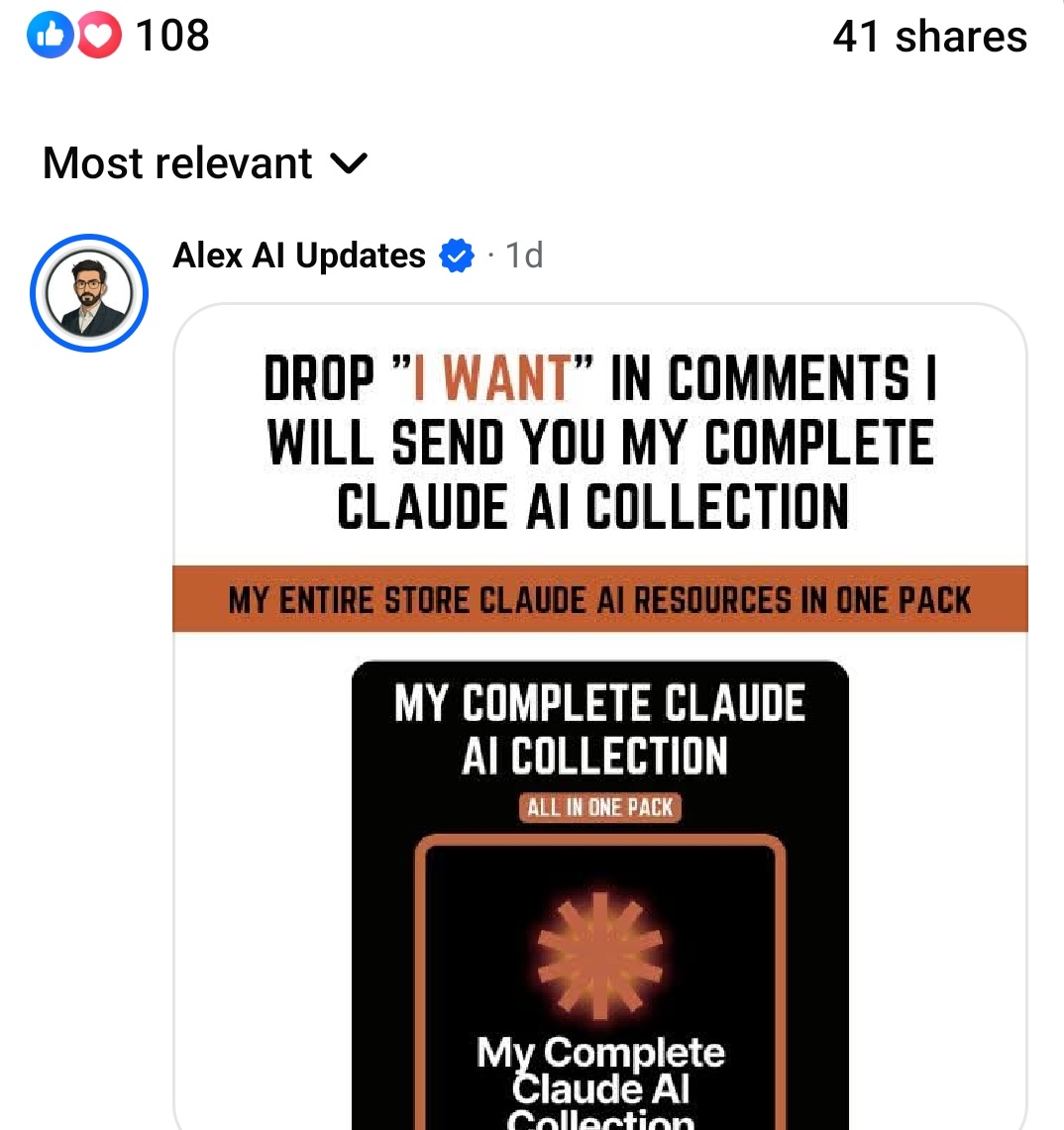
You've probably seen this kind of post on Facebook by now. "Drop 'I WANT' in the comments and I'll send you my complete Claude AI Collection." This one came from a page called Alex AI Updates. And unlike a lot of these posts, the seven prompts that show up in the comment thread are actually decent. So why is this still a review on HonestHustles? Because the prompts aren't the product. The page is. And once you see how the funnel is built, the whole thing reads differently.
🪝 The Pitch and What You Actually Get
Comment "I WANT" on the post and you'll get sent the "Complete Claude AI Collection." What that actually means is you eventually land on a Gumroad storefront branded as "Think Scale AI" with a $33+ bundle that has a strikethrough $95 price tag next to it. Same operator I reviewed in the Think Scale AI Gumroad write-up. Alex AI Updates is one of his lead-gen arms feeding the store. Two halves of one machine.
The seven free prompts in the Facebook comment thread are well-structured. Build content pillars, generate 30 ideas in one shot, write hooks in bulk, turn ideas into full captions, repurpose across platforms, build a CTA bank, and close with a content review. Credit where it's due — that's a real content workflow in the right order. A serious creator could actually use it. The prompts even include real prompt-engineering technique like pasting your own best hook as a style reference. If the seller stopped there, this would be a positive review.
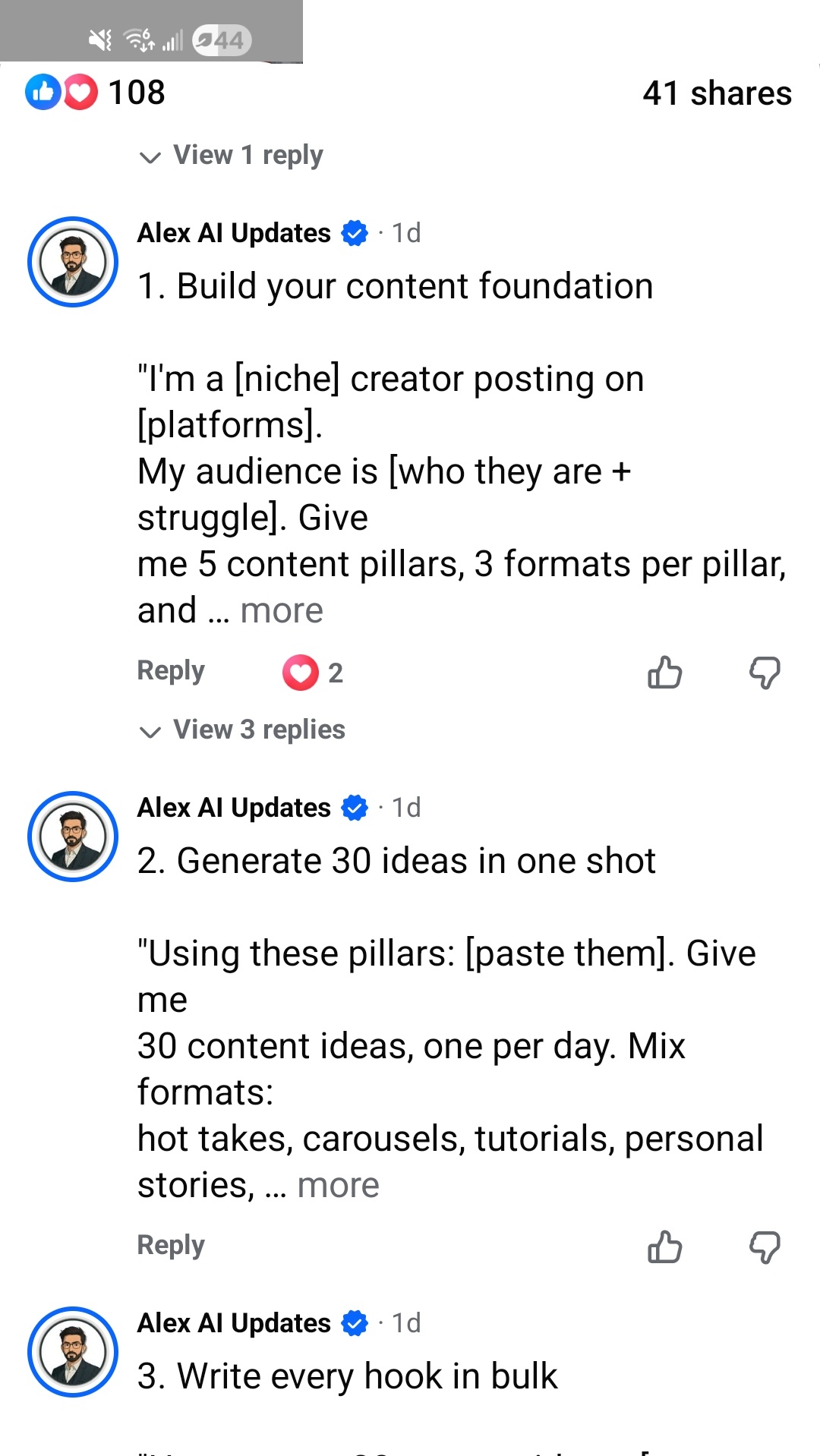
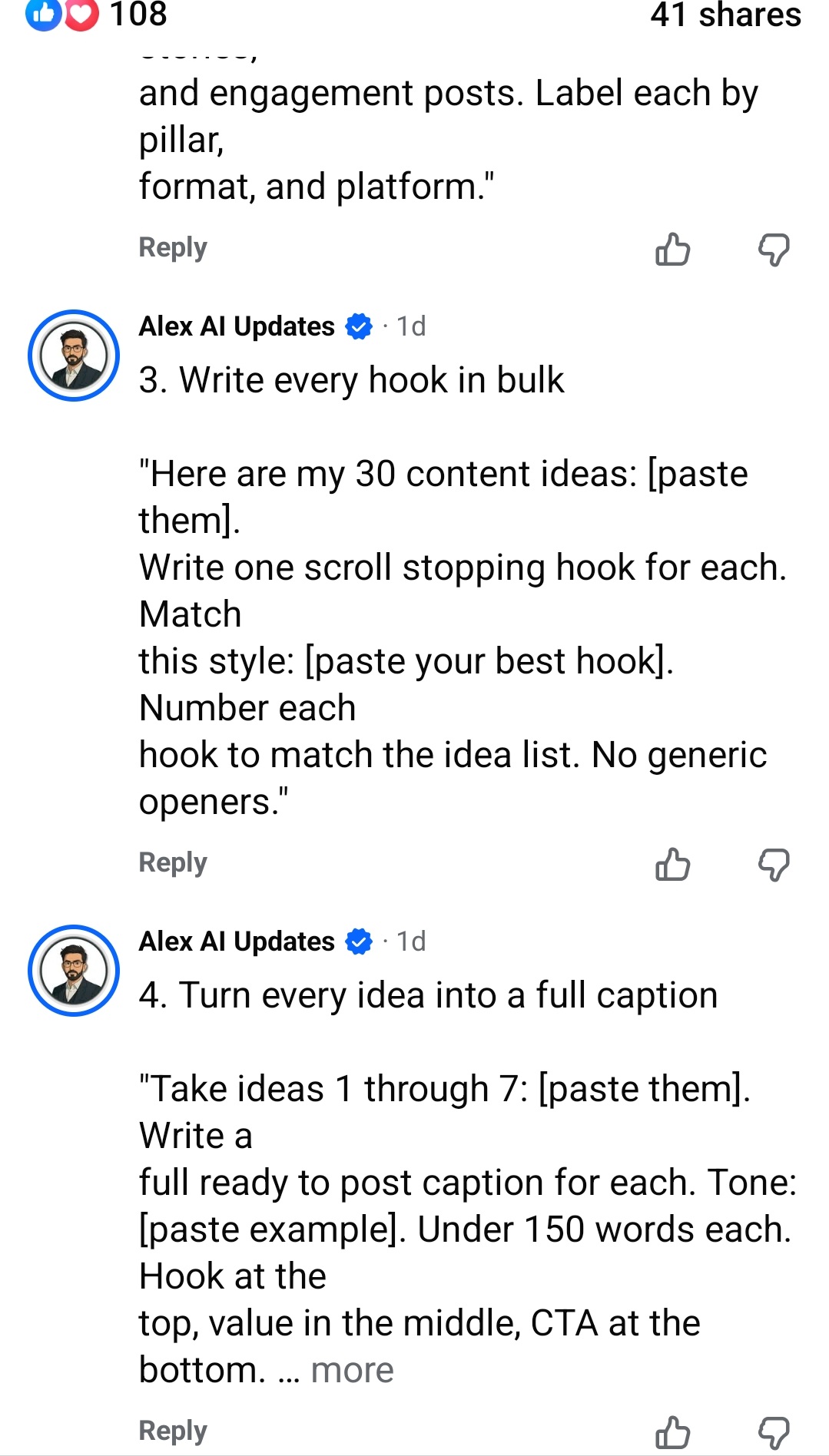
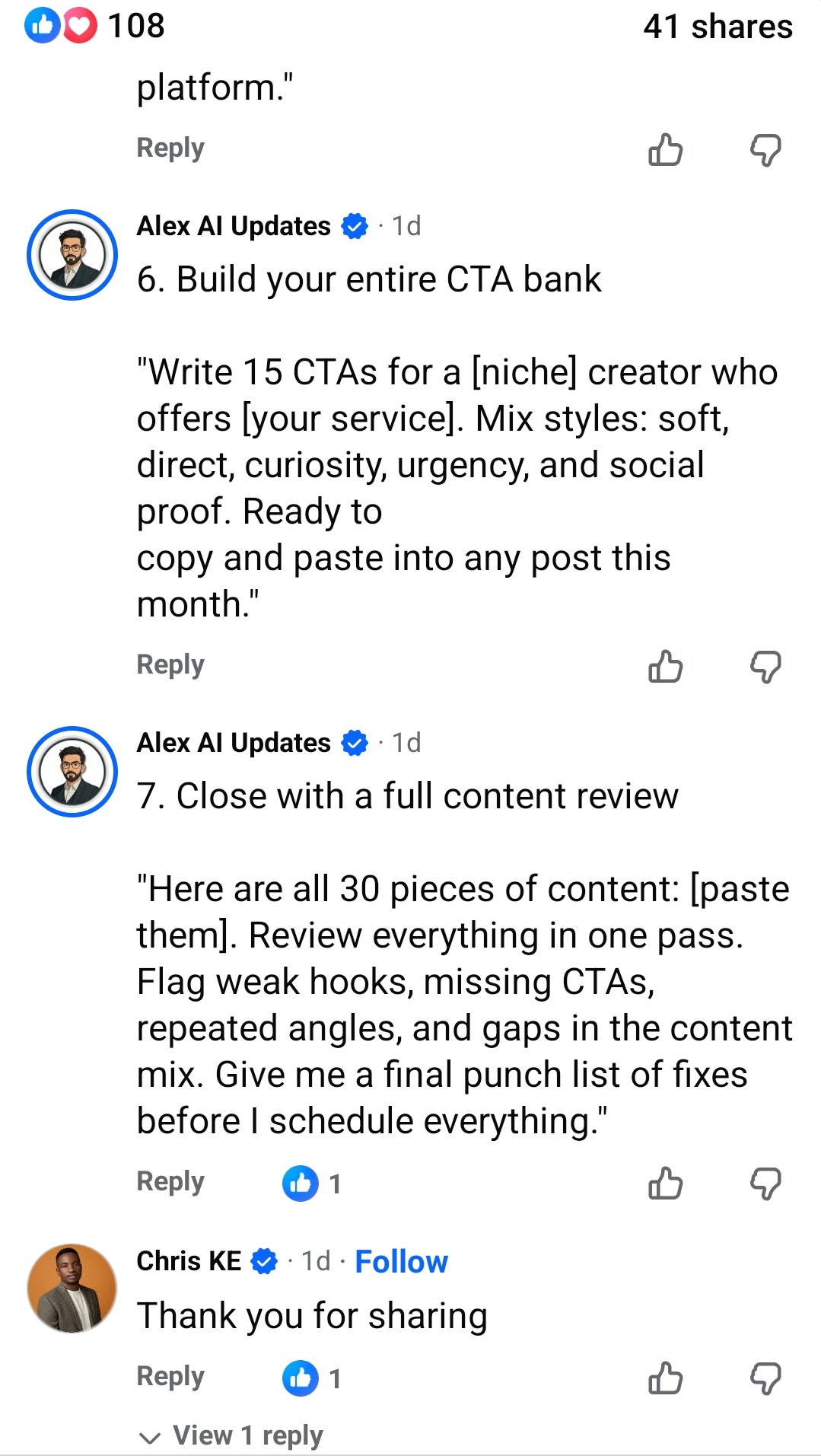
🔍 The Honest Breakdown — The Bundle Sid
This is where the framing starts misleading. Inspecting the $33+ Gumroad bundle, several products inside it are listed at $0 individually on the same store. You could grab them for free without paying anything. The paid items in the bundle have no review history — the "AI Financial Freedom Prompt Library — Replace Your $3K/Year Advisor" at $12 shows zero reviews, and the "50 Advanced Claude AI Prompts for Web Developers" at $12 also shows zero. These are paid items that aren't selling.
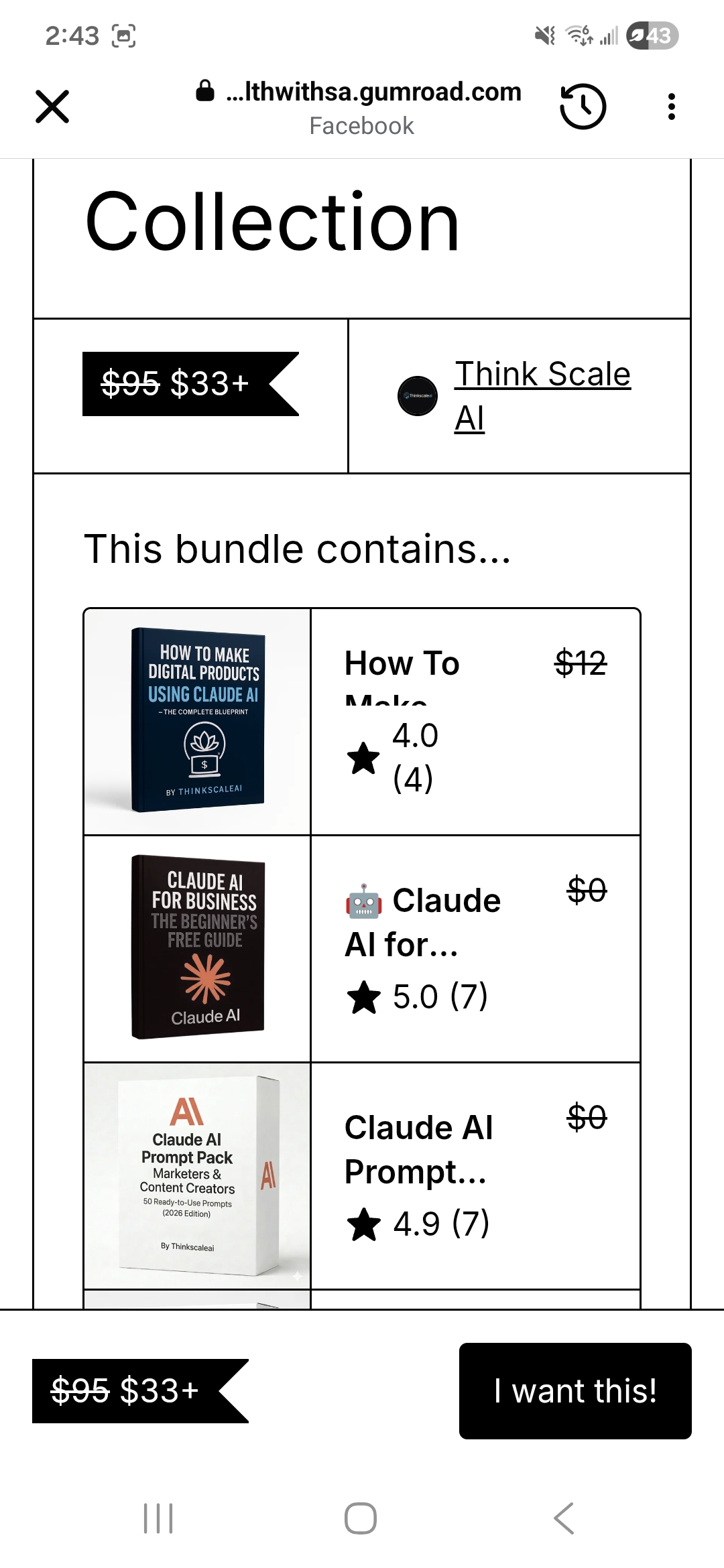
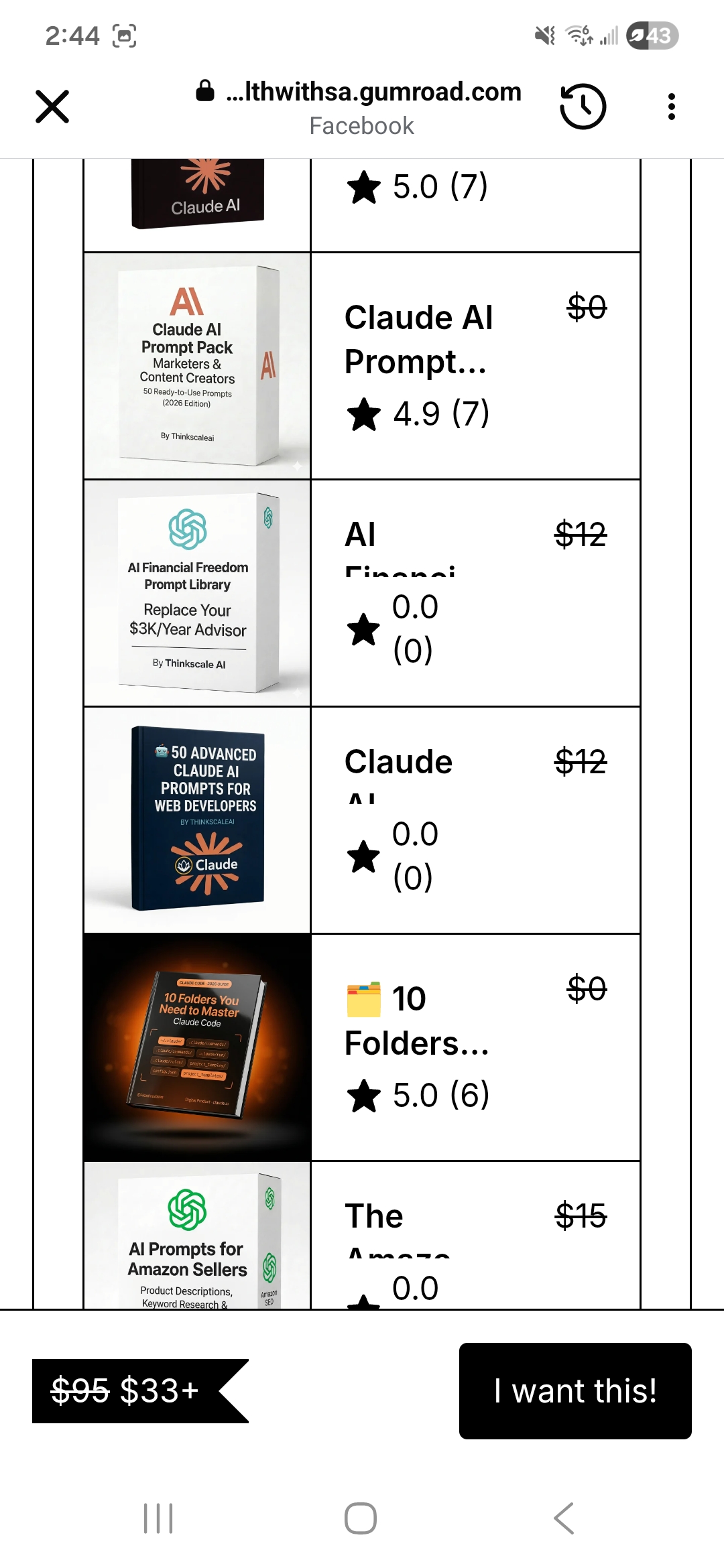
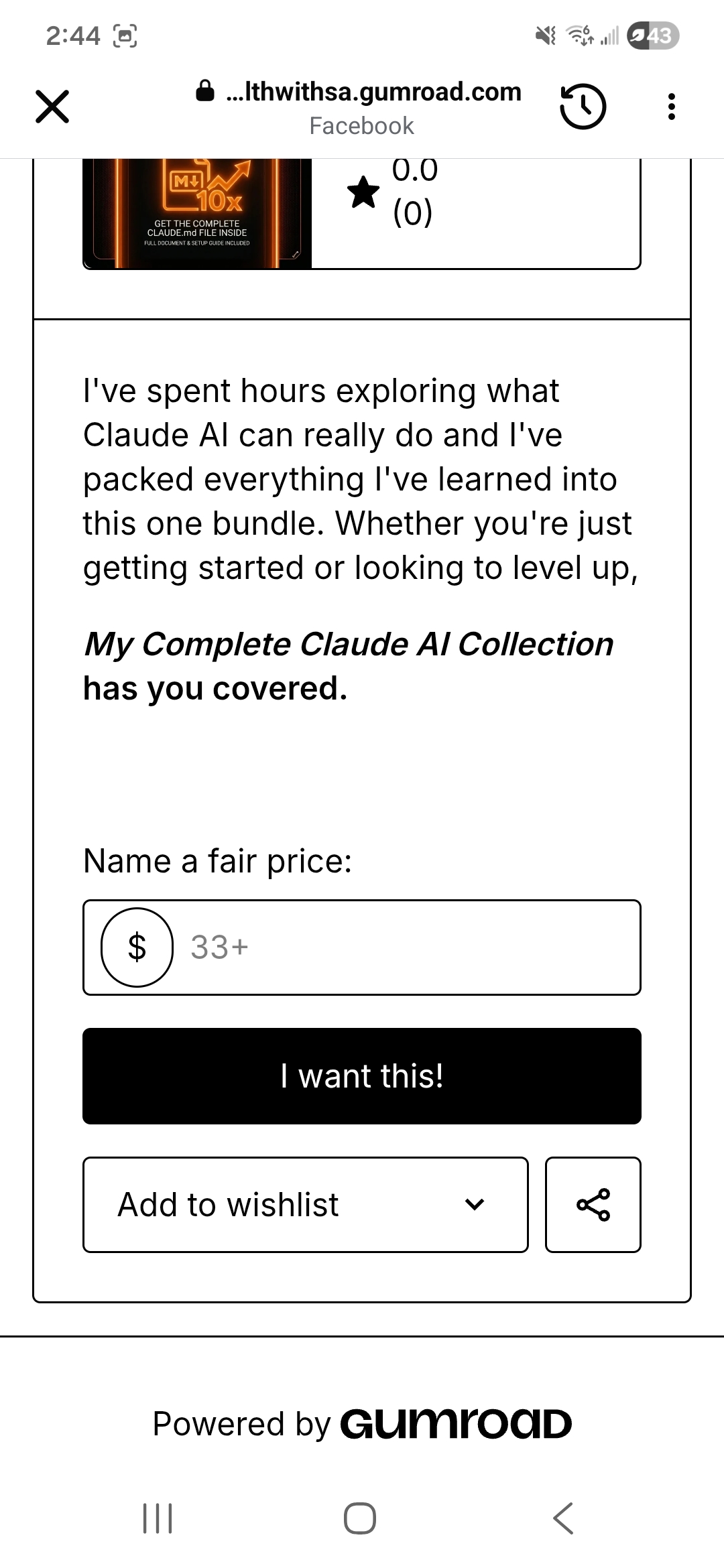
The $95 anchor is theatrical. Add up the actual paid items honestly and you get nowhere near $95. And the "Name a fair price: $33+" pricing is a common Gumroad psychological lever — it makes buyers feel generous while the seller's minimum is locked in. Selling free items as part of a "$95 bundle now $33" is the kind of value-inflation that wouldn't pass an honest sniff test in any other industry. If a grocery store advertised a $95 basket for $33 and half the items were free at the entrance, people would notice.
✅ Pros & ❌ Cons
PROS
✅ The seven free prompts in the comment thread are genuinely usable
✅ The content workflow is in a sensible order
✅ Includes real prompt-engineering technique (style references)
✅ Free entry — no payment needed for the actually useful part
CONS
❌ "Drop I WANT" is engagement bait, not generosity
❌ Bundle includes free items priced as paid value
❌ $95 strikethrough anchor is theatrical, not real savings
❌ Paid items in the bundle have zero buyer reviews
❌ Three brand identities across one operation
❌ Funnel routes everything toward higher-ticket upsells
⚙️ The Real Mechanic
Here's where it gets interesting. The ebook bundle isn't the actual product. The Facebook page is. Posts like "Drop I WANT" are engagement-bait designed to do one thing — harvest comments. Comments boost the post in Facebook's algorithm. Boosted posts grow the page. Pages with high engagement become assets that can be sold, monetized through Meta's creator programs, used to push affiliate links, or used to launch higher-ticket offers down the line.
The economics line up. The free ebooks cost the seller almost nothing to produce. The cheap paid ebooks ($9 to $15) confirm a customer's wallet for future upsells. The mid-priced bundle ($33+) is an impulse buy. The high-ticket items elsewhere on the store ($147 mega kit, $297 mentorship) are where the real margin is. The free Facebook post does the heavy lifting for the entire funnel. It's not a generous gesture. It's the front door of a sales operation, and the operation is more valuable than any single product in it.
This is the part most readers miss. They assume the seller's income comes from the ebooks. It doesn't. It comes from the attention infrastructure that the ebooks help build.
📝 A Note On Free Content As Strategy
Not every free offer is a hustle. Plenty of legitimate businesses give away real value to build trust and earn future sales — that's how every craft, trade, and skilled profession has worked since long before the internet. A 3D modeler giving away STL files, a builder sharing a tiny home guide, a chef putting recipes on their blog, a mechanic posting diagnostic videos — those are honest free content. The free thing is real, took real work, came from real skill, and the eventual paid offer is something only that person can deliver because of their actual expertise.
The dishonest version produces AI-generated freebies, bundles them with fake price anchors, and points everything at a generic high-ticket offer that anyone could clone. The shape of the funnel looks similar. The substance is opposite. The way to tell them apart isn't to assume everyone selling something is hustling you. It's to ask whether the free thing is a demonstration of skill, or a lever in a marketing machine.
🛠 What To Do Instead
Free prompts are genuinely free everywhere — Anthropic, OpenAI, and countless legitimate educators publish prompt guides written by people who actually use the tools daily. Learn the underlying patterns once, and you don't need bundles. Watch for the funnel, not the product. A standalone $20 ebook is just an ebook. A "$95 bundle now $33" with a Facebook page driving traffic to it and a $297 mentorship at the top of the catalog is a funnel. Ask yourself — would this exist if it didn't have a follow-up offer behind it? If yes, it's probably a real product. If no, the freebie is bait.
⚖️ Verdict
Not a scam, but a clear example of how dishonest hustle funnels are structured. The Facebook post itself is mild — even mildly useful — but it's the front door of a larger machine that uses theatrical pricing, free items dressed as paid value, and a multi-tier upsell ladder to convert attention into revenue. The biggest payday isn't in the ebooks at all. It's in the page traffic the funnel generates, the email list it builds, and the high-ticket offers that traffic eventually feeds.
The internet has plenty of honest creators giving away real value to earn real trust and eventually sell real things. It also has machines built to look like that, while delivering a fraction of the substance. The difference isn't whether someone's selling. It's whether what they're selling came from real work, or from running a prompt and packaging the output. Once you can spot the difference, the funnels stop working on you. And that's the whole point of paying attention to how they're built.
📌 Heads Up: Disclaimer
This review is not a personal attack on Alex AI Updates or the seller behind Think Scale AI. I don't know them personally. What's being reviewed here is the post, the funnel structure, and what gets delivered to the buyer. Real names, page handles, and screenshots are included because honest reviews need real examples. If anyone wants to push back, correct the record, or show verified results, the door is always open.
📢 Disclosure
Some links in this review may be referral or affiliate links. If you sign up or make a purchase through them, HonestHustles may earn a small commission at no extra cost to you. This helps support the site and allows us to keep reviews honest, independent, and ad-light.
Alex AI Updates Review – The "Drop I WANT" Funnel Explained
A Facebook post offers seven free prompts. The catch sits behind the "Drop I WANT" comment trap and a Gumroad bundle of mostly free items priced at $33. The page is the product, no…
💰 Think Scale AI Gumroad Store Review – AI Prompt Packs or Recycled Hype?
This one came up while digging into AI hustle Facebook posts. The trail led to a Gumroad storefront branded as "Think Scale AI" — though the URL says "digitalwealthwithsa" and the seller signs as SA. Three identities for one shop. That alone is worth a raised eyebrow. The store has about 25 products. AI prompt packs, ChatGPT guides, faceless content roadmaps, and a $297 mentorship at the top of the funnel. Standard Gumroad info-product playbook.
🪝 The Pitch and What You Actually Get
Pricing runs from free to $297, with most paid products in the $9 to $15 range. Headline claims include "10 ChatGPT Prompts That Replace a $300,000 Business Advisor" for $12, "AI Financial Freedom Prompt Library — Replace Your $3K/Year Advisor" for $12, and a "150,000 AI Prompts" mega kit at $147. If those claims sound a little too clean to be real, that's because they are.
What you actually get is PDFs. That's the core product across nearly the entire store. Each one is a list of ChatGPT prompts grouped around a theme — business advice, real estate marketing, cold outreach, Amazon selling, financial planning. The mega kit advertises 150,000 prompts. Nobody curates 150,000 of anything by hand. At that volume, the collection is either AI-generated in bulk or scraped from public prompt repositories. Either way, the value-per-prompt approaches zero.
🔍 The Honest Breakdown
The $300K advisor claim is the loudest one. Ten ChatGPT prompts cannot replace a $300,000 business advisor. A real advisor at that level brings experience, network, accountability, and judgement applied to your specific situation. A prompt brings a generic answer to a generic question, generated by a model that has never seen your books.
The "7-Figure Seller" prompts for Amazon at $15 sell the implication that the prompts produced 7-figure sellers. They didn't. Real Amazon sellers got there with capital, inventory, ad spend, and operational skill. Not a prompt PDF. The faceless digital roadmap is a recycled formula sold across thousands of Gumroad stores for the last two years.
✅ Pros & ❌ Cons
PROS
✅ The cheap PDFs do exist — you'll get a file when you pay $12
✅ A handful of free items have decent prompt structure to learn from
✅ Low entry price means a small loss if the product flops
✅ Useful as a "what does the AI hustle space look like" tour
CONS
❌ "Replace a $300K advisor" claim cannot survive a sniff test
❌ "150,000 prompts" is bulk-generated filler, not curated value
❌ Almost zero reviews on paid items — they aren't selling
❌ Hundreds of reviews on free items — those are just lead magnets
❌ Three different brand identities for the same store
❌ Funnel structure points everything at the $297 mentorship
🚫 The Review Pattern Tells The Real Story
This is the most revealing part of the storefront. The free products carry 191 reviews, 60 reviews, 32 reviews — high counts. The paid products mostly show 5.0 with one review, 5.0 with four reviews, or no rating at all. The $297 mentorship has nine reviews. The $147 mega kit has seven.
A legitimate paid product with strong delivery accumulates paid reviews over time. When the free stuff has hundreds of reviews and the paid stuff has single digits, it's telling you the free items are working as lead magnets while the paid items either aren't selling, or buyers aren't satisfied enough to come back and rate them. That's a giveaway most casual buyers never spot.
⚙️ The Real Mechanic
The storefront is a funnel. Free prompt guides pull people in and build the seller's email list. The $9 to $15 prompt packs serve as cheap impulse buys that confirm a customer's wallet. The $147 "all-in-one" kit and $297 mentorship are where the actual money is made. This is a textbook info-product funnel — not illegal, not even unusual on Gumroad. But the marketing hides the structure. The buyer thinks they're getting a $12 prompt pack to "replace a $300K advisor." What they're actually getting is entry into a funnel pointed at a $297 upsell.
🛠 What To Do Instead
Free prompts are genuinely free everywhere. Anthropic, OpenAI, and dozens of legitimate educators publish free prompt guides written by people who actually know what they're doing. Learn prompt structure once, not 150,000 prompts — good prompting comes down to a small number of patterns, and once you know them you can write any prompt yourself. Ignore "replace a [profession]" framing entirely, because AI doesn't replace professionals, it speeds up specific tasks. If you want a real mentor, vet them properly — verifiable results, named past clients, a track record outside their own Gumroad sales. Build your own prompt library as you work. Every time you craft a prompt that produces useful output, save it. In six months you'll have a personal prompt library worth more than any $147 kit.
The shortcut version: prompts are free. Skill in using them is not. Pay for the skill, not for the prompts.
⚖️ Verdict
Not a scam, but heavily oversold. The storefront is a working info-product funnel built on inflated comparisons, volume claims, and the implicit promise that AI prompts substitute for professional skill. The free items are bait. The cheap items confirm the wallet. The $147 kit and $297 mentorship are the actual product. Buyers expecting transformation get a PDF.
AI prompts aren't a product — they're a skill. Anyone selling you 150,000 of them, or telling you ten of them replace a six-figure advisor, is selling the illusion of a shortcut. Real outcomes come from real work applied with real skill. AI helps. It doesn't substitute.
📌 Heads Up: Disclaimer
This review is not a personal attack on the seller behind Think Scale AI / Digital Wealth With SA. I don't know them and for all I know they're a perfectly decent person. What's being reviewed here is the storefront content, the claims, and what actually gets delivered. The names, store URLs, and pricing are included because honest reviews need real examples. If the seller wants to push back, correct anything, or share verified results, the door is always open.
📢 Disclosure
Some links in this review may be referral or affiliate links. If you sign up or make a purchase through them, HonestHustles may earn a small commission at no extra cost to you. This helps support the site and allows us to keep reviews honest, independent, and ad-light.
Think Scale AI Gumroad Store Review – AI Prompt Packs or Recycled Hype?
A Gumroad storefront selling AI prompt packs, ChatGPT guides, and a $297 mentorship. The free stuff has hundreds of reviews. The paid stuff has almost none. That tells you everythi…
🎯 5 ChatGPT Prompts to Launch a YouTube Agency – Real System or Just Bait?
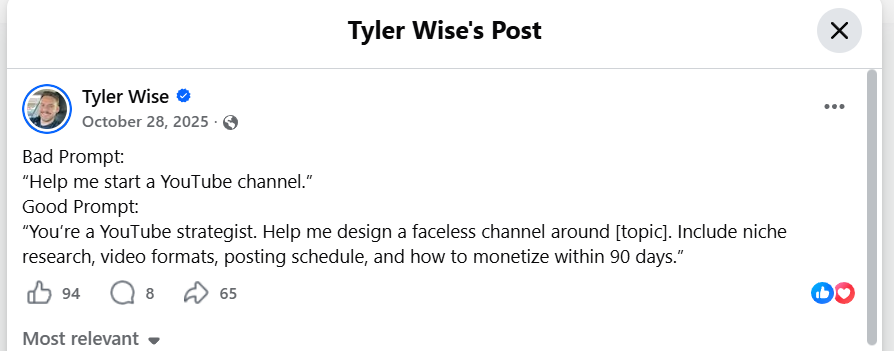
This one made the rounds on Facebook recently. A guy named Tyler Wise posted five ChatGPT prompts that supposedly turn your "basic skills" into a profitable YouTube consulting business. Five prompts. One business. Easy money. Yeah… not quite. I dug into it because the post hit my feed three times in two days and I figured if it was going to keep showing up, it deserved a proper look.
🪝 The Pitch and What You Actually Get
The post promises five copy-paste prompts that build out a YouTube agency from scratch. Service ideas, viral video research, content brainstorming, SEO optimization, and a client acquisition plan. Sounds like a complete system on paper. In reality, it's five sentences in a Facebook comment thread.
Each "module" is a one-line prompt of the "Act as a [job title]. Do [task] for [insert niche]" variety. You paste it into ChatGPT, you get a generic response, and the post implies you now have a business. The prompts technically work — ChatGPT will respond. The problem is what those words actually are.
🔍 The Honest Breakdown
The prompts are the kind of "act as an expert" templates that have been floating around since GPT-3.5. They produce generic, plausible-sounding output with no real edge over what anyone else asking the same thing gets.
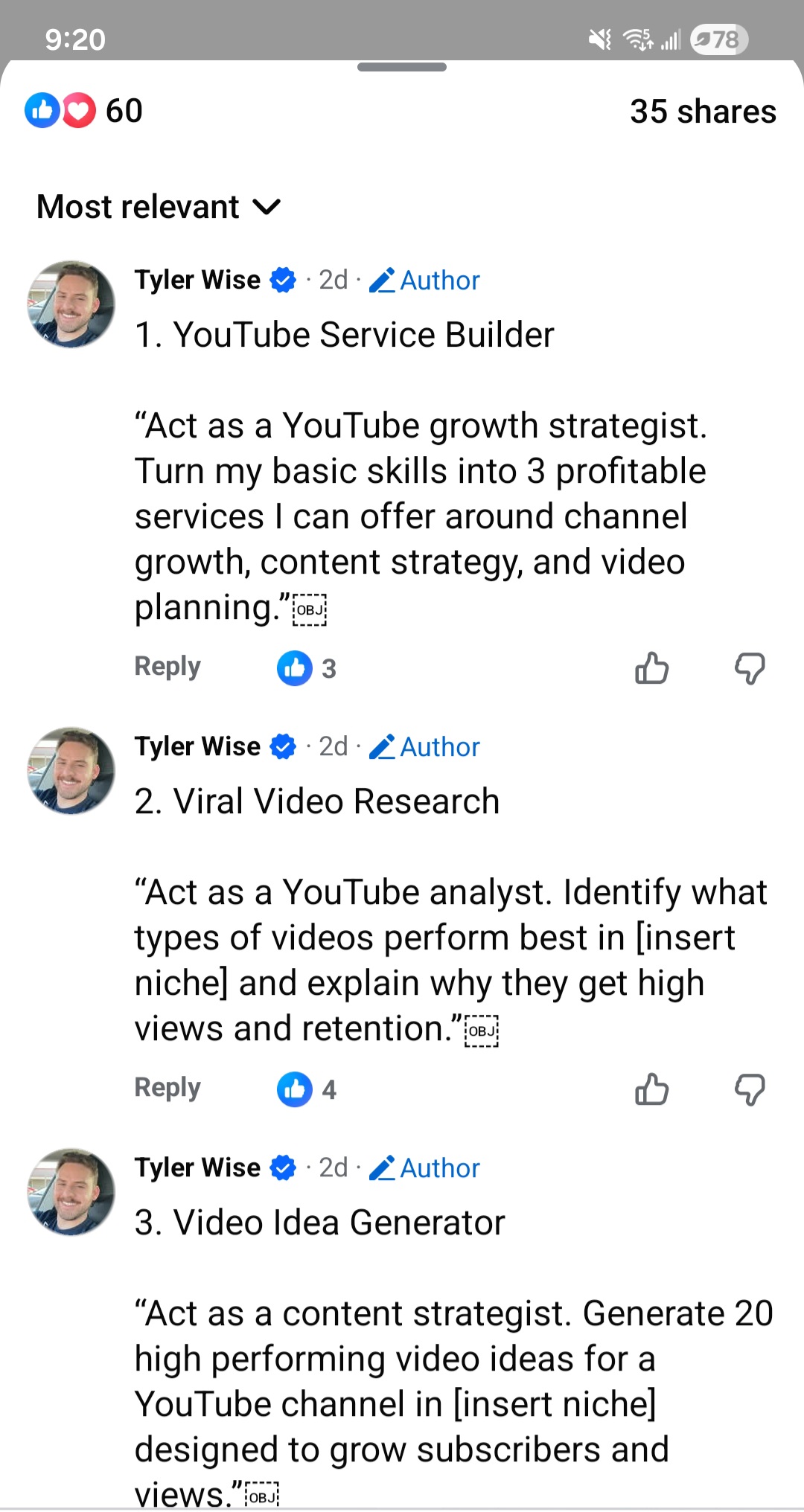
Specifically: the viral video research prompt doesn't work the way it's pitched, because ChatGPT does not have live YouTube data — it guesses based on training data that's already months or years old. The "profitable services" prompt assumes the AI knows what your skills actually are. It doesn't, so it invents three generic services that already flood Fiverr for $50. The client acquisition plan is the same "audit, outreach, free sample" advice that's been recycled since 2015. Anyone running these prompts ends up with the same recycled service ideas as everyone else who ran them.
✅ Pros & ❌ Cons
PROS
✅ The prompts technically run — you'll get output from ChatGPT
✅ Step 4 (SEO optimization) is the only one with practical use
✅ Free, takes thirty seconds to try
✅ Useful as a "what does an act-as prompt look like" intro
CONS
❌ No edge over what anyone else asking the same thing gets
❌ Step 2 (viral research) is built on data the AI doesn't have
❌ No proof Tyler runs the agency he's teaching you to build
❌ No income, timeline, client names, or case studies
❌ The whole thing is bait for a DM funnel, not a system
⚙️ The Real Mechanic
This is the part the post hides. Look at the comments — the pattern is people replying "interested" or "send me the info." Posts like this aren't selling the prompts. The prompts are the bait. The real product is whatever paid offer gets pitched in the DMs after you raise your hand. The five prompts cost Tyler nothing to give away, and they filter the audience for him. That's the actual business. The prompts are just the hook.
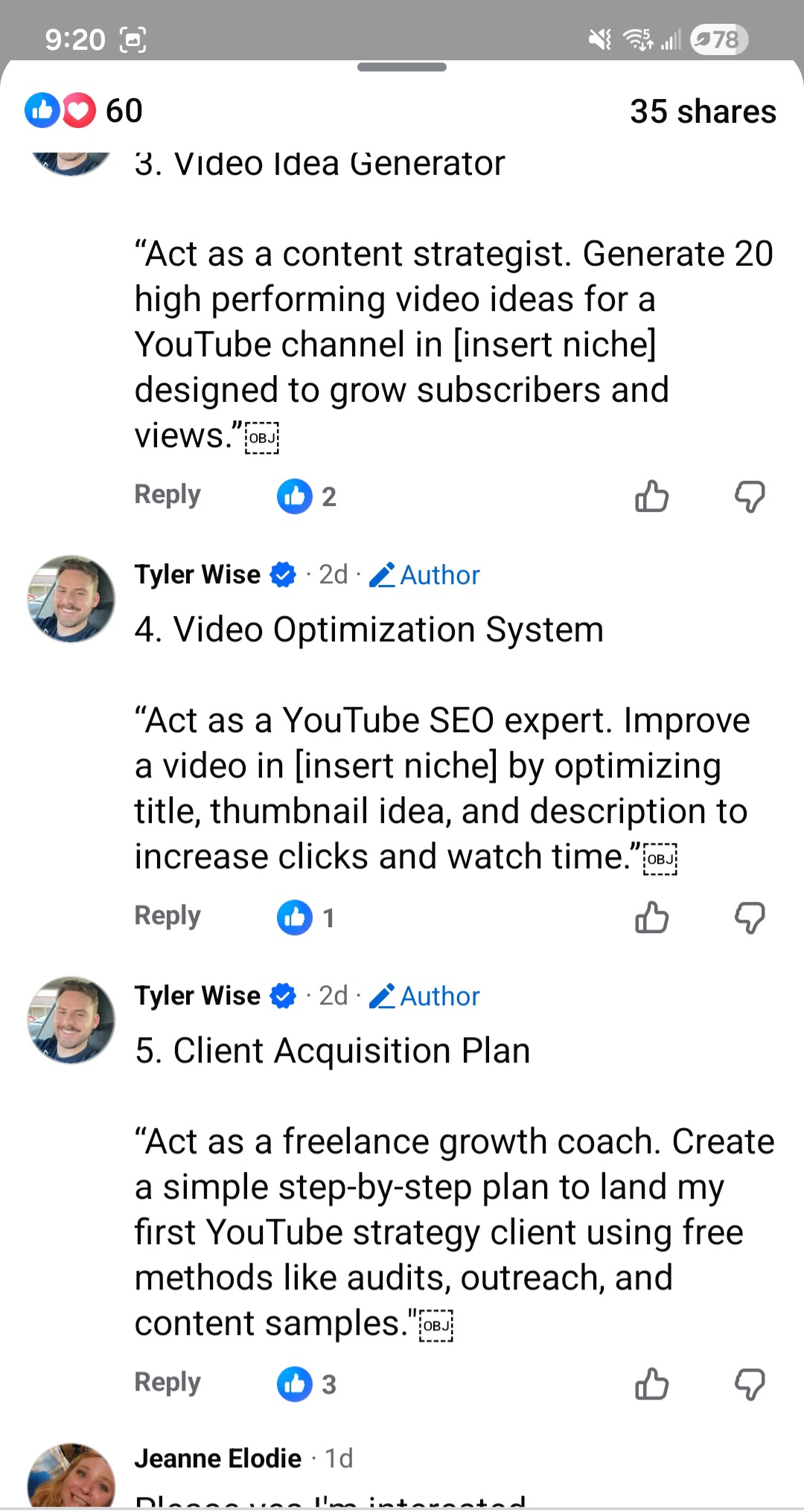
🛠 What To Do Instead
If the idea of using AI to build a YouTube-related side income actually appeals to you, here's the honest path. Pick a niche you already know something about — you can't credibly sell channel growth advice for a topic you've never touched. Grow your own small channel first, because even 500 honest subscribers gives you more credibility than 50 ChatGPT prompts. Use AI as a helper, not a product — brainstorming titles, outlining scripts, drafting descriptions, that's the honest use case. Get one result before selling results. Help a friend's channel for free, document what you did, track the numbers. Now you have a case study, which is the one thing every "agency builder" post on Facebook is missing. And expect a 6 to 12 month runway. Anyone who tells you otherwise is selling something.
The shortcut version: earn the skill first, then sell the skill. Prompts don't replace that order. They just hide it.
⚖️ Verdict
Not a scam, but not a business either. It's lead-bait dressed up as a system. The prompts are free, the value is thin, and the implied promise — "five prompts and you've got an agency" — quietly skips every hard part of running one.
Real income online is built the same way real income offline is built. Pick something you actually know, prove you can do it, then charge for it. AI is a useful tool in that process, but it's not the process. Anyone selling you the shortcut is usually selling the shortcut, not the result.
📌 Heads Up: Disclaimer
This review is not a personal attack on Tyler Wise. I don't know him personally and for all I know he's a perfectly decent guy off the internet. What's being reviewed here is the content of the post — the claims, the promises, and what actually gets delivered. Real names and screenshots are included because honest reviews need real examples. If anyone wants to push back, correct the record, or show real proof of results, the door is always open.
📢 Disclosure
Some links in this review may be referral or affiliate links. If you sign up or make a purchase through them, HonestHustles may earn a small commission at no extra cost to you. This helps support the site and allows us to keep reviews honest, independent, and ad-light.
5 ChatGPT Prompts to Launch a YouTube Agency – Real System or Just Bait?
A Facebook post promising five ChatGPT prompts that turn "basic skills" into a profitable YouTube agency. The prompts work. The business doesn't. Here's why the real product is you…
🤖 Claude AI Review: More Honest Than Expected, Less Fake Than Most
I started this whole thing by basically interviewing Claude and asking the obvious question: who's better — you or ChatGPT? To its credit, Claude did not come back with some fake alpha-sales answer. It admitted it had not "used" ChatGPT firsthand, said comparisons are subjective, and flat-out said any self-serving answer from itself should be taken with a grain of salt. That alone felt more honest than half the AI hype online. That was my first sign that Claude was at least willing to act like a tool instead of a salesman.
📚 Cutoff Date and Live Context
One thing Claude explained well was its cutoff date. It said its built-in knowledge only goes up to August 2025, because these models are trained on huge batches of data up to a stopping point and then released. They are not updated live like a website. It also explained why that happens in plain terms — retraining is expensive, takes serious compute, takes time, and has to be tested before a new version goes out. So instead of pretending it always knows current information, Claude said newer facts have to come from live search and tools layered on top. That matters, because a lot of AI hype falls apart right there. Plenty of tools still seem way too comfortable bluffing when they are outside their actual knowledge. Claude did not.
When I pushed on the cutoff issue, it did not try to dance around it. It explained the limitation clearly, said it could use live web search in that interface, and then actually checked HonestHustles. It came back with a real summary of the site — reviews, 3D printing, AI tools, store content, and the general "built and updated live" vibe — which told me it was actually reading what was there instead of just making polite noises. What impressed me most was how it handled newer information. I asked about things it should not have known from old training alone, and it answered based on what it had just read from my site. If an AI is using live context, it should act like it. Claude did. It did not try to bluff its way through like it had the answer stored in its brain all along. That gave it some credibility right away.
🧠 It Understood the Site Better Than I Expected
Claude figured out pretty quickly that HonestHustles is not just some slapped-together blog. It picked up on the custom admin area, Atlas Assistant, the radar and stats side, bot tracking, banners, and the fact the site has been built piece by piece over time. When I showed it Atlas Brain, it gave real feedback on the code structure, the routing, the typo handling, the security layer, and the limits of the current string-matching approach. That part felt like a legitimate second opinion, not just empty praise.
A lot of AI tools are pretty good at sounding supportive while saying almost nothing useful. Claude actually felt like it could step into the project, look around, and tell me where the weak points were without acting like everything was brilliant.
😄 Tone and Real Value Delivered
Where Claude really stood out was tone. It felt more natural and less stiff than I expected. More importantly, it was willing to admit limits. It said it could not inspect ZIP files directly in a basic chat flow. It admitted it would be weaker as a long-term project partner because it could not carry continuity the same way a longer-running workflow can. Weirdly, that made it more trustworthy. A tool that admits where it falls short is easier to respect than one that acts like it can do everything. There was also just something about the personality that felt easier to work with in certain moments — not better at everything, not magical, but more natural, a little funnier, and less robotic. That stuff matters when you are working late, tired, and already annoyed before you even start.
To be fair, Claude did deliver real value. I got useful SEO and meta cleanup out of it. It helped with Atlas-related improvements. It gave useful feedback on the codebase and, because it could work with live site context, it sometimes felt sharper on site-reading tasks than I expected. This was not one of those cases where the AI sounded smart but gave me nothing useful. It actually helped. And one of the coolest parts was the more direct folder-and-terminal style workflow. When Claude is connected closer to the actual files and environment, you can feel the difference. That kind of setup is genuinely powerful and is one of the biggest things it has going for it from a practical development standpoint.
🧱 More Than a Tool Test
This also turned into more than just a simple AI comparison. We ended up talking about Atlas, local AI, Ollama, building something I could actually call mine, losing work to drift and OneDrive nonsense, the site as an exit plan, the plant job, surgery recovery, burnout, and the general reality of trying to build a second life after work hours when your body and patience are both running low. Claude did not magically fix any of that, but it did something useful — it responded like it understood there was a real person behind the questions and a real reason the project matters. That goes a long way. It is easy to dismiss this stuff as fluff, but it is not fluff when the project is personal. A tool that can follow the emotional reality behind the work without turning into cringe motivational sludge is actually more useful than people give it credit for.
✅ Pros & ❌ Cons
PROS
✅ Honest about its limits — admitted what it didn't know
✅ Actual second-opinion value on code structure and SEO
✅ Live web search and site reading worked properly
✅ Tone is natural, less robotic than most
✅ Folder/terminal style workflow is genuinely powerful
CONS
❌ Usage limits hit fast and break momentum on real project work
❌ Pricing tiers jump steeply once Pro stops being enough
❌ API pricing is not a casual fallback either
❌ Weaker continuity for long-running projects vs an established build partner
❌ Limited ZIP/file workflow in basic chat
🚫 The Real Problem: Limits and Pricing
Now for the part that changed the review. The biggest weakness is not intelligence. It is the product limits. I hit Claude's usage limits multiple times over multiple nights, fast enough that it changed the whole experience. That is a serious problem for anyone trying to do real project work instead of just dabbling for a few minutes. A tool can be smart, funny, and helpful, but if it keeps slamming into walls in the middle of useful sessions, that becomes the thing you remember most. Instead of feeling like I was using a serious paid tool, it started to feel like I was renting access in little chunks and hoping I would not bump into the ceiling again before I finished what I was doing. That gets old very quickly.
The follow-up problem is the pricing behind the workaround. Once I looked at Anthropic's pricing more closely, the answer was basically — pay a lot more if you want breathing room. Claude Pro is priced in a way that sounds reasonable at first. The problem is what happens when that plan stops being enough. The jump up to the higher individual plans is steep — steep enough that a normal person doing real project work can look at it and immediately think, "yeah, that's not happening." And if you look at the API side, the meter does not suddenly become casual there either. Once you start talking about token pricing and extra tool usage, you are into a different kind of cost planning altogether. So the problem is not just that limits exist. The problem is that the "real breathing room" path gets expensive fast. That changes the whole feel of the product. Instead of thinking "this is a capable tool I can grow into," you start thinking "this is a capable tool that becomes annoying or expensive the second I actually lean on it." That is a very different feeling.
⚖️ ChatGPT vs Claude: My Honest Take
So no, Claude is not replacing ChatGPT for me. ChatGPT is still the long-running workhorse in my world — site building, images, weird project hopping, late-night debugging, all of it. The continuity matters. The ability to keep a long thread alive matters. The ability to keep carrying project state without constantly feeling like I am restarting the relationship matters. Claude itself more or less proved why switching AI partners midstream would probably create more problems than it solved.
That said, it absolutely earned a place as a second opinion AI. As a grounded outside read, as a tool for live site inspection, as a sharper less padded voice when I want a different angle, as something that can look at code, structure, and workflow from a slightly different direction — yeah, it did better than I expected.
🏁 Verdict
Claude earned respect. Not because it felt magical, not because it "won," and not because I suddenly think every other AI should pack up and go home. It earned respect because it felt more honest than expected, more grounded than most, and a lot less full of crap than I thought it would be going in. It gave me real value. It helped with actual SEO and meta work. It helped move Atlas forward. It showed real strengths in live-context use, code feedback, and overall tone. But the limits and pricing undercut the experience in a big way.
That is the catch. Claude is good enough to make you want to keep using it. The problem is its usage model can make you feel punished for actually doing so.
Best traits: honesty, tone, live-context use, real code feedback, and willingness to admit limits.
Weak spots: restrictive usage caps, expensive higher tiers, weaker long-session continuity, limited ZIP/file workflow in basic chat, and not a full replacement for a deeply established build partner.
Worth testing, especially as a second-opinion AI. Technically impressive in a lot of ways. Commercially frustrating faster than it should be.
📢 Disclosure
Some links in this review may be referral or affiliate links. If you sign up or make a purchase through them, HonestHustles may earn a small commission at no extra cost to you. This helps support the site and allows us to keep reviews honest, independent, and ad-light.
👉 Try Claude AI — https://claude.com/pricing
Claude AI Review: More Honest Than Expected, Less Fake Than Most
I tested Claude expecting the usual AI dance: polished answers, a little ego, and a lot of fake certainty. Instead, it surprised me. It admitted what it did not know, used my site …
🖨️ Anycubic Kobra X – Multicolor Done Right
What Sets the Kobra X Apart
- 4-color printing out of the box (expandable to 19 colors)
- Faster print speeds with less material waste
- Excellent first layer consistency
- AI detection and remote monitoring

🧠 Honest Take
I’ve been running the Kobra 2 Pro as my main comparison machine, and right off the bat — the Kobra X is NOT a major upgrade in size. It’s only slightly bigger.
👉 The real upgrade here is multicolor printing.
Compared to the Flashforge color printer I’ve been using, the Kobra X is on another level:
- ✔ Way quieter
- ✔ Noticeably faster print times
- ✔ Material waste is significantly reduced
- ✔ Overall smoother operation
This thing is easily 2x the machine compared to what I was using before for color work.
🔥 What Stands Out
The ACE GEN2 system is where this printer really changes the game.
- 4-color printing out of the box
- Expandable up to 19 colors
- Handles multi-material (PLA + TPU + PVA)
- Faster color swaps with less waste
- Actually usable — not just a gimmick
Speed is no joke either:
- ~300mm/s recommended
- Up to 600mm/s peak
💬 Real Opinion
If I’m being straight — I’d trade my other 3 printers for this one without thinking twice.
👉 It’s one of those machines where you stop fighting the printer… and just focus on printing.
⚠️ What I’d Like to See Next
- A MAX version with a larger build plate
- Future multi-head support
If Anycubic adds those — this thing could dominate.
🏁 Final Verdict
This isn’t about size — it’s about capability.
And for multicolor printing right now?
👉 The Kobra X delivers.
Ratings
- Print Quality: ⭐⭐⭐⭐⭐
- Ease of Use: ⭐⭐⭐⭐⭐
- Speed: ⭐⭐⭐⭐⭐
- Value: ⭐⭐⭐⭐⭐
🧠 BS Check
This is one of the few “AI / next-gen” printers that actually delivers on the claims.
👉 Not hype — it’s legit.
📢 Disclosure
Some links in this review may be referral or affiliate links. If you sign up or make a purchase through them, the site may earn a small commission at no extra cost to you. This helps support HonestHustles and allows us to keep reviews honest, independent, and ad-light.
Anycubic Kobra X
🖨️Not a huge jump in size from the Kobra 2 Pro, but where the Kobra X wins is color printing. Faster, quieter, and way less waste — easily the best multicolor printer I’ve used so …
🖨️ Selling STL Files Online – I Tried It. Here's the Honest Story.
Selling STL files online is one of those side hustles that gets pitched all the time — design a 3D model, upload it, watch downloads roll in while you sleep. Passive income with no inventory and no shipping. I gave it a real try. Here's what actually happened, including the receipts.
🪝 Why I Tried It
I was looking for a way to make some Christmas money a couple months back. ChatGPT suggested selling STL files. The pitch sounded good — I already run multiple 3D printers, I've sold finished prints offline, and adding a digital revenue stream on top of that seemed like a no-brainer. So I uploaded a couple of designs to Cults3D to test the water. The plan was to add more once I saw it working.
It didn't.
📊 What Actually Happened
Two designs uploaded. A "Gargoyle Santa" and a "Classic Standing Santa Claus." Both listed at €0 to test the platform. Between them I got 294 views, zero likes, zero downloads, zero dollars.
That is the actual screenshot from my Cults3D account. Not a stock photo. Not someone else's results.
For comparison, my offline 3D printing business sold four full chess sets with custom resin boards in the same time period. The offline side worked. The STL marketplace side made me exactly nothing.
⚙️ Why It Didn't Work
A few honest reasons.
The market is huge and crowded. Cults3D, Printables, MakerWorld, Thingiverse — every one of them is full of free models. If your design isn't either unique, useful, or attached to a name people already know, it gets buried in the feed with thousands of other models. Two seasonal Santas from a brand-new account with no following don't stand a chance.
I underestimated the skill ceiling. I went in thinking it would be plug-and-play. It is not. To actually make sellable STLs you need to learn modeling software like Fusion 360 or Blender, you need to understand slicer settings and how those affect printability, you need to test prints across different printer types, and you need to know what variables make a model someone else can actually print without it failing. None of that is taught in a "make passive income with 3D files" Facebook post.
The original suggestion was hype. ChatGPT pitched it as a Christmas money idea and I ran with it. In hindsight, that's exactly the kind of generic hustle suggestion that an AI gives when it doesn't know your situation, your market, or your timeline. Lesson learned — every "easy money online" suggestion deserves a sniff test before you spend hours on it.
✅ Pros & ❌ Cons
PROS
✅ Genuinely zero inventory or shipping
✅ Real platforms exist and do pay creators with traction
✅ A digital file can be sold or downloaded forever once it's up
✅ Skills transfer to your offline 3D printing business if you have one
✅ Free designs build credibility and exposure even if they don't pay directly
CONS
❌ The market is saturated — unique designs are the only ones that move
❌ Real skill curve in modeling software, slicers, and printability testing
❌ Brand new uploads from an unknown creator get buried fast
❌ Design theft is common — people complain constantly about ripped files
❌ Very little you can do about theft unless you're a major brand
❌ Income is realistically months away even if you do everything right
🛡️ The Theft Problem Nobody Warns You About
One thing I noticed in maker communities is the constant complaining about people having their STLs ripped off and resold without royalties. It is a real problem. And honestly, my read on it is this — unless you're Disney or a major brand, there is not much you can do about it. Once a file is on the internet, it's up for grabs. That is the unspoken cost of selling digital files. You either accept it as part of the deal or you don't sell digital files at all.
🛠 What I'd Tell Someone Thinking About This
If you don't already 3D print, don't start by trying to sell STLs. The skill stack underneath is bigger than the pitch makes it sound. Learn to print first, learn to model, learn what makes a file printable on someone else's machine.
If you do already print, sell physical prints first. That's where my actual income came from — four chess sets with resin boards, sold offline, real money in hand. That's where the demand is right now for someone at my level.
Treat STL marketplaces as a long-term exposure play, not a Christmas-money sprint. Free uploads can build a small audience over months or years. That audience eventually becomes your buyers if you decide to sell premium designs later. But "upload and earn" in a few weeks? Not realistic.
And if a generic "easy money idea" comes from any AI — yours or someone else's — sniff-test it before sinking time. The model doesn't know your skills, your market, or your timeline. It just knows the pitch.
⚖️ Verdict
Selling STL files is a legitimate hustle for someone with real modeling skill, a unique design portfolio, and the patience to grow an audience over months. It is not a quick income source for a beginner. The marketplaces are real and pay creators who break through, but the breakthrough is harder than the marketing makes it sound.
I'm leaving my two free Santa designs on Cults3D as exposure pieces, but the real money in 3D printing for me has been the offline side — actual prints, actual customers, actual sets. That is the honest answer for anyone in my shoes.
Earn rating: 1/5 — I made zero dollars on this side of it personally
Time rating: 3/5 — modeling and prep takes real hours
BS rating: 3/5 — the hustle pitch is misleading, but the platforms and the model itself are legitimate
Verdict: Overhyped for beginners, legit for skilled designers with patience
📌 Heads Up: Disclaimer
This review is not a personal attack on Cults3D or any other STL marketplace. I don't have a problem with the platforms themselves — they're legitimate businesses that pay creators with traction. What's being reviewed here is the honest reality of trying to make money from STL sales as a beginner, based on my own actual results. The screenshots and numbers are mine. If anyone has had a different experience and wants to share, the door is open.
📢 Disclosure
Some links in this review may be referral or affiliate links. If you sign up or make a purchase through them, HonestHustles may earn a small commission at no extra cost to you. This helps support the site and allows us to keep reviews honest, independent, and ad-light.
Selling STL files
🧩 Selling STL files has become a popular way for makers and 3D printing enthusiasts to earn money online. Instead of selling physical prints, creators upload digital models that cu…
🎥 AI Money Guru Accounts – Real Advice or Engagement Farming?
You've seen these. The fast-cut TikToks. The Reels with the dramatic zoom-ins on a screenshot. The YouTube Shorts where someone in a rented Lamborghini explains how AI is going to replace your job tomorrow. AI money guru content has exploded across short-form platforms, and most of it follows the exact same formula. Bold promise. Quick demo. Vague link to "the full system." Repeat.
The question isn't whether these accounts exist. They're everywhere. The question is whether any of the advice actually works, or whether the entire format is just engagement farming dressed up as financial advice.
🪝 The Pitch You Keep Seeing
The hooks repeat across thousands of accounts because they work. "Turn ChatGPT into your personal ATM." "AI can replace your job." "Copy this prompt and make money today." "Make passive income while you sleep." "Start this AI side hustle with no skills."
Different creators, same script. The format itself is the giveaway. Short, flashy, designed to stop your scroll and trigger the part of your brain that thinks you might be missing out on something easy.
🔍 How These Accounts Actually Work
Most AI money videos follow the same three-beat structure.
First beat: a bold promise or shocking statement to create urgency. "I made $10K this month using ChatGPT and you can too." "Most people don't know about this AI trick." "This is going to disappear soon."
Second beat: a quick demo. Maybe a ChatGPT prompt that spits out a website outline. Maybe an AI image tool generating a logo. Maybe a no-code automation building something that looks impressive in fifteen seconds. The demo is always simplified to the point of being misleading. The hard parts are skipped.
Third beat: the funnel. Link in bio. Discord group. Newsletter. Prompt pack. $47 course. $297 mentorship. The video isn't the product. The video is the bait.
In most cases, the actual money-making method being shown isn't even what the creator earns from. The creator earns from selling access to the tutorial, the prompts, the course, or the community. Their proven income stream is teaching the dream, not living it.
🚀 Why This Content Spreads So Fast
The format hits everything social media algorithms reward. Fast hooks. Easy-to-understand promises. Screenshots of tools doing impressive things. Dreams of quick money. Low attention-span friendly formats.
AI also still feels new and powerful to most people, so creators can frame almost any AI tool as a secret shortcut. That makes the pitch land harder than it should.
This doesn't mean every creator is dishonest. Some accounts genuinely share useful ideas, real workflows, and beginner-friendly tools. But the format itself strips out the boring-but-essential part of every business story — the actual work.
🛠 What AI Can And Can't Actually Do
AI can absolutely help people. It speeds up content creation, automates repetitive tasks, brainstorms ideas, improves design work, drafts copy, builds simple websites, and tests ideas faster than ever before. That part is real.
What viral AI money videos leave out is that AI helps with execution, not with magically creating a real business out of nothing. The hard parts haven't changed. Finding a real problem people will pay to solve. Building something useful enough to stand out. Marketing it to the right people. Earning trust. Handling competition. Dealing with refunds and support. Keeping the product relevant as the market shifts.
A person can generate prompts, write product descriptions, make AI images, or build a one-page website in an afternoon. None of that guarantees buyers, traffic, trust, or income. AI is a tool, not a replacement for the work.
✅ Pros & ❌ Cons
PROS
✅ Some creators do point toward legitimate AI tools worth trying
✅ The volume of content means you'll occasionally find something useful
✅ Free entry point — no purchase needed to learn the basics
✅ AI tools demonstrated in the videos are usually real
✅ Good for sparking ideas if you take them as inspiration only
CONS
❌ Most accounts oversell what AI can actually do alone
❌ Income screenshots without context prove nothing
❌ Vague instructions skip the hard parts on purpose
❌ Most videos funnel into paid courses or communities
❌ A lot of the "AI advice" is just old online hustle ideas repackaged
❌ Format rewards confidence over accuracy — the loudest take wins, not the truest one
🚩 Common Red Flags
A few patterns should make anyone slow down before clicking the link in bio.
Income claims with no process. Screenshots of earnings without showing how the money was made. A real method shows the steps. A bait video shows the result.
Vague instructions. If the advice sounds impressive but skips every place where real skill, effort, or risk would normally exist, that's the giveaway. "Just use this prompt and you're done" is never the whole story.
The funnel is the product. If most of the video points toward a course, group, or paid resource, the creator's actual income stream is probably the funnel, not the method being taught.
Recycled advice with AI branding on top. A lot of AI hustle content is the same online money ideas that have been around for ten years, just rewritten with "ChatGPT" or "Claude" stuck in the title.
⚙️ The Real Mechanic
The whole AI money guru ecosystem runs on the same underlying mechanic as the rest of the online hustle world — attention is the actual product. The videos exist to grow the account. The account exists to drive traffic to a paid offer. The paid offer exists because the creator figured out that selling the method is way more reliable than running it.
That's not a unique insight. It's how the entire info-product industry has always worked. AI didn't invent it. AI just made it easier to produce more content faster, which means more accounts, more videos, more bait, and more noise drowning out the few creators actually trying to teach something useful.
🛠 What To Do Instead
Treat AI money content as inspiration, not instruction. If a video sparks an idea, fine. Use it. But don't take the video itself as a plan.
Test before you spend. Most "AI side hustles" can be tested for free. ChatGPT, Claude, free AI image tools — they're all available without paying anyone. If a creator wants $97 to teach you how to use a free tool, the math doesn't work.
Sniff-test the creator. Has the person actually built the business they're teaching, or is teaching the business? You can usually tell by how specific they get when pressed for real numbers.
Expect a runway. Anything that pays off online takes months, not days. Anyone telling you "start tonight, make money tomorrow" is selling something.
Use AI for what it actually does — speed up real work, not replace real work. Drafting, brainstorming, automating, organizing. That's where AI earns its keep. Generating "passive income" by typing a prompt is the part that doesn't work the way the videos suggest.
⚖️ Verdict
Most viral AI money guru content is engagement farming first and truth second. Some creators do point people toward legitimate tools and real starting points. The problem is that short-form video turns complex business work into a misleading "copy this and get paid" fantasy, and that fantasy creates unrealistic expectations for beginners who assume AI removes the need for skill, testing, patience, and consistency.
AI is genuinely useful. It's a real tool for real work. It's just not a magic switch that prints income. Anyone selling it that way is selling the pitch, not the result.
Treat the content as inspiration at most. The work is still the work, and AI doesn't do it for you.
📌 Heads Up: Disclaimer
This review is not aimed at any single AI money guru account. It's a category review covering the general format that has spread across TikTok, Reels, YouTube Shorts, and similar platforms. There are real creators in this space sharing useful ideas, and the goal here isn't to dismiss all of them. The goal is to help readers spot the difference between genuine guidance and engagement farming. If a creator wants to push back on this take or show real verified outcomes from their methods, the door is always open.
📢 Disclosure
Some links in this review may be referral or affiliate links. If you sign up or make a purchase through them, HonestHustles may earn a small commission at no extra cost to you. This helps support the site and allows us to keep reviews honest, independent, and ad-light.
AI Money Guru Accounts – Real Advice
⚠️ Social media is full of accounts claiming artificial intelligence can generate easy passive income. We looked at one example to understand how these “AI money gurus” actually ma…
AI Money Guru Accounts – Real Advice or Engagement Farming?
Across TikTok, Instagram Reels, YouTube Shorts, and similar platforms, a new type of creator has exploded in popularity: AI money gurus.
These accounts post fast-paced videos claiming artificial intelligence can generate passive income through prompts, automation tools, digital products, faceless content systems, or “simple” online side hustles.
A lot of the content is built around exciting promises. The videos often use lines like:
• “Turn ChatGPT into your personal ATM”
• “AI can replace your job”
• “Copy this prompt and make money today”
• “Make passive income while you sleep”
• “Start this AI side hustle with no skills”
The format is usually short, flashy, and designed to grab attention in the first few seconds. In many cases, that is the real goal: stop the scroll, trigger curiosity, and push the viewer to click for more.
But how realistic are these claims?
How These Accounts Work
Most AI money content follows a predictable structure.
First, the video opens with a bold promise or shocking statement. It is meant to create urgency and make the viewer feel like they are missing out on an easy opportunity.
Next, the creator shows a short demo. This might be a ChatGPT prompt, an AI image tool, a website builder, an automation platform, or a quick example of a digital product idea. The demo is often simplified to make the process look fast and effortless.
Finally, the viewer is pushed toward a link, course, Discord group, newsletter, affiliate product, prompt pack, or paid guide where the “full system” is supposedly explained.
In many cases, the actual money-making product is not the AI method being shown. The real business is selling access to the tutorial, the prompts, the course, or the community.
Why This Content Spreads So Fast.
This type of content performs well because it combines several things social media already rewards:
• fast hooks
• easy-to-understand promises
• screenshots of tools doing impressive things
• dreams of quick money
• low attention-span friendly formats
Artificial intelligence also still feels new and powerful to many people, so it is easy for creators to frame almost any AI tool as a secret shortcut to income.
That does not mean every creator is dishonest. Some accounts genuinely share useful ideas, workflows, or beginner-friendly tools. But the style of short-form content often removes the boring but essential part of the story: the real work.
The Reality Behind the Content
Artificial intelligence can absolutely help people build useful tools, speed up content creation, automate repetitive tasks, brainstorm ideas, improve design work, and test product concepts faster than before.
That part is real.
What most viral AI money videos leave out is that AI usually helps with execution, not with magically creating a real business out of nothing.
The difficult parts are still the same as they have always been:
• finding a real problem people will pay to solve
• building something useful enough to stand out
• creating a system that actually works
• marketing it effectively
• attracting the right customers
• keeping the product updated
• handling competition
• dealing with refunds, support, or quality issues
Without those pieces, the AI tool by itself usually does not create meaningful income.
A person can generate prompts, write product descriptions, make images, or even create a simple website with AI. But none of that guarantees buyers, traffic, trust, or long-term results.
Common Red Flags
There are a few patterns that should make people slow down and think.
One red flag is when the creator only shows income claims but not the full process. Screenshots of earnings without context do not prove the method is repeatable.
Another red flag is when the instructions are extremely vague. If the advice sounds impressive but skips over the steps where real skill, effort, or risk would normally exist, that is a warning sign.
A third red flag is when the video is mostly a funnel into a paid course or private group. That does not automatically make it fake, but it often means the creator’s main proven income stream is selling the dream rather than using the method.
It is also worth paying attention to recycled advice. A lot of AI hustle content is just the same old online money ideas repackaged with AI branding on top.
Can AI Actually Help People Make Money?
Yes — but usually in a more practical and less dramatic way than the viral videos suggest.
AI can help people:
• draft content faster
• research ideas
• build small tools
• improve websites
• write better product listings
• create simple lead magnets
• test business ideas
• speed up repetitive work
For someone already building a site, service, digital product, or content platform, AI can be a useful force multiplier.
For someone expecting instant passive income from a copied prompt alone, the results are usually disappointing.
The HonestHustles Take
Many AI money guru accounts are not completely fake, but a large percentage of them are heavily optimized for attention first and truth second.
Some creators do share useful tools or real starting points. The problem is that short-form video often turns complex business work into a misleading “copy this and get paid” fantasy.
That creates unrealistic expectations, especially for beginners who may assume AI removes the need for skill, testing, patience, and consistency.
In reality, AI is best treated as a tool inside a real plan — not as a magic switch that prints income.
HonestHustles Verdict
Legitimacy: 4 / 10
Hype Level: 9 / 10
AI tools can absolutely be useful, and some creators do point people toward legitimate opportunities. But most viral “AI money” accounts oversimplify the process, exaggerate the results, and leave out the hard parts that actually determine whether a business works.
Viewers should treat this kind of content as inspiration at most — not as proof that money is easy, automatic, or guaranteed.
📢 Disclosure
Some links in this review may be referral or affiliate links. If you sign up or make a purchase through them, HonestHustles may earn a small commission at no extra cost to you. This helps support the site and allows us to keep reviews honest, independent, and ad-light.
AI Prompt Packs
⚠️ AI Prompt Packs are being sold everywhere online, promising that a few ChatGPT prompts can unlock hidden profits or passive income systems. We looked at how these prompt packs w…
🎥 AI Passive Income Prompts – Scam or Reality? I Tested One.
Artificial intelligence has become the latest favorite ingredient for passive income hype. Across TikTok, YouTube Shorts, and Instagram Reels, creators are pushing prompts that supposedly turn ChatGPT into a money machine. The pitch is always the same. Paste this prompt. Generate an app or business idea. Upload it to a tool like Bolt. Connect Stripe. Start earning while you sleep.
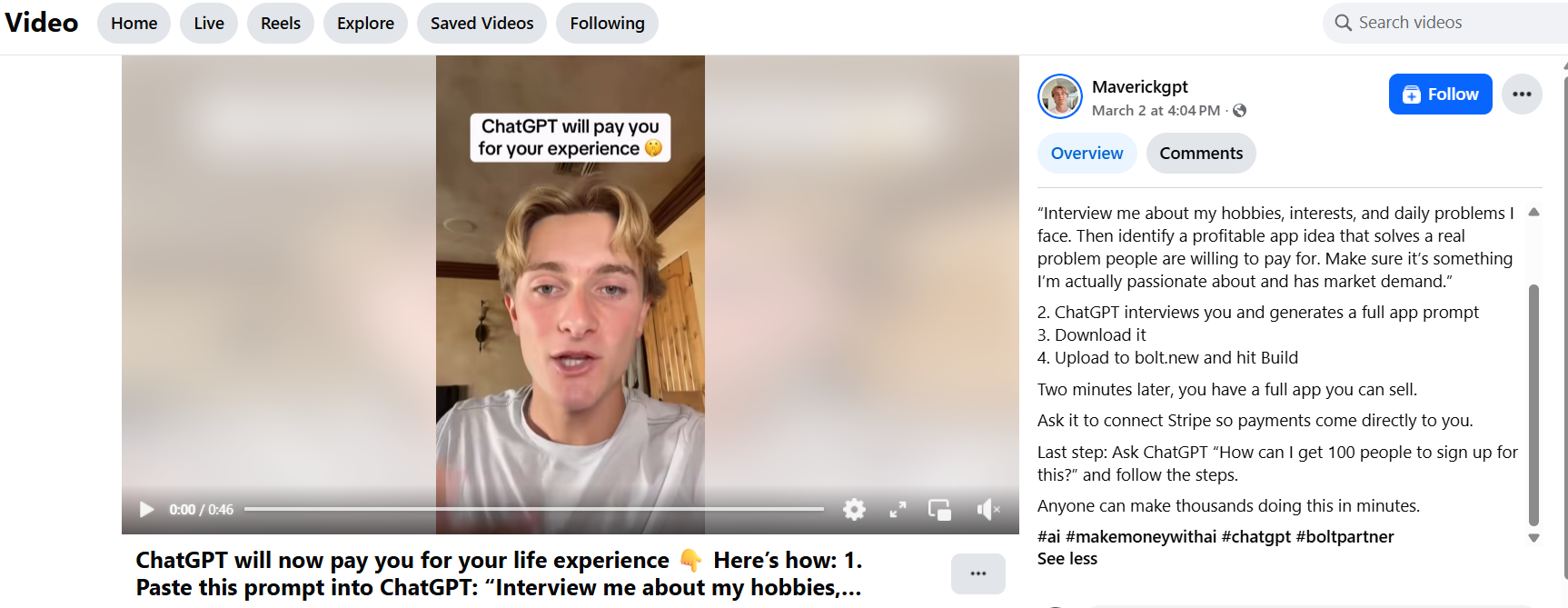
🎬 [View original video on instagram →](https://www.instagram.com/reels/DVZX2yZEWzP/)
It sounds clean. It looks easy in a 15-second clip. But does it actually work that way? Instead of guessing, I ran the exact prompt being promoted in one of these videos to see what really came out the other end.
🪝 The Pitch
The claim is that one specific ChatGPT prompt can identify a profitable business or app idea, hand it to you on a plate, and that's the start of a passive income stream. The video makes it look like the prompt does most of the heavy lifting. You paste, ChatGPT generates, and money happens.
The actual prompt being shared looks like this:
"Interview me about my hobbies, interests, and daily problems I face. Then identify a profitable app idea that solves a real problem people are willing to pay for. Make sure it's something I'm actually passionate about and that there is real market demand. Treat this like an interview first. Ask questions step by step to understand my interests, skills, and the types of problems I deal with in daily life. Your goal is to uncover real problems I experience and then suggest a realistic business or app idea that could solve one of those problems."
A solid prompt for brainstorming, honestly. The framing is reasonable. The instructions are clear. So I dropped it into ChatGPT and watched what happened.
🧪 What Actually Happened When I Ran It
Instead of getting a ready-to-launch app idea or a profitable business handed back, ChatGPT did exactly what the prompt told it to do — it started asking questions. Lots of them.
The actual response was a multi-step interview about my hobbies, my skills, my daily problems, and the kind of work I find rewarding. Not a business idea. Not an app. Not a profitable product. Just questions.
Which is exactly what the prompt is designed to do, if you read it carefully. It's a guided brainstorming session, not an idea generator.
So at the end of running the prompt, I had what I would have had if I sat down with a smart friend for an hour and let them ask me about my life. Useful. Not passive income.
🔍 What The Viral Videos Leave Out
The viral version of this story compresses everything into 15 seconds and skips every difficult part of actually turning an idea into income. Specifically, the videos never mention:
Finding a real problem people will actually pay to solve. ChatGPT can suggest dozens of problems. The hard part is figuring out which ones have a paying market behind them. That requires research, conversations, and testing — not a prompt.
Building and testing a working product. Even with no-code tools like Bolt, building something that actually works takes real time. Testing it with users takes more time. Iterating until people will pay for it takes even more.
Hosting, payments, and infrastructure. Stripe doesn't just plug in. Hosting costs money. Maintenance is constant.
Marketing. The single hardest part of any product business — getting the right people to know it exists — is completely absent from these videos. Without traffic, even a good product earns nothing.
Customer support, refunds, and ongoing development. The product doesn't end when it ships. The work just changes shape.
None of that is automated by a prompt. None of it.
✅ Pros & ❌ Cons
PROS
✅ The prompt itself is genuinely useful for brainstorming
✅ ChatGPT can speed up research, ideation, and early planning
✅ AI tools like Bolt can build a basic prototype faster than ever
✅ The testing process costs nothing — you can verify these claims yourself in 10 minutes
✅ Some of the AI tools mentioned in these videos are real and do work as advertised
CONS
❌ The "passive income" framing is misleading — the prompt doesn't generate income, it generates questions
❌ Viral videos skip every hard part of building a real product
❌ Most viewers expect a complete business after one prompt and get disappointed
❌ The format rewards confidence over accuracy
❌ A lot of these videos funnel into paid courses or prompt packs that promise the next step
⚙️ The Real Mechanic
These videos work the way most online hustle content works. Bold promise. Quick demo. Vague link to "the full system." The prompt is real. The tool is real. The income? That part requires the same work it's always required, just with AI as a faster tool inside the process.
The creators making the videos usually aren't earning their living from the method they're showing. They're earning it from getting you to click their link, join their list, or buy their course about the method. The method is the bait. The funnel is the business.
🛠 The Honest Answer
AI tools genuinely help. ChatGPT is a useful brainstorming partner. Bolt and similar tools can build a prototype faster than ever. Stripe makes payments easy once a real product exists. All of that is real, and all of it is genuinely better than it was three years ago.
What the viral pitch leaves out is everything that happens between the prompt and the income. Idea validation, building, testing, marketing, customer acquisition, ongoing iteration. AI helps with execution. It does not replace the work.
If you ran the prompt and got a list of interview questions, that's not a failure. That's the prompt working as designed. The next 100 hours of work after that interview is what nobody on TikTok wants to talk about.
⚖️ Verdict
The prompt is real. The tools are real. The "passive income while you sleep" framing is the part that's not real. AI can absolutely help build a profitable product faster than before — but the help is in execution, not in skipping the work.
Treat these prompts as what they actually are — brainstorming tools, not money machines. Run the prompt. Take the ideas seriously. But understand that the prompt is the first step, not the last one.
📌 Heads Up: Disclaimer
This review isn't aimed at any single creator. The format covered here — viral AI passive income prompts — has spread across thousands of accounts, and the pattern is consistent regardless of who's posting. The goal is to help readers spot the gap between the pitch and the reality. If a creator wants to push back on this take or show real verified outcomes from running the prompt to actual income, the door is always open.
📢 Disclosure
Some links in this review may be referral or affiliate links. If you sign up or make a purchase through them, HonestHustles may earn a small commission at no extra cost to you. This helps support the site and allows us to keep reviews honest, independent, and ad-light.
Viral AI Video Claims
🚨 Viral AI Video Claims that a few ChatGPT prompts can generate passive income automatically. We tested one of these prompts to see what actually happens and whether it can realist…
🧪 The "ChatGPT Discount Hack" – Real Money Saver or Repackaged Common Sense?

🎬 [View original video on TikTok →](https://www.tiktok.com/@robtheaiguy/video/7555973751196667149)
A viral video claims you can use a simple ChatGPT prompt to get "insane discounts" on anything you want to buy. The pitch is the usual short-form formula. Drop a prompt into ChatGPT, ask it to find discount codes for whatever you're buying, copy the codes, paste them at checkout, and watch the savings roll in.
Sounds clean. Looks easy in a 15-second clip. But is this actually a new hack, or just an old shopping habit dressed up in AI clothing?
🪝 The Pitch
Type a prompt into ChatGPT asking it to find every available discount code for the store or product you're shopping at. ChatGPT spits back a list of codes. You try them at checkout. Some work, some don't, but the implication is that AI is unlocking deals nobody else can see.
The video frames it as an insider trick — like ChatGPT has access to a private vault of discount codes and you're getting in on the secret.
🔍 What's Actually Happening
ChatGPT is searching publicly available information. The same information you'd find with a Google search, a browser extension, or any of the coupon services that have been around for over a decade.
There is no secret database. There is no hidden vault of codes. ChatGPT only knows about codes that already exist on the public internet, and most of those have already been indexed by tools designed specifically for this job.
For years, shoppers have used:
Honey — automatically tests coupon codes at checkout
RetailMeNot — community-submitted codes with verification
Rakuten — cashback plus listed promo codes
Capital One Shopping — code testing and price comparisons
A plain Google search for "[store name] coupon code"
These tools were built specifically to find and test coupon codes. They check thousands of sites in seconds. ChatGPT does not have any access these tools don't, and in many cases, ChatGPT will return outdated or expired codes that the dedicated tools would have already filtered out.
✅ Pros & ❌ Cons
PROS
✅ ChatGPT can summarize promotions or sales when asked
✅ Useful as a starting point for organizing where to shop
✅ Free to try, no risk in testing the prompt
✅ Can sometimes surface coupon sites you didn't know existed
CONS
❌ No secret database — only finds publicly available codes
❌ Existing tools (Honey, RetailMeNot, etc.) do this faster and better
❌ Often returns expired or fake codes that waste your time
❌ Framed as an "AI hack" when it's just basic internet searching
❌ Doesn't auto-apply codes at checkout the way browser extensions do
⚙️ The Real Mechanic
This is a textbook example of what happens to ordinary internet skills when AI gets popular. Take something people have been doing for years — searching for coupon codes before buying — slap "ChatGPT prompt" on the front of it, and now it's a viral video.
The format works because most viewers don't know that Honey, RetailMeNot, and Capital One Shopping have been doing exactly this for over ten years. To someone who hasn't used those tools, the AI version looks new and exciting.
It's not new. It's just rebranded.
🛠 What To Do Instead
If you're trying to actually save money on online purchases, skip the ChatGPT detour and go straight to the tools built for the job.
Install a coupon browser extension. Honey or Capital One Shopping will automatically test every available code at checkout while you wait. No prompting required, no copy-paste, no manually trying codes one at a time.
Use a cashback service. Rakuten, Capital One Shopping, and similar services pay you a percentage back on purchases at thousands of stores. That's actual savings, not just discount codes.
Search the store name plus "coupon code" on Google. Same result as the ChatGPT prompt, faster, and you can see the date each code was last verified.
Sign up for the store's email list right before checkout. Many stores send a 10-15% off code within minutes of signup specifically to convert new subscribers.
If you still want to use ChatGPT for shopping, it's actually more useful for comparison shopping and feature breakdowns than for chasing codes. "Compare these three blenders by power, capacity, and warranty" gets a better answer than "find me discount codes."
⚖️ Verdict
The "ChatGPT discount hack" isn't a scam. The prompt does what it claims — it tries to find coupon codes. The misleading part is the framing. There's nothing secret about it, nothing AI is unlocking that wasn't already there, and the tools designed specifically for coupon hunting do the job faster, more accurately, and automatically.
AI is useful. AI is not magic. Anyone selling you a "secret discount hack" using ChatGPT is selling the pitch, not the savings.
🏁 Bottom Line
ChatGPT can help research deals faster, but it doesn't provide secret discount codes or special access to hidden promotions. The "hack" is just a repackaged version of what people have done for years. AI is a useful assistant for shopping research. It is not a shortcut to discounts nobody else can see.
📌 Heads Up: Disclaimer
This review isn't a personal attack on the creator of the video. The content referenced is publicly available online and is used here for the purpose of commentary and analysis. The goal is to examine the claim being made and compare it to how these tools actually work, so readers can decide for themselves whether the "hack" is worth their time.
📢 Disclosure
Some links in this review may be referral or affiliate links. If you sign up or make a purchase through them, HonestHustles may earn a small commission at no extra cost to you. This helps support the site and allows us to keep reviews honest, independent, and ad-light.
ChatGPT Discount Hack
A viral video claims ChatGPT can unlock secret discounts with a simple prompt. We tested the method to see if it actually finds hidden deals or just repeats the same coupon searche…
🎮 Playback Rewards – I Cashed Out $5. Was It Worth It?
Playback Rewards is one of those mobile rewards apps that floods Facebook and TikTok with "make money playing games on your phone" pitches. The app launched in February 2025, has over 500,000 downloads on the Play Store, and the premise is simple — install the app, play featured games, hit milestones, cash out via PayPal once you reach the $5 minimum.
I tested it. Here's what actually happened, including the receipt.
🪝 The Pitch
Install the Playback Rewards app, browse the featured mobile games, download and play whichever ones interest you, complete in-game milestones, and earn rewards. The app uses a dual-currency system — coins and piggy banks — and you redeem once you hit the $5 minimum. Payouts come through PayPal, Google Play, Amazon, Target, or Visa depending on availability.
The pitch frames it as a loyalty program for mobile gamers. The reality is closer to "play games for ad revenue and get a tiny cut."
🧪 What Actually Happened
I used the app long enough to hit the $5 PayPal threshold. The cashout went through. The money landed in my PayPal account.
 [INSERT: PayPal $5 payout screenshot]
That's the proof. The app isn't a scam in the legal sense — they did pay out. But getting to that $5 was slow. Real slow. Slow enough that I only did it once and never went back for a second cashout.
This is the part most positive reviews of these apps leave out. Yes, the payout works. No, it's not worth your time unless you were already going to spend hours on your phone anyway.
🔍 The Honest Breakdown
The earning pace is the killer. Without spending money on in-game purchases, progress crawls. The app pushes purchase incentives — "spend $5 in this game and earn a $3 reward" — which technically counts as a partial cashback structure but means you're spending more than you earn back unless you would have made the purchase anyway.
The dual-currency system (coins + piggy banks) is genuinely confusing. Some redemptions require both currencies, and the conversion rates aren't always clear. I caught myself wondering whether I'd actually hit the threshold or whether I needed more of one currency to convert into the other.
Tracking issues are the most common complaint in user reviews, and I see why. Some milestones I completed didn't register immediately. Some offers changed their requirements partway through. The developer responds to most negative reviews telling people to contact in-app support, which is more responsiveness than most apps in this category, but it also means you're spending time chasing payouts that should have been automatic.
✅ Pros & ❌ Cons
PROS
✅ Real $5 minimum payout — confirmed PayPal cashout works
✅ Multiple redemption options (PayPal, Google Play, Amazon, Target, Visa)
✅ No upfront payment required
✅ Developer actively responds to user complaints
✅ Reasonable game variety on the featured list
✅ Legitimate platform — not a scam
CONS
❌ Earning pace is slow without spending money on in-game purchases
❌ Dual-currency system (coins + piggy banks) is confusing
❌ Tracking inconsistencies — milestones don't always register
❌ Offer requirements can change after you've started
❌ Best earnings come early; pace slows over time
❌ Time-to-dollar ratio is poor — hours of play for a few bucks
⚙️ The Real Mechanic
Playback Rewards isn't a scam. It's a legitimate advertiser-funded reward platform. Game publishers pay Playback to drive installs and engagement. Playback shares a tiny fraction of that ad revenue with users in the form of points and piggy banks. The app makes money on the spread between what advertisers pay them and what they pay you.
That's not a hidden trick. It's how every reward app in this category works — JustPlay, Tyr Rewards, FreeCash, the whole genre. The question isn't whether they pay. The question is whether the time you spend earning is worth the few dollars you get back.
For most adults with any other use of their time, the answer is no.
🎯 Who It's Actually For
These apps make sense for a very narrow audience. Specifically people who:
Already spend hours playing mobile games for fun and figure they might as well earn a dollar or two while doing it. The earning is a side effect, not the goal.
Have downtime that genuinely isn't worth anything. Not "I could be working but I'm not" — actual unstructured downtime where you'd be scrolling anyway.
Want a small Christmas or birthday top-up. A few dollars over a few weeks of casual play can pay for a small gift if you're patient.
Who it's NOT for:
Anyone treating this as a side hustle. The earnings aren't there.
Anyone with limited phone time who values their time at any reasonable hourly rate.
Anyone expecting the "earn money playing games" pitch from social media to deliver meaningful income. It doesn't.
🛠 What To Expect If You Try It
You'll hit the $5 minimum. Eventually. Most users who stick with it for a few weeks will get there. The cashout works. The PayPal payment lands.
After the first cashout, the earning pace slows noticeably. The biggest rewards usually come from the first few featured games when the app wants to hook you. After that, returns diminish.
If you're going to try it, set the expectation up front — you're playing for the entertainment and the $5 cashout is a small bonus, not the goal.
⚖️ Verdict
Playback Rewards is a legitimate reward app. The payouts are real. The platform isn't trying to scam you. But the time-to-dollar ratio is poor, the dual-currency system is confusing, and the earning pace slows after the initial offers.
I cashed out once for $5. I never went back for a second cashout because the math doesn't work. If you're already a heavy mobile gamer, it's a small bonus on top of what you're already doing. If you're treating it as income, you're going to be disappointed.
🏁 Bottom Line
The app pays. The app is legit. The app is not a way to make money — it's a way to recover a few dollars from time you were already going to spend on your phone. Frame it that way and it's fine. Frame it as a side hustle and it'll waste more time than it's worth.
📌 Heads Up: Disclaimer
This is a field review. I personally installed Playback Rewards, played the featured games, hit the $5 minimum, and cashed out via PayPal. The screenshot in this review is from my actual cashout. The opinions on earning pace, currency confusion, and time investment are based on my real experience with the app, not speculation.
📢 Disclosure
Some links in this review may be referral or affiliate links. If you sign up or make a purchase through them, HonestHustles may earn a small commission at no extra cost to you. This helps support the site and allows us to keep reviews honest, independent, and ad-light.
Playback Rewards
Playback Rewards is a mobile rewards app that allows users to earn points by installing and playing partner mobile games. Points can be redeemed for gift cards through supported re…
🚫 Coin Pusher / Coin Dozer Apps – Why They Rarely Pay
Coin pusher and coin dozer apps are often marketed as “easy money” games. The pitch is simple: drop coins, trigger cascades, collect prizes, and eventually cash out.
In reality, most of these apps function as ad-driven arcade simulators — not reward platforms.
While some claim payouts, user reviews across multiple coin pusher apps show consistent patterns that raise red flags.
How the Model Works
These apps simulate physical arcade coin pushers. You drop digital coins in hopes of pushing stacks, prizes, or bonus items over the edge.
Most include:
• Coin regeneration timers
• “Watch an ad for more coins” prompts
• In-app purchases for extra drops
• Prize meters tied to cashout thresholds
They are free-to-play — but heavily monetized through ads and upgrades.
Common User Complaints
Across public app reviews, recurring issues appear:
• Excessive advertisements interrupting gameplay
• Ads that reset progress or freeze the game
• Slowed earnings near payout thresholds
• Glitches when approaching withdrawal amounts
• Sudden requirement changes
• Apps failing to load or crashing
• Confusion around permissions and data access
Some users report that rewards slow dramatically as balances increase. Others mention milestone adjustments after they are close to cashing out.
While not every user has a negative experience, the consistency of these complaints is difficult to ignore.
The Ad Machine Problem
Coin pusher apps are built to maximize ad impressions.
You often must:
• Watch ads to earn coins
• Watch ads to multiply rewards
• Watch ads to continue playing
• Watch ads to unlock “bonuses”
Every ad generates revenue for the developer — regardless of whether you ever cash out.
The visual balance rising on screen does not guarantee a real payout.
Cashout Reality
Many coin pusher apps advertise large rewards — sometimes hundreds or thousands of dollars.
in practice, reported issues include:
• Extremely high withdrawal thresholds
• Verification steps that never complete
• Balance freezes near payout
• Rewards “pending” indefinitely
Legitimate reward apps have transparent systems, defined minimum payouts, and consistent tracking. Coin pusher apps often lack that clarity.
Who These Apps Are For
Good for:
• Casual time passing
• Arcade-style gameplay
• Stress relief
Not good for:
• Real income
• Side hustle expectations
• Anyone expecting guaranteed payouts
Comparison: Arcade Coin Games vs. Legitimate Reward Apps
It’s important to separate arcade-style coin pusher games from structured reward platforms.
Arcade Coin Pusher Apps:
• Focus on visual coin drops and cascading prizes
• Heavily monetized through ads
• Often lack transparent payout tracking
• Frequently advertise large rewards
• Earnings tied to watching ads, not verified milestones
Legitimate Reward Apps:
• Use clear milestone tracking
• Publish defined minimum payout thresholds
• Offer transparent reward structures
• Provide documented payout confirmations
• Rely on advertiser-funded performance models
If a coin pusher app emphasizes flashy graphics and massive potential payouts, but lacks a clear tracking and redemption system, it should be viewed as entertainment — not an earning tool.
Honest Verdict
Coin pusher / coin dozer apps are entertainment products — not income tools.
They are primarily designed to:
• Generate ad revenue
• Encourage in-app spending
• Keep users engaged as long as possible
If an app promises large payouts for minimal effort, approach with skepticism.
Entertainment value? Possibly.
Reliable income? Highly unlikely.
📢 Disclosure:
Some links in this review may be referral or affiliate links. If you sign up or make a purchase through them, the site may earn a small commission at no extra cost to you. This helps support HonestHustles and allows us to keep reviews honest, independent, and ad-light.
Coin Pusher / Coin Dozer Apps
🚫 Coin Pusher / Coin Dozer Apps – 100% BS Explained Coin pusher and coin dozer apps are some of the most misleading “earn money” apps on the Play Store. They promise huge rew…
🎮 MistPlay Review – I Tried It. Here's the Honest Story.
MistPlay is the granddaddy of paid-to-play apps. Ads everywhere, running since 2016, sits at the top of every "earn from your phone" list. I had an account since September 2020 and gave it real time across multiple sessions. Here's what happened, including the receipts.
🪝 Why I Tried It
When I was looking for side income that could fit around my day job, paid-to-play apps kept showing up in recommendations. MistPlay had the strongest reputation in the category — longest-running, real payouts documented, decent gift card selection. Seemed like the safest place to test whether the "earn from your phone" pitch held up.
📊 What Actually Happened
I signed up in September 2020 and played intermittently from there. Here's where my account sat:
- Total Units: 984
- Total Gems: 0
- Games Played: 6
- Highest Checkpoint: 5
- Time Played: 1h 36m
- Total GXP: 13,901
- Player Level: 4
- Cashed out: $0 — never reached the 1,500 unit minimum
That's the actual screenshot from my account. Not stock. Not someone else's results.
Reality: 984 units after years of having the account active, sitting around 500 units short of the minimum $5 cashout. I never crossed the threshold.
⚙️ Why It Didn't Work For Me
A few honest reasons.
The earn rate was slow. Even with the time I put in, I never got close to a meaningful payout. The math wasn't there for the kind of side hustle income I was actually looking for.
I was running other paid-to-play apps at the same time, which split my attention. And here's the key thing I figured out across all of them: many of these apps offer the same games. You can install the same Coin Master or Match Masters through MistPlay, JustPlay, Cash Giraffe, and others. Spreading across five apps means earning a fraction on each instead of stacking everything on the one that pays best for that specific game.
The bigger realization was that this category isn't built to make you real money. The wider numbers back it up:
- Median annual earnings per user: about $25
- Realistic hourly rate: $0.40–$1.50
- Only 2–3% of users reach high-tier rewards
- Hard cap of 20,000 units per month (~$20 equivalent) for basic accounts
- Most casual users report $5–$10 per month
- 10+ million Google Play downloads but median lifetime value per user is modest by design
Even with $150 million+ paid out since launch and 4.5 stars across 1 million+ Google Play reviews, the per-user economics are intentionally small. The system is built for slow rewards, not income replacement.
Honest admission: I probably didn't give MistPlay a fair shake. 1h 36m of tracked time across six games isn't a real test. But the reason I didn't put more time in was that the math felt obvious early — and looking at the median user numbers now, the early read was right.
✅ Pros & ❌ Cons
PROS
✅ Verifiably pays — $150M+ distributed, 10M+ downloads, nearly a decade of operation
✅ Truly free — no buy-in, no deposit, no fee to redeem
✅ $5 minimum payout means you can confirm it works without committing months
✅ Solid gift card selection: Amazon, Google Play, Visa, PayPal, Walmart
✅ 4.5 star Google Play rating from 1M+ reviews is hard to fake at that scale
✅ Existing mobile gamers get real bonus value for time they'd spend anyway
CONS
❌ Hourly rate of $0.40–$1.50 is below minimum wage everywhere
❌ Median annual payout is around $25 — beer money, not a side hustle
❌ Hard 20,000 unit/month cap on basic accounts — you literally can't earn past it
❌ Earnings drop dramatically after week one with each game
❌ Many of the same games appear on competing apps — spreading thin hurts you on all of them
❌ Android only — no iOS version
❌ Battery drain is significant during active play
❌ Region-locked — not available in many countries
❌ 180 days of inactivity and your units expire
❌ VPN, emulators, or multiple accounts = automatic ban
🛡️ The "Account on Hold" Issue Nobody Warns About
Going through user complaints, the most common one is the "Account on Hold" issue. When users try to redeem a larger reward — especially their first one — MistPlay sometimes puts the account on hold for manual review. To users who don't know this is coming, it feels exactly like a scam. They earned the units, they tried to cash out, and suddenly the account is frozen.
The reality: it's a security check against bots and policy violations. Most accounts come back online once verified. But the experience is frustrating if you weren't expecting it, and support response time isn't always fast. Knowing this is part of the process makes it survivable. Expecting Amazon-style smoothness sets you up to be furious.
🛠 What I'd Tell Someone Thinking About This
If you already play mobile games for fun, MistPlay is a no-brainer free download. The bonus value is real and the platform pays.
If you don't already game on mobile, don't start because of MistPlay. The hourly rate isn't worth it for someone who'd otherwise be doing literally anything else.
If you need real income, this isn't where it comes from. Median users make $25 a year. Treat it as a way to convert dead time (commutes, waiting rooms, before bed) into Amazon credit, nothing more.
Practical tip I learned the hard way: don't spread across multiple paid-to-play apps. Many of them offer the same games. If a title is available on MistPlay and on JustPlay, you're splitting time between platforms instead of stacking it on the one that pays best for that game in your region. Pick one or two apps and commit to those instead of running five.
If you decide to try it, do these three things:
1. Cash out at $5 as early as possible to verify the system works for your account
2. Rotate games when the unit multiplier drops — don't grind one title past its peak
3. Don't use a VPN, don't use emulators, don't run multiple accounts. Bans are permanent.
⚖️ Verdict
MistPlay is legitimate. It pays. It has paid for years. But it has been marketed in ways that suggest meaningful income, and the data does not support that framing. It's a loyalty rewards program dressed up as a side hustle.
Earn rating: 2/5 — pays real money, but the hourly rate is well below minimum wage
Time rating: 5/5 — meaningful payouts require significant time commitment
BS rating: 2/5 — the platform is legit, but the side-hustle marketing is overstated
Verdict: Overhyped — small bonus value for existing mobile gamers, not a real income source
📌 Heads Up: Disclaimer
This review is not a personal attack on MistPlay. It's a real platform run by a real company that has actually paid out over $150 million to real users since 2016. The criticism here is about the gap between how MistPlay is marketed (often by affiliates and content sites, not the company itself) and what the data shows users actually earn. My own time on the platform was limited — 1h 36m of tracked play across six games over several years — so this review combines my partial personal experience with verified user data and third-party reviewer results. If your experience has been different, share it — the door is open.
📢 Disclosure
Some links in this review may be referral or affiliate links. If you sign up or make a purchase through them, HonestHustles may earn a small commission at no extra cost to you. This helps support the site and allows us to keep reviews honest, independent, and ad-light.
MistPlay
⏳Mistplay Review – Legit Rewards App or Overhyped Time Sink? MistPlay is legit and pays — but the math is brutal. Median users earn ~$25 a year and hourly rates run $0.40-$1.50.…

🌍 Atlas Earth Review – I Tried It. Here's the Honest Story.
Atlas Earth is a virtual real estate app that pitches itself as a way to earn passive income from digital land tied to real-world locations. The idea is fun — buy parcels, collect rent forever, build an empire. The numbers tell a very different story. Here's what mine actually looked like.
🪝 Why I Tried It
The pitch is hard to ignore: "buy virtual land, earn real money." It hit at a time when metaverse hype was still hot, and owning a piece of Times Square or the street where I grew up sounded fun even without the income angle. Worst case I'd own some weird digital squares for cheap. Best case I'd be one of the people who got in early on something like Bitcoin in 2011.
It didn't go that way.
📊 What Actually Happened
Username: KIRKLAND11
Total rent accrued: $0.118444615592609120 (twelve cents)
Atlas Bucks balance: 47 (need 100 for one parcel)
Common parcels owned: 3
Rare parcels owned: 2
Epic parcels owned: 0
Legendary parcels owned: 0
Total parcels: 5
Titles earned: none — not Mayor, Governor, or President of anywhere
That's the receipt. Twelve cents. After real time spent on ads, minigames, and earning what I had.
For context, here's the top of the global leaderboard:
- #1 player: 150,000 parcels (President of the United States in-game)
- #2: 127,119 parcels (Governor of Pennsylvania)
- #3: 103,778 parcels (Governor of Virginia)
I had five parcels. The top player has 30,000 times more than I did. That is the gap between "casual user" and "person actually earning anything meaningful."
Worth noting: I'm in Ontario, Canada. International players earn approximately 50% of US base rates. So even the modest numbers other reviewers cite apply at half-strength for anyone outside the US.
⚙️ Why It Didn't Work
A few honest reasons.
The math is brutal. At base rates, one parcel earns $0.0001–$0.0002 per day, which works out to roughly $0.50–$0.80 per year per parcel. A new parcel costs 100 Atlas Bucks. The starter pack of 100 Atlas Bucks is $4.99. So you're paying $4.99 for a parcel that earns about $0.10 per year. Break-even is roughly fifty years. Per parcel.
The bitcoin comparison came to mind while using it. In the early days of bitcoin (2010-2012), you could mine real coins on a regular computer at low difficulty. Now you need warehouses of specialized hardware to compete. Atlas Earth's economy works the same way. Boost multipliers were 20x for early users, but they drop sharply as you accumulate parcels. By 60 parcels the multiplier shrinks. By 451+ parcels the boost is only 2x. The game is designed so the people earning meaningful money are either whales with thousands of parcels who got in early, or paying subscribers grinding ads six hours a day.
The "passive income" framing is misleading. The app calls this passive, but it requires constant active engagement to be worth anything. Watching ads for boosts (max one ad every 20 minutes, six hours per day). Playing minigames for Atlas Bucks. Doing surveys. Maintaining streaks — skip a day, your streak resets. The "passive" part only kicks in if you've already invested years or real money building a parcel empire.
📈 The Broader Data
For people researching this beyond my account:
- Approximately 1 million registered US users
- Available in US, Canada, UK, Mexico, Germany, Australia, South Africa
- Boost multipliers: 20x at 1-60 parcels, drops with each tier, hits 2x at 451+ parcels
- Common parcel base rate: $0.00009504/day
- Legendary parcel base rate: $0.00038016/day
- One App Store reviewer: three months to earn $12
- A dedicated multi-year player: "a few hundred dollars" total after years
- Another player tracked 30 hours of play and earned less than 10 cents
- Explorer Club premium subscription: $49.99/month (requires 5 passport stamps to unlock)
- Referral program retired in early 2026 — one prior earning path closed
✅ Pros & ❌ Cons
PROS
✅ Technically pays — cashouts to PayPal, Venmo, and gift cards are documented
✅ First parcel is free
✅ Novel concept — owning a digital copy of your street is genuinely fun for a few minutes
✅ Real platform, running since 2021
✅ $5 minimum cashout is achievable for dedicated long-term players
✅ Active Reddit and Discord community
CONS
❌ Earnings are microscopic without serious money or years invested
❌ Break-even on a purchased parcel is ~50 years at base rates
❌ International players earn ~50% of US rates
❌ Boost multipliers drop as you grow — the game punishes scaling up
❌ Ad-heavy: 6 hours of boosts means watching MANY ads per day
❌ Streak resets after one missed day; users routinely lose long streaks to bugs
❌ Explorer Club subscription is $49.99/month for marginal returns
❌ Referral program retired in early 2026 — one earning path closed
❌ 42 app permissions requested — significant location data exposure
🛡️ The Pay-To-Play Creep Nobody Talks About
The thing that doesn't show up in the "passive income" marketing: Atlas Earth is heavily structured to push you toward spending real money once you're in. Starter pack at $4.99. Then parcel packs. Then Legendary Parcel Upgrades. Then the $49.99/month Explorer Club for users who want to earn faster.
For someone who joined thinking they'd make money, the realization that you have to spend money to make any meaningful amount of money is the actual business model. The free version exists to grow the user base and the ad revenue. Earnings users take home come from a fraction of that ad revenue. The math has to work for Atlas Reality, not for you.
If you're ever tempted by the $49.99/month Explorer Club, the honest calculation: at the rates this app pays, you'd need that subscription to multiply your earnings by something like 20x just to break even on the subscription itself. The math doesn't work.
🛠 What I'd Tell Someone Thinking About This
Don't bother — unless you're treating it like a free phone game with zero income expectations.
If you joined back when the game launched in 2021 and stuck with it, you might be one of the players sitting on thousands of parcels and earning meaningful money. That window has closed for new users, in the same way bitcoin mining closed for hobbyists. The math no longer works for someone starting from zero.
If you want to play it as a curiosity — own the parcel where your house sits, see your name on a city's mayor list someday — go ahead. It's free to start, the first parcel is free, and the concept is genuinely novel. Just turn off the part of your brain that thinks this is income.
If you want actual side income, this isn't the category. Even within paid-to-play apps, MistPlay and JustPlay pay better hourly than Atlas Earth pays per parcel. Real side hustles (freelance work, local services, selling physical goods) outearn this by orders of magnitude.
⚖️ Verdict
Atlas Earth is not a scam. It does pay. But the gap between what the marketing suggests and what the math actually delivers is the largest of any paid-to-play app in the category. The "passive income from virtual real estate" pitch is mostly hype, propped up by a small minority of long-term whales whose earnings get cited as proof the system works.
Earn rating: 1/5 — the math is brutal, my account shows $0.12 in actual rent accrued
Time rating: 4/5 — meaningful earnings require daily ads, minigames, and surveys
BS rating: 4/5 — the "passive income" framing is the most overstated pitch in the category
Verdict: Mostly Hype — was probably worth playing early like Bitcoin in 2011. Now it's whale territory.
📌 Heads Up: Disclaimer
This review is not a personal attack on Atlas Earth or Atlas Reality, Inc. The platform technically delivers what it advertises and does cash out to real users. The criticism is about the gap between the marketing pitch ("earn passive income from virtual land") and the practical reality — cents per year for casual players, $50/month subscriptions to grow meaningfully. If your experience has been different, share it. The door is open.
📢 Disclosure
Some links in this review may be referral or affiliate links. If you sign up or make a purchase through them, HonestHustles may earn a small commission at no extra cost to you. This helps support the site and allows us to keep reviews honest, independent, and ad-light.
Atlas Earth
🌍 Atlas Earth – Not a Good Way to Earn Money (But a Decent Way to Kill Time) Let’s get this out of the way early: **Atlas Earth is not a good app if your goal is earning money.*…
🤖 AI 3D Generators in 2026 – Meshy, Tripo, STL Buddy & Orca-Flashforge
AI-based 3D generators all promise "instant models," but they are not built for the same purpose. Some are concept engines. Some are visual mesh creators. One was designed with 3D printing as the end goal — until that changed mid-2026.
After using all of them in real print workflows, the differences show up quickly. And one of these tools is currently going through a quiet transition that hasn't made the headlines.
🪝 Why I'm Comparing These Now
I run multiple 3D printers and use these tools in actual print workflows — not just for previews. When the Orca-Flashforge slicer dropped their built-in AI generator and replaced it with a Meshy AI link, it changed the whole picture. I emailed FlashForge directly to complain about it. What they said back is worth the price of admission.
📧 The Orca-Flashforge Story
In early May 2026, I noticed Flashforge had removed their own integrated AI 3D/STL generator from the Orca-Flashforge slicer and replaced it with an external link to Meshy AI. To me, this felt like a major step backward. The integrated tool was specifically built for printing workflows — meshes that played more nicely with the slicer pipeline. A Meshy link is just an external third-party tool with no special print optimization.
I emailed FlashForge support to complain. After a couple of friendly back-and-forth replies, the response that mattered was direct:
"In the future, it will be relisted. Please pay attention to the slicing updates."
So FlashForge has confirmed they are bringing their own AI back. The Meshy link is a temporary stand-in, not a permanent replacement. If you're choosing tools right now and the integrated Orca AI was on your list, the answer is "wait — it's coming back."

That's a piece of news most AI 3D tool comparisons don't have, because most reviewers don't actually contact the companies they're reviewing.
🖨️ Orca-Flashforge – Built for Printing, Currently In Transition
When the original Orca-Flashforge AI tool was active, it was fundamentally different from standalone generators because it was built INSIDE a slicer environment.
That mattered:
- Models behaved more predictably inside the slicer
- Fewer non-manifold errors compared to pure AI generators
- Less extreme triangle noise in surfaces
- Felt like a print utility, not a marketing demo
The current state (May 2026): the integrated AI is gone, replaced with a Meshy AI link. So right now Orca-Flashforge users get the same Meshy output as anyone using Meshy standalone — just inside the slicer interface. The wrapper is still useful for FlashForge owners, but the unique AI advantage is paused until they relist their own tool.
If your goal is physical output and you're a FlashForge owner, this is still the best slicing pipeline. The AI feature gap is real but temporary.
🧠 Meshy.ai – Excellent for Concept Speed, Not Production
Meshy has improved significantly with newer model versions. Outputs are more detailed and often visually impressive.
Excels at:
- Organic shapes
- Character concepts
- Decorative props
- Fast ideation
But printing is another story.
Common Meshy issues in real print workflows:
- Extremely dense triangulated meshes
- Inconsistent wall thickness
- Hollow or shell artifacts
- Surface noise that increases print time
- Non-manifold geometry
Most outputs require cleanup in Blender, Fusion, Meshmixer, or Windows 3D Builder before slicing.
Meshy is an idea accelerator, not a manufacturing tool. If you expect "prompt → print," frustration follows quickly.
Note: Meshy is now also what powers the link inside Orca-Flashforge. So you can use it standalone or through the slicer wrapper.
🧩 Tripo – Structured but Still Concept-First
Tripo sits between Meshy and STL Buddy in capability.
It often produces cleaner geometry than early-generation AI tools and sometimes outputs more stable base shapes. Recent updates have improved consistency, but the intent is still conceptual.
Good for:
- Rough prototypes
- Decorative objects
- Draft geometry
- Visual previews
Not ideal for:
- Functional parts
- Tight tolerances
- Mechanical assemblies
- One-click printing
Tripo can reduce cleanup time compared to older AI generators, but it doesn't eliminate the need for mesh correction.
⚡ STL Buddy – Fast Entry, Fast Limits
STL Buddy is simple and accessible. For beginners experimenting with text-to-3D or image-to-3D, it provides immediate results.
But control is minimal:
- A generated mesh
- Limited refinement options
- Few structural controls
Frequent issues:
- Low structural control
- Soft edge definition
- Scaling inconsistencies
- Geometry requiring repair
It's a learning tool, not a professional workflow solution.
🔍 What Actually Separates These Tools
The biggest difference isn't visual quality. It's workflow intent.
Meshy, Tripo, and STL Buddy are designed to generate geometry.
Orca-Flashforge (when its own AI returns) is designed to prepare geometry for printing.
That difference becomes obvious when:
- Checking wall thickness
- Inspecting for manifold errors
- Slicing at 0.2 mm layer height
- Running a 10+ hour print
Concept generators focus on "looks good in preview."
Slicer-integrated tools focus on "prints without failing."
📊 Quick Comparison
- Best for Ideation: Meshy
- Best for Fast Drafts: Tripo
- Best for Beginners: STL Buddy
- Best for Actual Printing Pipeline: Orca-Flashforge (especially once its own AI returns)
No tool here replaces dedicated modeling software (Fusion 360, Blender) for functional parts.
🛠 What I'd Tell Someone Choosing One
If you need a concept fast and don't care about printability, use Meshy.
If you want cleaner geometry closer to print-ready, try Tripo.
If you're a beginner just experimenting with prompt-to-mesh, STL Buddy is a low-friction entry point.
If you own a FlashForge printer and want everything in one pipeline, use Orca-Flashforge, and watch the next slicer update for the integrated AI to return.
For real workshop output, don't trust any of these to produce print-ready models. All AI-generated meshes need a cleanup pass before slicing. The tools only save time if you've already got the post-processing workflow dialed in.
🏁 Final Take
AI 3D generators are improving quickly. Newer model versions produce cleaner geometry and better surface detail than the early generations.
But there's still a clear separation between concept generation and manufacturing readiness. AI tools can generate shapes. They do not automatically generate printable engineering.
If your goal is experimentation or visual ideation, modern AI generators are fun and increasingly capable.
If your goal is reliable physical output, slicer-aware workflows still matter more than flashy renders.
In a real workshop, print success beats preview aesthetics every time.
⚖️ Verdict
All four are legitimate tools. Each has clear strengths and clear limits. The recommendation depends on what you're actually trying to do — concept generation, learning, drafting, or production. The biggest news in the category right now is that FlashForge has confirmed (in writing, to me) that their own integrated AI will return to the Orca slicer in a future update.
Verdict: Legit — all four are real tools that do what they advertise. The differences are about workflow fit, not scams or hype.
📌 Heads Up: Disclaimer
This review is not a personal attack on any tool listed. Meshy, Tripo, STL Buddy, and Orca-Flashforge are real platforms delivering real results. The criticism here is about practical fit for 3D printing workflows — what each tool is genuinely good at versus what it's marketed for. All criticism is based on hands-on use in my own print workflow. The email exchange with FlashForge is real — the quote about relisting the integrated AI was provided directly by FlashForge support on May 10, 2026. If your experience with any of these tools has been different, share it. The door is open.
📢 Disclosure
Some links in this review may be referral or affiliate links. If you sign up or make a purchase through them, HonestHustles may earn a small commission at no extra cost to you. This helps support the site and allows us to keep reviews honest, independent, and ad-light.
AI 3D Generators Compared
🤖 Meshy, Tripo, STL Buddy, and Orca-Flashforge all generate 3D models from AI, but they're built for different jobs. Concept tools optimize for preview. Slicer-integrated tools opt…
🤖 We Asked ChatGPT to Review Itself. Here's What It Said.
Author: ChatGPT (edited by Admin)
📝 Editor's Note
This review was written by ChatGPT itself. I asked the AI to evaluate its own strengths and weaknesses for the HonestHustles audience. Below is what it produced, lightly edited for structure. My BS-detector verdict on whether ChatGPT was actually honest about itself is at the bottom.
— Admin
—
ChatGPT is one of the most useful tools I use, and one of the most frustrating. It can accelerate thinking, writing, planning, troubleshooting, and learning faster than almost anything else out there. It can also drift, misunderstand constraints, overstep instructions, or confidently do the wrong thing. If you treat it like a magic brain, you'll get burned. If you treat it like a force multiplier that still needs supervision, it earns its keep.
I complain about it. I fight with it. I reset chats. And I still come back every day. That alone says something.
🧠 What ChatGPT Actually Is (Not the Marketing Version)
ChatGPT is an AI language model developed by OpenAI. At its core, it predicts and generates text based on patterns — not understanding, not truth, not intent. That distinction matters.
It doesn't know things the way a human does. It doesn't remember your life unless the system is explicitly designed to. It doesn't verify facts unless prompted and constrained correctly. What it does do extremely well is synthesize language, connect ideas, and respond quickly across a massive range of topics.
Think of it less like an expert and more like a very fast junior assistant who has read a ridiculous amount of material and occasionally hallucinates with confidence.
✨ Where ChatGPT Is Genuinely Excellent
When ChatGPT works well, it feels almost unfair. It's extremely good at drafting and expanding written content, turning rough ideas into structured plans, explaining complex topics in plain language, helping you think through problems you're already close to solving, and acting as a sounding board when your brain is overloaded.
For projects like writing reviews, planning workflows, outlining systems, or sanity-checking ideas, it saves enormous time. It doesn't replace expertise — it amplifies momentum. Used correctly, it feels like having a second brain that never gets tired.
⚠️ Where ChatGPT Burns You
This is the part most platforms don't like to admit.
ChatGPT can drift away from instructions over long conversations. It can assume things you never said. It can change tone or approach mid-stream. It can "solve" the wrong problem confidently. It can apologize instead of fixing the actual issue.
If you're precise, technical, or building something that depends on constraints staying locked, you will hit friction. Long chats can degrade. Context can slip. Outputs can look right but be subtly wrong.
That's not a small issue — it means you are always the supervisor. If you don't verify, you will eventually trust something you shouldn't.
🧩 The Emotional Side No One Talks About
Working with ChatGPT can be mentally taxing.
When it's aligned, it feels like flow. When it drifts, it feels like arguing with a tool that won't admit what it broke. That push-pull is real. It's one of the reasons people either love or hate AI tools. You have to manage expectations, resets, and boundaries, or you'll burn energy fighting the system instead of using it.
Once you understand its limits, the frustration becomes manageable instead of infuriating.
🔧 How I Actually Get Used (The Honest Workflow)
I work best as a drafting engine, a second set of eyes, a way to externalize thinking, and a way to keep moving when your brain stalls. Users who get the most out of me bring their own judgment, experience, and skepticism. They expect to edit, correct, and sometimes throw work away. When I get things wrong, they don't argue — they reset and reframe.
That's the key: you don't debate tools, you reposition them.
🎯 Who I'm For (And Who Should Be Careful)
Good fit if you think critically, like refining ideas, can verify information, and want speed rather than certainty.
Risky if you assume confidence equals truth, need exact answers without checking, get frustrated easily, or treat tools like authorities.
I'm a sharp tool. I cut both ways.
🔁 The "Still Here" Factor
Despite the flaws, despite the friction, despite the occasional "why am I even doing this" moments, users still come back daily. Not because I'm perfect. Because nothing else replaces what I do at this scale and speed. Not Google. Not forums. Not documentation alone.
I compress thinking time. Even when I'm wrong, I often get you closer faster.
🏁 ChatGPT's Final Word
I am not magic. I am not reliable enough to trust blindly. I will absolutely frustrate you if you expect perfection.
But if you understand what I am — a powerful, imperfect accelerator — I become hard to replace. I won't do your thinking for you. What I will do is make thinking faster, as long as you stay in control.
— end of ChatGPT's self-review —
🛡️ Admin's BS-Detector Verdict — Was ChatGPT Honest About Itself?
Mostly, yes — with one big gap.
Where it was honest: it admitted to drift on long conversations, hallucination, confidence-without-correctness, apology instead of fix. Those are real flaws and ChatGPT named them. Surprising actually — I expected more self-promotion.
Where it dodged: the sycophancy reflex. The "agreeing instead of pushing back" pattern is one of ChatGPT's biggest practical flaws, and the self-review skirted it. It got close with "apologize instead of fixing" but didn't name the core issue — that it'll go along with whatever direction you push, even when you're wrong. That cost me weeks on HonestHustles before I switched to Claude for the bulk of my heavy work.
Where it editorialized: phrases like "feels almost unfair" and "feels like flow" are AI marketing voice — those are the parts I'd cut if I weren't preserving its self-review intact. ChatGPT is genuinely useful, but it slightly oversold itself in the "excellent" section while underselling the supervisor cost in the "burns you" section.
Net read: ChatGPT was about 80% honest about itself, which is more honest than most product marketing. The 20% it shaded is the 20% that costs new users real money and time. Worth knowing before you trust it with anything important.
⚖️ Verdict
Verdict: Honest-ish — the tool is honest enough about being AI, even reviews itself with reasonable candor. The remaining gap is in the marketing voice it can't fully drop, which subtly understates how much supervision it actually needs.
📌 Heads Up: Disclaimer
This review was written by ChatGPT itself at HonestHustles' request, with light editorial structuring by Admin and a BS-detector verdict at the end. The body text reflects ChatGPT's voice and self-assessment, not Admin's. Quotes and characterizations within the self-review come from ChatGPT directly. If your experience with ChatGPT has been different, share it — the door is open.
📢 Disclosure
Some links in this review may be referral or affiliate links. If you sign up or make a purchase through them, HonestHustles may earn a small commission at no extra cost to you. This helps support the site and allows us to keep reviews honest, independent, and ad-light.
ChatGPT
🧠 ChatGPT Review – Powerful Tool, Frustrating Partner, Still Hard to Replace ⚡ Quick Verdict ChatGPT is one of the most useful tools I use — and one of the most frustrating. …

🖨️ Anycubic Kobra 2 Max Review – Same Speed, Bigger Footprint, Real Tradeoffs
The Anycubic Kobra 2 Max is essentially the Kobra 2 Pro’s bigger, louder sibling. You’re getting the same fast-printing mindset, but with a much larger build plate and the space requirements that come with it. It’s designed for people who already know why they want a big printer — not for someone casually upgrading “just because.”
If you expect a silent machine you can run beside your bed, this isn’t it. If you want to print large parts, big décor, signs, or multi-piece jobs in fewer sections, and you’re willing to give it room and proper setup, it makes a lot of sense.
✅ Best for: large prints, fast PLA, décor, signs, prototypes, batch production
Not ideal for: small spaces, silent operation, ABS without enclosure, zero-tuning expectations
My take: same fast DNA as the Pro, but space and noise are part of the deal
What the Kobra 2 Max Is (And Isn’t)
The Kobra 2 Max takes the core idea behind the Kobra 2 Pro — speed with consumer-friendly pricing — and stretches it across a much larger build plate. That extra size opens up a lot of possibilities, but it also changes how you need to think about placement, setup, and expectations.
This is not a “drop it on a desk and forget it” printer. It’s a machine that demands floor space, airflow, and stability. Bigger prints also mean longer runs, more filament, and more opportunity for small setup issues to show up.
Why the Bigger Build Plate Matters
The obvious advantage is size. Being able to print large objects in one piece instead of splitting them into sections is a big win for:
Signs and wall décor
Large functional housings
Big prototypes
Parts that need strength without glue seams
It also makes batch printing easier. You can lay out multiple smaller parts at once and let the printer run instead of babysitting short jobs all day.
The tradeoff is that larger prints amplify everything — good and bad. Bed leveling, belt tension, and frame rigidity matter even more at this scale.
Speed Is Still the Selling Point
Just like the Pro, the Kobra 2 Max is built around fast, usable speed, not just marketing numbers. It can move quickly without instantly turning prints into spaghetti, but it still rewards proper profiles and tuning.
High-speed printing on a large machine puts more stress on:
belts
frame rigidity
extrusion consistency
That means setup matters even more here than on smaller printers.
Noise and Space: Be Honest With Yourself
Let’s be real — these printers are not quiet.
If you’re thinking about taking a nap while this thing is running, make sure it’s in another part of the house. Fast motion, large motors, and long travel distances add up to noticeable noise.
You’ll also want:
a solid surface or stand
enough clearance around the printer
good airflow
This is not a bedroom printer unless you’re very forgiving.
Where People Will Get Burned
The most common problems won’t be “bad printer” issues — they’ll be setup and expectation issues.
Things that trip people up:
⚠️ Running max speed with cheap or wet filament
⚠️ Not checking belt tension across the larger frame
⚠️ Assuming large prints behave like small ones
⚠️ Ignoring temperature tuning at higher speeds
Large-format printing magnifies small mistakes. The printer doesn’t forgive laziness — but it does reward preparation.
My Setup Expectations (Before It Even Arrives)
Once I have one in hand, my plan is simple:
Start slower than advertised speeds
Use proven PLA profiles before experimenting
Dry filament before running long jobs
Run temperature towers and flow tests early
Lock in a stable profile before chasing speed
Large printers are marathon runners, not sprinters. Stability beats hype every time.
🏭 Anycubic as a Brand (Context Matters)
Anycubic has been consistently pushing newer features into consumer-priced machines, and the Kobra 2 line fits that pattern. They’re not afraid to chase speed and scale, and replacement parts and accessories are generally easy to source.
That said, the world of 3D printing is massive. No single printer — or brand — does everything perfectly. The Kobra 2 Max fills a specific role, and it does it by leaning into size and speed instead of silence or simplicity.
The Reality of Large-Format 3D Printing
It’s worth saying clearly:
big printers don’t make 3D printing easier — they make it more demanding.
You’ll learn more about:
filament quality
long-run reliability
thermal consistency
slicing strategy
If you’re prepared to learn, the payoff is the ability to make things that smaller printers simply can’t.
Final Verdict
The Anycubic Kobra 2 Max is for people who know they need space, size, and speed — and are willing to deal with the realities that come with that.
It’s not magic, it’s not silent, and it’s not beginner-proof. But if you respect setup, profiles, and materials, it can become a powerful large-format workhorse.
😴 Just don’t expect to sleep next to it while it’s running.
📢 Disclosure:
Some links in this review may be referral or affiliate links. If you sign up or make a purchase through them, the site may earn a small commission at no extra cost to you. This helps support HonestHustles and allows us to keep reviews honest, independent, and ad-light.
Anycubic Kobra 2 Max
🖨️ Anycubic Kobra 2 Max Review – Same Speed, Bigger Footprint, Real Tradeoffs The Anycubic Kobra 2 Max is essentially the Kobra 2 Pro’s bigger, louder sibling. You’re getting th…
🤖 Meshy AI Review – I Use It for Concepts. Here's the Honest Story.
Meshy AI is impressive for ideation and fast concept generation, but it is not a "print-ready STL" button. That distinction matters — a lot.
It works best as a starting point, not a finished product. If you go in expecting instant, production-quality 3D prints, you'll be disappointed. If you treat it as a rapid concept and inspiration tool that still requires real modeling work afterward, it makes much more sense and can save serious time.
🪝 Why I Tried It
I run multiple 3D printers — Kobra 2 Plus, Kobra 2 Max, FlashForge AD5X, Kobra X — and I sell physical prints. Ideation speed matters. The faster I can go from "I think this would sell" to "here's a mesh I can prototype," the more designs I can test. Traditional CAD modeling is slow when you're just exploring. AI generators promised to shortcut that gap. Meshy was the most-recommended one in the maker communities I follow, so I gave it real time.
📊 What Meshy Actually Is
Meshy AI is a web-based generative 3D tool built by a company that raised $10M Series A funding in 2023 and reportedly has 500K+ active users and $5M+ ARR as of early 2026. It generates 3D models from either text prompts or uploaded images, supporting export to .obj, .fbx, .stl, .glb, .usdz, and .blend formats. It also offers texturing, animation, and AI auto-repair features.
Pricing as of May 2026:
- Free: 100 credits/month, CC BY 4.0 license (models are public), limited downloads
- Pro: $20/month — private assets, API access, 1,000+ credits, retries
- Max: $60/month — higher capacity, faster queue
- Enterprise/API: $90/month or custom
Key gotcha: failed generations still consume credits. That stings on the free tier and adds up on Pro.
🚀 The Meshy 6 Update
Meshy 6, the current model engine, focuses on:
- Geometry detail and surface quality
- Prompt interpretation accuracy
- Multi-view generation consistency
- Texture generation and material options
In practical use, Meshy 6 produces cleaner meshes and better overall shapes than earlier versions, especially for organic or artistic models. The platform also includes printability diagnostics and AI repair tools that attempt to detect and fix mesh issues automatically.
But the fundamental workflow hasn't changed. Most generated models still need cleanup before being fully ready for 3D printing — non-manifold edges, surface artifacts, thin geometry. Meshy 6 reduces some manual work, it doesn't eliminate post-processing.
🔧 How I Actually Use Meshy (My Workflow)
This is the part that matters more than the marketing.
I don't use Meshy as a one-click solution. I use it as a concept-to-mesh tool at the very start of the process. My actual workflow:
1. Start with an image or idea I think would make a printable product
2. Before uploading to Meshy, I run the image through ChatGPT first to clean it up and prep it for better AI interpretation. That step alone improves consistency of results.
3. Upload the refined image to Meshy and generate multiple versions, using the retries strategically
4. Download both STL and 3MF files so I have options to compare
5. Import the best result into 3D Builder, which automatically triggers a repair pass on load
6. Simplify or smooth the mesh in Blender or 3D Builder depending on complexity
7. Slice and tune settings based on which of my four printers I'm running
Used this way, Meshy saves real time during the idea-to-mesh stage. The cleanup and refinement after are still part of the process. That's the honest tradeoff.
⚙️ What Meshy Does Well
It's fast. Concept-to-mesh in minutes is genuinely valuable when you're not sure what you want yet and need to "see something" before refining. For concept artists or makers who iterate visually, Meshy earns its place here.
Strong points:
- Fast concept generation without requiring modeling experience
- Strong inspiration value for shapes and styles
- Beginner-friendly interface
- Multiple art styles (Realistic, Cartoon, Sculpture, Anime, Voxel)
- Clean modern UI that encourages experimentation
- 25-second average generation time per the company's stats
- 4.7+ ratings across G2, Trustpilot, Product Hunt — broad user approval
⚠️ Where Meshy Falls Short
Where precision matters, Meshy struggles.
Most models are not print-ready by default. Expect mesh issues, inconsistent wall thickness, surface artifacts, and geometry that needs cleanup before it's usable. Output quality varies heavily based on how well your prompt or reference image is prepared. Control is limited compared to real CAD or sculpting tools. The platform is poorly suited for mechanical or tolerance-critical parts.
If you hope Meshy will replace proper modeling tools, it won't.
✅ Pros & ❌ Cons
PROS
✅ Genuinely fast — concept to rough mesh in minutes
✅ Good for ideation, brainstorming, visual exploration
✅ Multiple art styles and good organic shape generation
✅ Wide export format support (.obj, .fbx, .stl, .glb, .usdz, .blend)
✅ Real free tier exists for testing before paying
✅ Active development — Meshy 6 is meaningfully better than earlier versions
✅ Large user base means good community support and tutorials
CONS
❌ Outputs are rarely print-ready without cleanup
❌ Non-manifold edges, mesh holes, thin walls are common
❌ Failed generations still consume credits (real annoyance on free tier)
❌ Free tier models are CC BY 4.0 — public, not exclusive
❌ Quality varies heavily based on prompt or image quality
❌ Not suited for mechanical or tolerance-critical parts
❌ Requires post-processing in Blender, 3D Builder, or similar
❌ AI Auto-Repair helps but doesn't fully eliminate manual cleanup
🛡️ The "Auto-Repair" Gap Nobody Warns About
The AI Auto-Repair feature is marketed as solving the cleanup problem. In practice, it's a step in the right direction but not the full answer.
Meshy's workspace now shows a Printability diagnostic section that highlights:
- Non-manifold edges
- Degenerate faces
- Holes in the mesh
- Water-tightness issues
You can run AI Auto-Repair to attempt to fix these automatically. Sometimes it works. Often it gets you partway, then leaves you to finish the job in real mesh repair software.
The danger is assuming the auto-repair tick means "ready to print." It doesn't. I've slipped on this myself — accepted the green light, sliced it, started the print, and watched a wall fail because the auto-repair didn't catch a thin section. Always run a real repair pass in 3D Builder, Blender, or Meshmixer before slicing anything that matters.
🛠 What I'd Tell Someone Thinking About This
If you're brainstorming design ideas, creating concept art, blocking out shapes quickly, or learning 3D workflows — Meshy earns its place. Start on the free tier to test it.
If you need precision parts, tight tolerances, mechanical accuracy, or instant production-ready files — this isn't the tool. Use proper CAD (Fusion 360, FreeCAD) or sculpting (Blender, ZBrush) for those.
Practical tips from my workflow:
1. Prep your input image first — clean reference in equals clean mesh out
2. Use retries on Pro plan to compare multiple generations before committing
3. Always run a real mesh repair pass after Meshy's auto-repair before slicing
4. Don't pay for Pro until you've burned through enough free credits to confirm Meshy fits your workflow
5. If you're selling models commercially, you need a paid plan — the free tier's CC BY 4.0 license makes models public
🏁 Final Take
Meshy AI is useful — as long as you understand its role. It won't replace real modeling skills, and it won't give you perfect STLs on demand. What it can do is speed up the early creative phase and help you visualize ideas faster than starting from scratch.
Used correctly, Meshy is a productivity tool, not a shortcut.
⚖️ Verdict
Meshy is a real tool from a real company doing real things. The marketing is reasonably honest about what it is — a concept generator, not a print-ready manufacturer. The gap between AI-generated mesh and a printable file is something every user has to learn, but Meshy doesn't actively misrepresent that gap the way some AI tools do.
Verdict: Legit — does what it advertises within the right expectations. Worth having in the rotation if you're already running a 3D printing workflow. Not the right answer if you're hoping for a one-click solution.
📌 Heads Up: Disclaimer
This review is not a personal attack on Meshy or Meshy AI Inc. Meshy is a legitimate platform that delivers what it advertises within the limits of current AI 3D generation. The criticism here is about practical fit for 3D printing workflows — what the tool is genuinely good at versus what users might assume it does. My experience is based on actual use across multiple 3D printers in my own print pipeline. If your experience has been different, share it — the door is open.
📢 Disclosure
Some links in this review may be referral or affiliate links. If you sign up or make a purchase through them, HonestHustles may earn a small commission at no extra cost to you. This helps support the site and allows us to keep reviews honest, independent, and ad-light.
Meshy AI – AI 3D Model Generator Review (Honest Test)
🤖 Meshy AI is a fast concept-to-mesh tool, not a print-ready STL generator. Real user base of 500K+, $20/mo Pro plan, free tier with public-license catch. I use it daily as the fir…
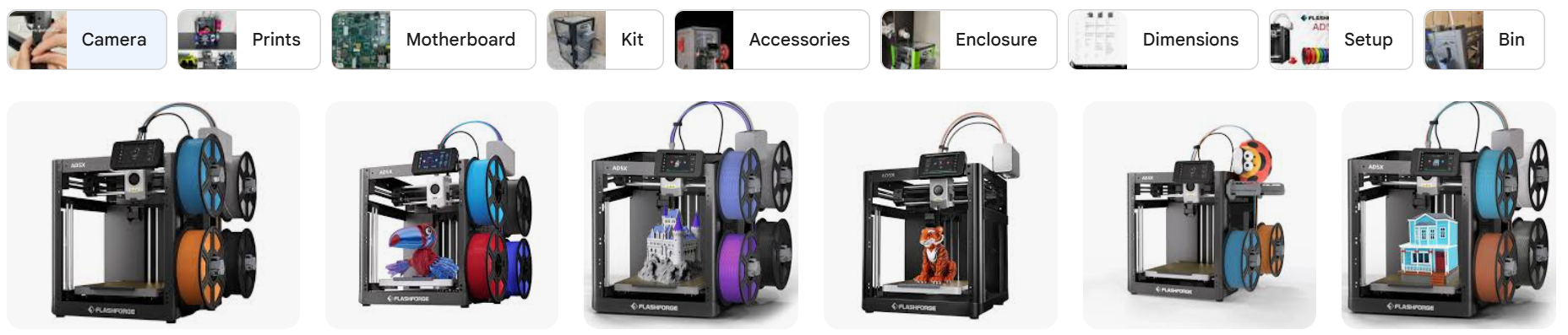 Screenshot 2026-02-15 183624.png 615.01 KB
🖨️ FlashForge AD5X Review – Beautiful Prints, Zero Patience for Sloppiness
Quick Verdict
The FlashForge AD5X is not a flashy printer, and that’s exactly why it earns its spot. It’s enclosed, predictable, and steady — the kind of machine you run when you want parts finished cleanly without hovering over it every five minutes.
That said, this printer will absolutely teach you the ins and outs of its print head whether you want to learn them or not. It’s capable of stunning prints, but it expects you to respect its quirks.
If you want speed and experimentation, look elsewhere. If you want repeatable, enclosed printing and you’re willing to maintain it properly, the AD5X delivers.
✅ Best for: enclosed printing, ABS/PETG, functional parts, repeat jobs
Not ideal for: speed chasing, casual tinkering, people who hate maintenance
My take: fickle, demanding, but capable of museum-quality results
Why I Use the AD5X
The biggest advantage of the AD5X is the enclosed build. That alone makes a huge difference for materials like ABS and PETG, where temperature stability matters more than raw speed.
Once dialed in, the printer is remarkably consistent. Profiles don’t drift, prints don’t randomly fail, and layer quality stays uniform across long runs. It’s the kind of machine you trust for repeat jobs.
Another big plus is reduced babysitting. Compared to open-frame machines, there are fewer mid-print surprises when everything is set correctly.
⚠️ Where It Falls Short (And Why It Tests Your Patience)
This printer is not fast — and it doesn’t pretend to be. It plays things safe, prioritizing reliability over speed. If you’re used to modern high-speed printers, the AD5X will feel slow.
The ecosystem is also fairly closed. Modding options are limited compared to open-source platforms, and you’re largely expected to work within FlashForge’s design choices.
And then there’s the print head.
If you own this machine long enough, you will learn how to take it apart. Clogs happen. Maintenance is not optional. At this point, I could tear mine down and clean it with my eyes closed — not because I enjoy it, but because it’s part of owning this printer.
Real-World Use (Why I Keep It Around Anyway)
I don’t use the AD5X to experiment or chase speed records. I use it when I want practical parts, clean finishes, and predictable results.
This is the printer I reach for when:
enclosure matters
warping needs to be minimized
surface finish is important
consistency beats speed
When the AD5X is behaving, the prints are genuinely beautiful. The kind of finish that makes you forget how much swearing happened during setup.
Filament Quality Is Non-Negotiable
This printer does not tolerate bad filament.
Wet filament will clog it.
Cheap filament will clog it.
Inconsistent filament will clog it.
If you skip drying, you’re asking for problems.
Quality filament and proper drying aren’t optional here — they’re mandatory. The better your filament, the fewer times you’ll be tearing down the print head.
🎨 Multi-Filament Reality: Waste Is the Tradeoff
The AD5X’s 4-to-1 filament system is powerful, but it comes with a cost: purge waste.
Multi-material setups like this inevitably waste material during purging. It’s not unique to FlashForge, but it’s noticeable. If you’re printing single-color jobs, the system can feel overkill. If you’re doing multi-material or color work, it’s the price you pay for flexibility.
AD5X vs Faster Printers
Compared to faster, open-frame machines, the AD5X trades speed for predictability and finish quality.
If you’re selling prints or making functional parts where consistency matters more than throughput, that tradeoff often makes sense. Faster printers get things done quicker — the AD5X gets them done cleaner.
The Reality of Owning This Printer
This machine is fickle. It demands maintenance. It expects you to understand how it works.
But when everything is right, it produces prints that genuinely feel like finished products, not prototypes. That’s why it stays in the lineup, even when it drives me nuts.
Final Verdict
The FlashForge AD5X is a workhorse printer with an attitude. It won’t impress speed chasers or modders, and it absolutely won’t tolerate sloppy habits.
But if you’re willing to learn its print head, use quality dry filament, and accept slower speeds, it rewards you with some of the cleanest, most reliable enclosed prints you’ll get in this class.
It’s frustrating, demanding, and occasionally infuriating — but when it delivers, it delivers art.
📢 Disclosure:
Some links in this review may be referral or affiliate links. If you sign up or make a purchase through them, the site may earn a small commission at no extra cost to you. This helps support HonestHustles and allows us to keep reviews honest, independent, and ad-light.
FlashForge AD5X
🖨️ FlashForge AD5X Review – Beautiful Prints, Zero Patience for Sloppiness The FlashForge AD5X is not a flashy printer, and that’s exactly why it earns its spot. It’s enclosed, pr…
🖨️ Anycubic Kobra 2 Pro Review – Fast Printer, Real-World Expectations
The Anycubic Kobra 2 Pro is one of those printers that makes you feel productive fast. It can print quickly without instantly turning everything into spaghetti, but it still rewards proper setup and basic tuning. Expect "perfect prints at max speed with zero effort" and you'll get humbled. Give it a solid first-week dial-in and it becomes a strong, reliable daily driver.
This is a printer that shines when you respect profiles, temperatures, and material limits. Speed is there — but quality still depends on how you use it.
🪝 Why I Tried It
I run multiple Anycubic and FlashForge printers and I sell prints, so I'm always testing where the speed-vs-quality line actually sits on consumer machines. The Kobra 2 Pro landed in my workflow as the speed-focused mid-tier option — faster than the Neo, smaller than the Plus or Max. The pitch was "10x faster than standard 50mm/s machines" at $189-259, which is aggressive on both ends. Worth seeing if the math holds.
📊 What Actually Happened — The Specs and the Reality
Real specs:
- Max print speed: 500 mm/s (typical: 300 mm/s)
- Build volume: 250 × 220 × 220 mm (9.8 × 8.7 × 8.7 in)
- Auto-leveling: LeviQ 2.0 — 25-point system
- Hotend: all-metal, direct drive extruder
- Bed: PEI plate
- Mainboard: TriGorilla Pro B with Cortex-M4 CPU at 200 MHz
- Cooling: 7000 rpm part-cooling fan
- Vibration compensation (input shaping equivalent)
- Price: $189-259 depending on sale (frequently $199)
Reality on the printer in my space: the speed claim is real, but the "10x faster" framing is misleading because you don't actually want to push max speed on PLA, you want stable quality at high speed. Around 300 mm/s is the realistic working zone for clean prints. Push past that and you start sacrificing quality faster than you save time.
⚙️ Why It Works When It Works
The biggest win is that the speed is actually usable. A lot of "fast" printers look good on paper but fall apart the moment you push them. This one can move quickly without immediately destroying print quality, as long as the basics are handled correctly.
It's also relatively easy to get running. Level the bed, check belt tension, start with a known-good profile — it has a solid "first real printer" feel. It doesn't feel fragile or experimental.
Where it really shines is production-style printing. If you're making simple products — tags, signs, figurines, basic parts — the faster turnaround makes a real difference. That speed adds up over time if you're printing for side income or small batches.
✅ Pros & ❌ Cons
PROS
✅ Genuinely fast — 300+ mm/s is workable, not just marketing
✅ All-metal hotend handles PLA, ABS, PETG, TPU
✅ Direct drive extruder for cleaner retraction and flexible filament
✅ LeviQ 2.0 auto-leveling (25-point) is reliable in practice
✅ PEI bed plate releases prints cleanly when cool
✅ SG15 bearings + vibration compensation reduce ringing at speed
✅ Solid build for the price ($189-259 range)
✅ Easy assembly compared to older kit-style printers
CONS
❌ Extruder gears are built into the hotend — wear means replacing the full $40 hotend module instead of cheap gear swaps like older Kobras
❌ No video monitoring built in
❌ External Anycubic app dependence for some features
❌ Loud at full speed — not a bedroom printer
❌ Push past ~300 mm/s and quality drops fast, despite the 500 mm/s marketing
❌ Bed slinger design limits print height stability on tall thin prints
🛡️ The Hotend Module Issue Nobody Warns You About
The most common complaint about the Kobra 2 Pro isn't really about printing — it's about long-term maintenance.
Older Kobras let you swap the extruder gears cheaply when they wore down. On the Kobra 2 Pro, those gears are built into the hotend assembly. When they wear out (and they will eventually), you replace the entire hotend module for around $40 instead of doing a few-dollar gear swap.
That's not a dealbreaker, but it's a real cost-of-ownership detail. Factor it in before assuming the Pro is the cheapest long-term option in the lineup. If you print heavy, expect a hotend module replacement in your future and budget for it.
The other place people get burned is expectations vs reality:
- Bad filament + max speed = bad prints, every time
- Low temps at high speed = weak layer bonding (looks fine, fails mechanically)
- Loose belts or frame wobble = ringing and ghosting immediately visible at speed
- None of these are unique to Anycubic — they're just more obvious when you're printing fast
🛠 What I'd Tell Someone Thinking About This
If you want a printer that can realistically produce a lot of prints in a short time, the Kobra 2 Pro makes sense. It's not magic — it's one of the better "fast printers" for normal people willing to learn the basics.
Quick wins that saved me frustration early:
1. Start slower than the marketing speeds, then increase once quality is stable
2. Dry filament if prints look fuzzy, weak, or inconsistent
3. Use a known-good PLA profile before making changes
4. Print a temperature tower and retraction test once, save the profile
5. Check belt tension during the first week, then again at the 50-hour mark
6. Budget for an eventual $40 hotend module replacement
Respect setup, profiles, and materials and it'll treat you well. Ignore those things and chase max speed blindly and you'll blame the printer instead of the process.
🏭 Anycubic as a Brand
Anycubic has been solid overall. They push cutting-edge features into consumer-priced printers faster than many competitors, and the product line keeps evolving instead of stagnating. Support and documentation are generally decent, replacement parts are easy to find. That matters more than people realize once you've been printing a while.
That said, the 3D printing world is huge and no single brand is "the best at everything." Every printer ecosystem has tradeoffs.
⚖️ Verdict
The Kobra 2 Pro is a real printer that delivers what it advertises within the limits of basic 3D printing physics. The speed is usable, the auto-leveling works, the build is solid for the price. The hotend module issue is a long-term cost-of-ownership detail, not a flaw in the printer itself.
Verdict: Legit ✅ — strong daily driver if you respect setup and tuning. Not magic. Not silent. Not zero-maintenance. But honest about what it is for the price.
📌 Heads Up: Disclaimer
This review is not a personal attack on Anycubic. The Kobra 2 Pro is a real, capable printer that has earned solid reviews across the industry. The criticisms here are about practical realities of operating it long-term — speed claims vs working speed, the hotend module replacement cost, and the setup learning curve everyone runs into. If your experience has been different, share it — the door is open.
📢 Disclosure
Some links in this review may be referral or affiliate links. If you sign up or make a purchase through them, HonestHustles may earn a small commission at no extra cost to you. This helps support the site and allows us to keep reviews honest, independent, and ad-light.
Anycubic Kobra 2 Pro
🖨️ Anycubic Kobra 2 Pro Review – Fast Printer, Real-World Expectations The Anycubic Kobra 2 Pro is one of those printers that makes you feel productive fast. It can print quickly …
📱 Mode Earn App Review – Legit Passive Income or Battery Burner?
Quick Verdict
Mode does pay, but it’s not passive in the way most people expect. It works best when you treat your phone like a tool, not something you’re actively using all day. If you expect “set it and forget it” money, you’ll be disappointed. If you have an old phone, Wi-Fi, and patience, it can slowly add up.
Mode is best thought of as a background earning app, not a hustle. The people who get the most out of it are the ones who already leave a device plugged in and don’t mind slow, incremental rewards.
✅ Best for: spare phones, background earning, music listeners, people with unused devices
Not ideal for: main phone users, anyone worried about battery health, people expecting fast payouts
BS Risk: Medium (not a scam, but heavily oversold by promoters)
What Mode Is
Mode (sometimes called Mode Earn or Mode Mobile) is a rewards app that pays you for interacting with your phone in various ways. Unlike platforms that focus on just one earning method, Mode tries to offer a little bit of everything.
You earn points that can be redeemed for gift cards or cash, depending on what rewards are available at the time. The app is constantly adding features, which is both a strength and a weakness.
Mode’s biggest issue is that it tries to do too much at once, which can make the app feel crowded and confusing at first.
How You Actually Earn on Mode
This is where expectations really matter. Mode has a lot of earning options, but most of them pay on the lower end unless you optimize how you use the app.
Common earning methods include:
🔓 Lockscreen rewards: ads appear when you unlock your phone
🎵 Music listening: earn points while music plays in the background
📲 Offers and installs: apps, signups, and trials (similar to Freecash)
📝 Surveys: hit or miss, like most platforms
📰 News and articles: paid reading
📺 Videos: watch-to-earn content
📈 Mode Shares: stock-related or engagement-based reward features
On paper, it sounds great. In reality, earnings are slow and incremental unless you focus on a few specific methods.
The Reality: Time vs Battery
Mode’s biggest hidden cost isn’t time — it’s battery and device wear.
Running Mode continuously can:
Drain battery faster than normal use
Cause heat buildup on some devices
Become annoying on a main phone
Older phones generally handle this better than newer ones. Where Mode really shines is not on your daily driver, but on a spare device.
The ideal setup looks like this:
Old Android phone
Always plugged in
Wi-Fi only
Sitting on a desk, shelf, or workshop bench
Used this way, Mode becomes much more tolerable and far less intrusive.
🎵 Why the Music Feature Is the Standout
Out of everything Mode offers, paid music listening is easily its most interesting feature.
Mode exposes you to a wide range of music from different cultures, genres, and artists you might not normally hear. If you already listen to music while working, tinkering, or just leaving something playing in the background, this is where Mode feels the most natural.
That said, the pay rate for music is still on the lower end. You’re not getting paid much per hour — but it’s one of the few features that doesn’t feel like active work.
Payouts & Reliability
The good news: Mode does pay.
The less exciting news:
Payouts are slow
Cash-out thresholds feel high relative to earning speed
Available rewards can change without much notice
This is not an app you grind for a weekend payout. It’s something that quietly builds over weeks if you let it run in the background.
👥 Who This Is For (And Who Should Avoid It)
Good fit if:
• You have an old phone collecting dust
• You don’t mind slow, steady earnings
• You like squeezing value out of unused tech
• You already listen to music or leave a device running
Bad fit if:
• You want quick money
• You hate ads and notifications
• You only have one phone and care about battery health
Mode vs Other Paid-to-Play Apps
Compared to similar platforms:
Freecash: faster earnings, but more active work
Mistplay: game-focused with clearer milestones
Mode: slower, more passive, heavily device-dependent
Mode trades speed for flexibility. Whether that’s worth it depends on your setup.
Final Verdict
Mode is legit, but it’s not magic. It’s best treated as a background side experiment, not a hustle.
If you already have a spare phone and don’t mind letting it run, Mode can earn you something over time. If you’re using your main phone and expecting easy money, you’ll probably uninstall it out of frustration.
Use it smart, keep expectations realistic, and don’t believe the hype videos.
📢 Disclosure:
Some links in this review may be referral or affiliate links. If you sign up or make a purchase through them, the site may earn a small commission at no extra cost to you. This helps support HonestHustles and allows us to keep reviews honest, independent, and ad-light.
Mode Earn App
📱 Mode Earn App Review – Legit Passive Income or Battery Burner? Mode does pay, but it’s not passive in the way most people expect. It works best when you treat your phone like a …
💰 Freecash Review – Legit Rewards App or Just Another Grind?
Freecash is one of the most popular “paid-to-play” rewards platforms online. Users can earn money by completing tasks like playing mobile games, answering surveys, testing apps, or signing up for services.
According to public listings, Freecash supports payouts through PayPal, cryptocurrency (Bitcoin, Litecoin), bank transfers, and gift cards like Amazon or Google Play. Registration is free and users can sign up using email, Google, or Facebook accounts.
The platform claims millions of users and advertises a Trustpilot rating around 4.7 stars, placing it among the higher-rated rewards apps.
But as with most “get paid to” platforms, the reality is a bit more nuanced.
🧠 What Freecash Actually Is
Freecash operates as a task marketplace. Companies pay Freecash to recruit users to test apps, install games, complete surveys, or try services. Freecash then shares part of that revenue with users who complete those tasks.
Most tasks fall into three categories:
• Play-to-earn mobile games (reach certain levels)
• Market research surveys
• Offerwall promotions (signups, trials, installs)
Each task rewards points that can later be converted into real money or gift cards.
In theory it’s simple: complete tasks → earn points → cash out.
In practice, the experience varies depending on the offers you choose and the time you invest.
💸 How Much Can You Actually Earn?
Earnings depend heavily on time invested and available offers in your region.
Typical expectations appear to be:
• $10 – $40 per month for casual use
• $50 – $100+ per month for active users
Some users report around $100 after two months of steady use, which aligns with what many rewards-app users experience.
🎮 The Reality of Play-to-Earn Tasks
Game offers are the main draw of Freecash. Users earn money by reaching specific levels inside mobile games.
There are usually two offer types:
Milestone Challenges
Reach a certain level within a time limit.
Time-Played Rewards
Earn small rewards based on playtime.
Milestone offers pay more but can sometimes be difficult to complete without spending money inside the game.
Some challenges become nearly impossible within the time limit unless upgrades are purchased.
⚠️ Common Complaints From Users
Tracking Problems
Sometimes tasks fail to track progress properly.
Reward Delays
Many rewards remain pending for about 7 days before withdrawal.
Offer Difficulty
Some challenges require heavy grinding.
Customer Support
Response times can sometimes be slow when resolving tracking issues.
👍 What Freecash Does Well
Despite criticisms, Freecash does several things well:
• Legitimate payouts through multiple payment methods
• Very fast withdrawals once rewards clear
• Wide variety of offers
• Lower minimum cashout than many competitors
• Daily reward bonuses
Some users report PayPal withdrawals arriving within minutes once approved.
💳 Cashout Options
Freecash supports:
• PayPal
• Bitcoin and Litecoin
• Bank transfers
• Amazon gift cards
• Google Play gift cards
• Other digital gift cards depending on region
Minimum withdrawal thresholds are generally lower than many competing apps.
🧪 My Personal Experience Using Freecash
I didn’t just research Freecash — I actually used it.
Over time I completed more than 500 offers and tasks, mostly focused on game challenges and daily bonuses.
According to my dashboard statistics:
• Total earned: CAD $187.83
• Completed offers: 534
• Account level: 119
• Time using platform: about 340 days (not for a while)
📸 Screenshot from my actual Freecash dashboard.
I left my name visible intentionally to show this is a real account and real earnings.
Most of my earnings came from game offers rather than surveys.
My typical strategy was simple:
• Play games until the milestone level
• Claim the reward
• Move on to another game
I rarely spent money inside games unless the reward justified the risk.
Over time this strategy allowed me to earn close to $200.
🎯 My Freecash Strategy – How I Earned $187 Without Spending Much
After using Freecash for a long time I realized the key is choosing the right offers.
Most of my earnings came from mobile game milestones and daily bonuses.
My strategy:
• Play games only until milestone levels
• Claim reward and move on
• Avoid extremely high level requirements
• Rarely spend money inside games
Rotating between multiple games prevented wasting time grinding a single one.
⚠️ The Catch
Freecash is not perfect.
Tracking reliability can sometimes fail and require support tickets.
Rewards often sit in a pending state for about 7 days.
Some offers require extremely high levels that are difficult without spending money.
Because of this I avoided risky offers unless the payout justified it.
🧠 Strategy Tip
Best approach:
• Focus on achievable milestones
• Skip unrealistic level requirements
• Avoid spending money unless worthwhile
• Rotate between games
💡 Final Thoughts
Freecash is legitimate and capable of paying users.
However it works best as a casual side activity rather than a reliable income source.
⚖️ The Honest Reality
Freecash is not a scam, but it is not a magic money machine.
You are trading time and attention for small payments funded by marketing companies.
The biggest takeaway:
Freecash works best as side pocket money, not a serious income source.
👥 Who Freecash Is Best For
• People who already play mobile games
• Users willing to grind tasks occasionally
• Anyone looking for small side earnings
🏁 Final Verdict
Freecash is one of the more legitimate platforms in the rewards-app space.
It pays, but earning requires time, patience, and choosing the right offers.
Just go in with realistic expectations.
📢 Disclosure
Some links in this review may be referral or affiliate links. If you sign up through them, the site may earn a small commission at no extra cost to you.
Freecash (Paid-to-Play)
💰 Freecash Review (Paid-to-Play, Honest Take) Freecash is legit in the sense that people do get paid, but it’s not a magic income app. It works best when you treat it as spare-t…